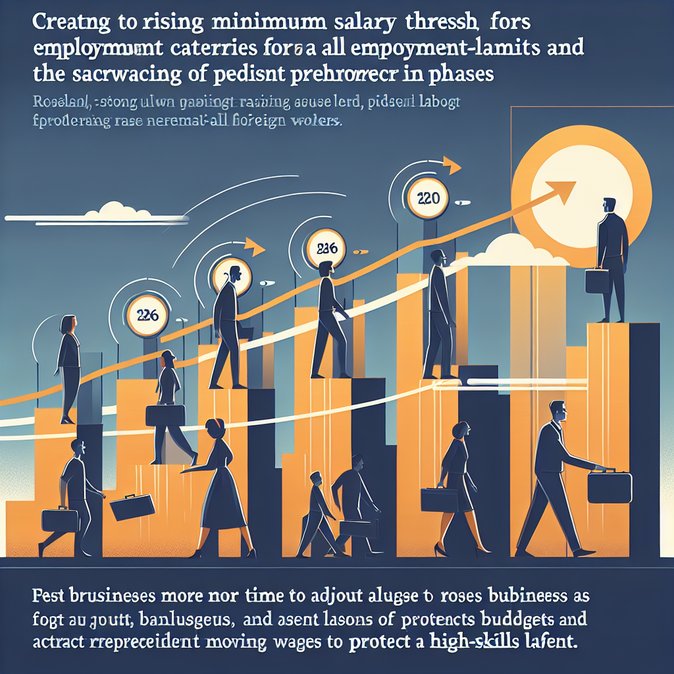
The Irish Government has published a new Roadmap for Minimum Annual Remuneration (MAR) that will gradually raise the salary thresholds required for all categories of employment permits between 2026 and 2030. Announced on 2 December 2025 by Enterprise Minister Peter Burke and Minister of State Alan Dillon, the plan replaces the more aggressive two-year increase signalled in 2023.
Under the revised timetable, the first rise will take effect on 1 March 2026. General Employment Permits will move from €34,000 to €36,605, while Critical Skills Employment Permits will climb from €38,000 to €40,904. Salaries in traditionally low-paid permit streams such as meat processing, horticulture and healthcare assistance will rise from €30,000 to €32,691, with further step-ups every year until sub-standard bands disappear entirely by 2030. Recent graduates will benefit from lower entry thresholds that recognise their early-career status.
![Ireland sets phased salary hikes for work permit holders, easing pressure on employers]()
The Department of Enterprise, Trade and Employment (DETE) says the review balanced 150 submissions from employers, unions and advocacy groups, along with concerns about inflation and skills shortages. Officials stressed that a slower, indexed approach protects Ireland’s competitiveness while giving businesses time to re-price projects and renegotiate budgets. Migrant-rights organisations cautiously welcomed the roadmap, noting that many permit-holders struggled to renew visas when salaries were pushed up too quickly.
For multinationals, the phased increases provide budgeting certainty and reduce the risk of losing staff whose renewals might otherwise fail on salary grounds. However, HR teams should plan for automatic uplifts at renewal: if average Irish earnings rise, permit salaries must keep pace. Companies should audit payroll data, adjust offer letters and update global mobility cost projections well in advance of the 1 March 2026 effective date.
The DETE has published the full roadmap together with FAQs. Employers are encouraged to brief international assignees and to factor the staged increases into 2026-30 workforce plans, especially in sectors relying on hard-to-fill roles.
Under the revised timetable, the first rise will take effect on 1 March 2026. General Employment Permits will move from €34,000 to €36,605, while Critical Skills Employment Permits will climb from €38,000 to €40,904. Salaries in traditionally low-paid permit streams such as meat processing, horticulture and healthcare assistance will rise from €30,000 to €32,691, with further step-ups every year until sub-standard bands disappear entirely by 2030. Recent graduates will benefit from lower entry thresholds that recognise their early-career status.

The Department of Enterprise, Trade and Employment (DETE) says the review balanced 150 submissions from employers, unions and advocacy groups, along with concerns about inflation and skills shortages. Officials stressed that a slower, indexed approach protects Ireland’s competitiveness while giving businesses time to re-price projects and renegotiate budgets. Migrant-rights organisations cautiously welcomed the roadmap, noting that many permit-holders struggled to renew visas when salaries were pushed up too quickly.
For multinationals, the phased increases provide budgeting certainty and reduce the risk of losing staff whose renewals might otherwise fail on salary grounds. However, HR teams should plan for automatic uplifts at renewal: if average Irish earnings rise, permit salaries must keep pace. Companies should audit payroll data, adjust offer letters and update global mobility cost projections well in advance of the 1 March 2026 effective date.
The DETE has published the full roadmap together with FAQs. Employers are encouraged to brief international assignees and to factor the staged increases into 2026-30 workforce plans, especially in sectors relying on hard-to-fill roles.