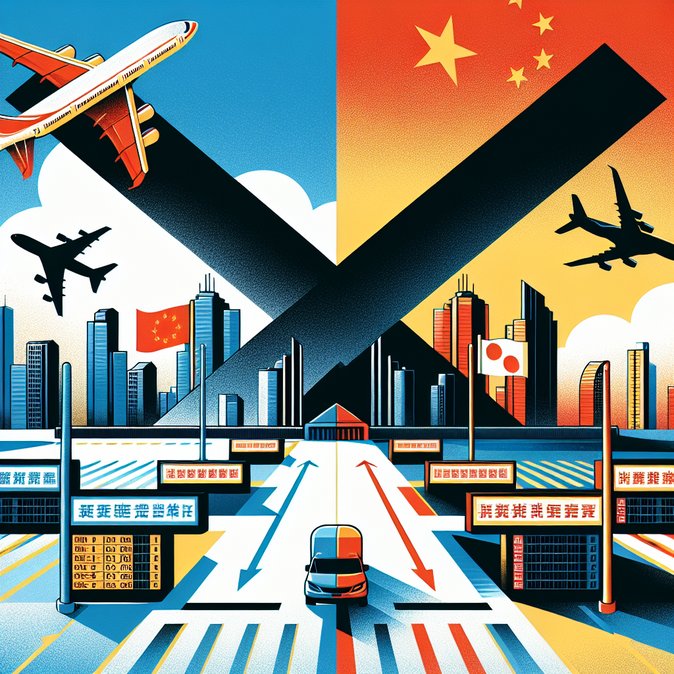
Chinese carriers have executed one of their largest collective schedule cuts since the pandemic, wiping out roughly 1,900 China–Japan flights planned for December 2025—about 40 per cent of the month’s total capacity . Flagships China Eastern, China Southern and Air China are trimming Osaka, Sapporo and Tokyo services, while niche operators such as Loong Air have pulled out of Japan altogether.
The pull-back follows Beijing’s late-November travel warning citing ‘‘security risks’’ after Japanese Prime Minister Sanae Takaichi suggested Tokyo could join military action in a Taiwan conflict. Online platforms show hundreds of thousands of ticket cancellations, and Chinese OTAs report Japan falling out of the top-five outbound search list for the first time in a decade.
![Chinese airlines cancel 1,900 Japan flights as diplomatic spat deepens, cutting December capacity by 25 %]()
Business implications are immediate: seat inventory for Sino-Japanese commuters has tightened, premium-class fares are up 18 %, and Japanese hotels dependent on mainland tour groups face a soft holiday season. Corporate travel managers are advising staff to reroute via Seoul or Taipei and to factor longer journey times into project schedules.
Slot coordinators at Kansai and Narita airports say returned slots may be reassigned to South Korean low-cost carriers, further complicating recovery of the once-busy corridor. Analysts warn that if the diplomatic freeze persists, bilateral air capacity could finish 2025 at barely 55 % of pre-COVID levels, delaying the full return of manufacturing-supply-chain travel between the two neighbours.
The pull-back follows Beijing’s late-November travel warning citing ‘‘security risks’’ after Japanese Prime Minister Sanae Takaichi suggested Tokyo could join military action in a Taiwan conflict. Online platforms show hundreds of thousands of ticket cancellations, and Chinese OTAs report Japan falling out of the top-five outbound search list for the first time in a decade.
Business implications are immediate: seat inventory for Sino-Japanese commuters has tightened, premium-class fares are up 18 %, and Japanese hotels dependent on mainland tour groups face a soft holiday season. Corporate travel managers are advising staff to reroute via Seoul or Taipei and to factor longer journey times into project schedules.
Slot coordinators at Kansai and Narita airports say returned slots may be reassigned to South Korean low-cost carriers, further complicating recovery of the once-busy corridor. Analysts warn that if the diplomatic freeze persists, bilateral air capacity could finish 2025 at barely 55 % of pre-COVID levels, delaying the full return of manufacturing-supply-chain travel between the two neighbours.