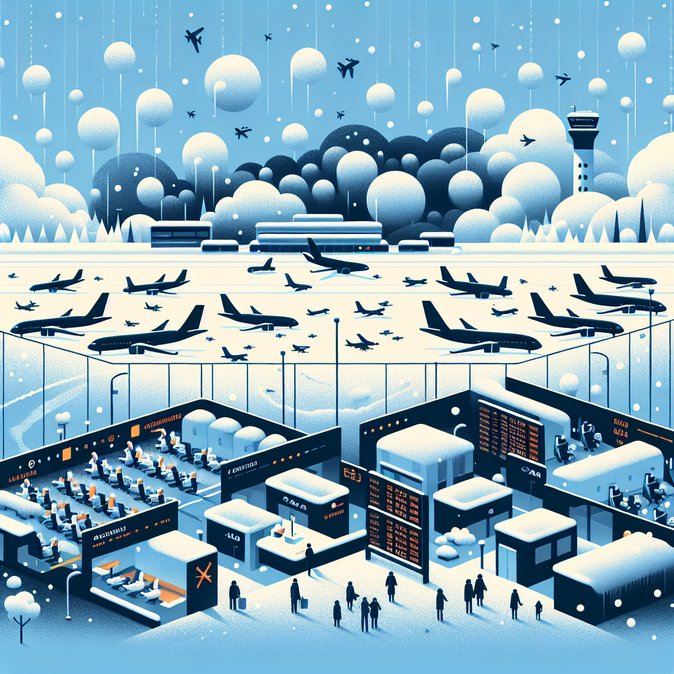
U.S. airlines were gearing up for the busiest day of the year on Sunday—but Mother Nature had other plans. A fast-moving winter storm dumped up to a foot of snow across the Midwest and Great Lakes, triggering more than 5,600 flight delays and 624 cancellations by mid-afternoon, according to FlightAware data. Chicago O’Hare, Dallas–Fort Worth, Charlotte, Atlanta, and Detroit were the hardest-hit hubs.
Carriers had forecast 31 million passengers during the 11-day Thanksgiving window (Nov 21–Dec 1), with 3.4 million slated to fly on Sunday alone—a post-pandemic record. Airlines executed advance waivers and crew re-positioning, but de-icing queues of 45–60 minutes at northern airports rippled through network schedules. Even southern gateways such as Austin and Miami reported knock-on delays as aircraft and crews fell out of position.
![Winter Storm Snarls Record-Setting Thanksgiving Travel Rush Across U.S. Airports]()
Southwest, whose point-to-point model is sensitive to cascade effects, logged 956 delayed flights—21 percent of its schedule—followed by American, United, and Delta. The storm arrived just days after regulators cleared Airbus flight-control software updates, allowing airlines to return previously grounded A320neos to service, but the weather—not technology—proved the larger disruptor.
Business implications: corporate travel managers should expect elevated re-accommodation costs, duty-of-care notifications, and potential payroll impacts for employees stuck overnight. Experts recommend building extra buffer days into December itineraries as the same weather system slides toward the Northeast early next week. Travelers enrolled in CLEAR or TSA PreCheck reported shorter re-booking lines, underscoring the ROI of trusted-traveler programs for frequent flyers.
Looking ahead, airlines are lobbying the FAA for more flexible slot rules during irregular-operations days and for broader acceptance of digital waivers that allow passengers to self-rebook via apps rather than gate agents—an efficiency gain that could become permanent before the 2025 Christmas peak.
Carriers had forecast 31 million passengers during the 11-day Thanksgiving window (Nov 21–Dec 1), with 3.4 million slated to fly on Sunday alone—a post-pandemic record. Airlines executed advance waivers and crew re-positioning, but de-icing queues of 45–60 minutes at northern airports rippled through network schedules. Even southern gateways such as Austin and Miami reported knock-on delays as aircraft and crews fell out of position.

Southwest, whose point-to-point model is sensitive to cascade effects, logged 956 delayed flights—21 percent of its schedule—followed by American, United, and Delta. The storm arrived just days after regulators cleared Airbus flight-control software updates, allowing airlines to return previously grounded A320neos to service, but the weather—not technology—proved the larger disruptor.
Business implications: corporate travel managers should expect elevated re-accommodation costs, duty-of-care notifications, and potential payroll impacts for employees stuck overnight. Experts recommend building extra buffer days into December itineraries as the same weather system slides toward the Northeast early next week. Travelers enrolled in CLEAR or TSA PreCheck reported shorter re-booking lines, underscoring the ROI of trusted-traveler programs for frequent flyers.
Looking ahead, airlines are lobbying the FAA for more flexible slot rules during irregular-operations days and for broader acceptance of digital waivers that allow passengers to self-rebook via apps rather than gate agents—an efficiency gain that could become permanent before the 2025 Christmas peak.