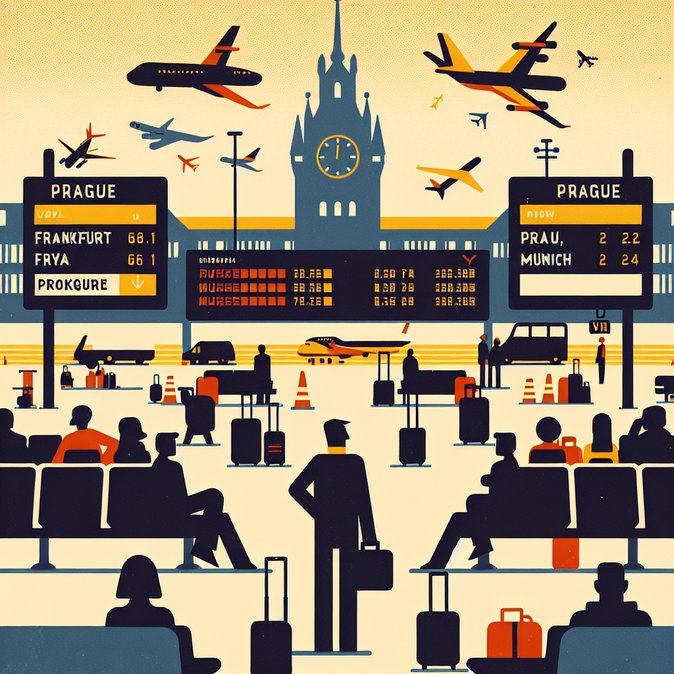
Just twenty-four hours after Europe’s network began to stabilise, a four-hour national air-traffic-control (ATC) strike in Italy on 10 April unleashed fresh turmoil across the continent—again ensnaring the Czech Republic. Published tallies from industry monitoring services show at least 464 flights cancelled, including multiple sectors on the Prague–Rome Fiumicino, Prague–Milan Malpensa and Prague–Venice routes that are heavily used by Czech exporters and tour operators. The strike, called by unions representing ENAV controllers between 13:00 and 17:00 CEST, forced airlines to thin schedules well beyond the formal window. Aircraft slated to overfly Italian airspace were rerouted—adding flight time, fuel burn and, in crew-scheduling terms, complexity. Several carriers simply axed rotations rather than risk crews “going out of hours” on the return. Prague-based holiday airline Smartwings cancelled its afternoon Milan rotation, while national carrier ČSA retimed its evening Rome departure, illustrating how quickly distant labour disputes ripple into Czech operations. Corporate-mobility teams with staff shuttling between pharmaceutical plants in Northern Italy and headquarters in Prague reported missed meetings and urgent rebooking.
![Italian Air-Traffic-Control Strike Cancels 464 Flights—Prague Services Among Casualties]()
Amid such operational uncertainty, services like VisaHQ can lighten the administrative load. The company’s dedicated Czech portal (https://www.visahq.com/czech-republic/) enables travellers and corporate travel managers to check evolving entry rules, secure visas and receive real-time compliance alerts—valuable peace of mind when last-minute reroutings or extended layovers threaten to complicate documentation.
Because strikes by third-party ATC staff are classified as ‘extraordinary circumstances’, cash compensation under EU 261 is unlikely, although airlines must still provide meals, accommodation and refunds or re-routing. Travel managers are therefore reminding assignees to retain receipts for any out-of-pocket costs not covered by airlines. The walkout lands at an awkward moment: Europe’s new biometric Entry/Exit System (EES) went fully live on 10 April. Travellers who are re-routed outside the Schengen Area risk having to complete a second biometric enrolment on their eventual return, potentially adding border processing time in Prague. Mobility advisers suggest briefing employees on EES procedures and ensuring ample connection buffers when itineraries involve Italy until at least mid-April, when union leaders say they will decide on further strike action. Airlines have resumed normal operations, but analysts warn that the real test will come during the upcoming May-Day holiday peak. If further industrial action coincides with seasonal traffic growth, Prague’s connectivity to Southern Europe—vital for both Czech exporters and inbound tourists—could face repeated shocks. Firms with time-critical assignments are urged to keep contingency plans and consider alternative routings via Vienna or Munich where feasible.

Amid such operational uncertainty, services like VisaHQ can lighten the administrative load. The company’s dedicated Czech portal (https://www.visahq.com/czech-republic/) enables travellers and corporate travel managers to check evolving entry rules, secure visas and receive real-time compliance alerts—valuable peace of mind when last-minute reroutings or extended layovers threaten to complicate documentation.
Because strikes by third-party ATC staff are classified as ‘extraordinary circumstances’, cash compensation under EU 261 is unlikely, although airlines must still provide meals, accommodation and refunds or re-routing. Travel managers are therefore reminding assignees to retain receipts for any out-of-pocket costs not covered by airlines. The walkout lands at an awkward moment: Europe’s new biometric Entry/Exit System (EES) went fully live on 10 April. Travellers who are re-routed outside the Schengen Area risk having to complete a second biometric enrolment on their eventual return, potentially adding border processing time in Prague. Mobility advisers suggest briefing employees on EES procedures and ensuring ample connection buffers when itineraries involve Italy until at least mid-April, when union leaders say they will decide on further strike action. Airlines have resumed normal operations, but analysts warn that the real test will come during the upcoming May-Day holiday peak. If further industrial action coincides with seasonal traffic growth, Prague’s connectivity to Southern Europe—vital for both Czech exporters and inbound tourists—could face repeated shocks. Firms with time-critical assignments are urged to keep contingency plans and consider alternative routings via Vienna or Munich where feasible.