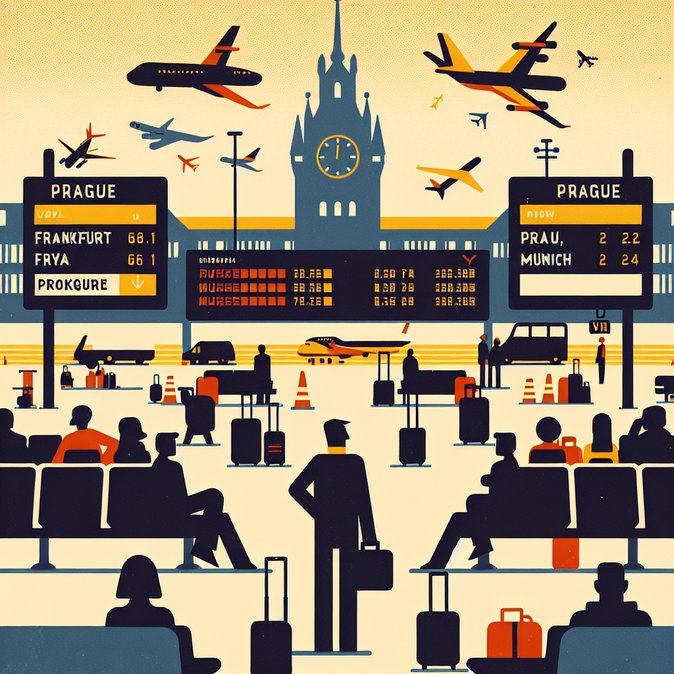
Prague’s Václav Havel Airport spent the weekend firefighting a wave of schedule chaos that began hundreds of kilometres away. According to real-time flight-tracking data and airline advisories, widespread delays and cancellations on 9 and 10 April at major Western-European hubs finally converged on the Czech capital during the night of 10 April and throughout 11–12 April. Carriers operating the busy Frankfurt-Prague, Munich-Prague and Paris-Prague corridors reported on-time performance plunging into the mid-40 percent range, while several intra-European low-cost operators scrubbed whole rotations to regain punctuality. Behind the disruption is a cocktail of factors: short but intense spring storms, rolling staff shortages at airports recovering from the Easter peak, and a series of labour actions among air-traffic-control and cabin-crew unions in Germany, France and Italy. Each incident on its own was manageable, but together they created cascading aircraft and crew mis-positioning. Prague, strongly connected to the German and Italian hub system, became collateral damage even though no local technical fault occurred.
![European Flight Chaos Ripple Reaches Prague: Hundreds Face Delays After 9–10 April Disruptions]()
Whether you’re rerouting around the disruption or planning future trips, make sure your paperwork is in order. VisaHQ can quickly determine whether you need a Czech visa, help you gather the right documents, and submit everything online—often in just minutes—so unexpected schedule changes don’t derail your plans. Check requirements or start an application at https://www.visahq.com/czech-republic/
Business travellers were hit hardest. Consultancies moving personnel between headquarters in Frankfurt or Milan and client sites in Prague reported last-minute hotel bills and project delays. Mobility managers noted that tight 45-minute connections frequently used by consulting and tech staff are “simply unworkable” in the current operating climate. Long-haul itineraries suffered too: several passengers missed nightly departures from Prague to the Gulf and onward to Asia when their feeder flights arrived after curfew. Under EU Regulation 261, passengers are entitled to care—and, in many instances, compensation—but only when the cause is within an airline’s control. Strikes by third-party air-traffic staff or severe weather can remove the cash-compensation element. Travel-risk advisers therefore urge corporate travellers to 1) keep boarding passes and expense receipts, 2) opt for flexible tickets or dynamic travel policies, and 3) build at least two-hour buffers into any same-day connections through Prague for the rest of April. Looking ahead, airline network-planning teams say the knock-on effects should ease within 48 hours if no further strikes are announced. Yet the episode is a reminder that even well-run secondary hubs such as Prague can be pulled into pan-European disruptions—something global-mobility managers will need to factor into relocation timelines and duty-of-care calculations this spring.

Whether you’re rerouting around the disruption or planning future trips, make sure your paperwork is in order. VisaHQ can quickly determine whether you need a Czech visa, help you gather the right documents, and submit everything online—often in just minutes—so unexpected schedule changes don’t derail your plans. Check requirements or start an application at https://www.visahq.com/czech-republic/
Business travellers were hit hardest. Consultancies moving personnel between headquarters in Frankfurt or Milan and client sites in Prague reported last-minute hotel bills and project delays. Mobility managers noted that tight 45-minute connections frequently used by consulting and tech staff are “simply unworkable” in the current operating climate. Long-haul itineraries suffered too: several passengers missed nightly departures from Prague to the Gulf and onward to Asia when their feeder flights arrived after curfew. Under EU Regulation 261, passengers are entitled to care—and, in many instances, compensation—but only when the cause is within an airline’s control. Strikes by third-party air-traffic staff or severe weather can remove the cash-compensation element. Travel-risk advisers therefore urge corporate travellers to 1) keep boarding passes and expense receipts, 2) opt for flexible tickets or dynamic travel policies, and 3) build at least two-hour buffers into any same-day connections through Prague for the rest of April. Looking ahead, airline network-planning teams say the knock-on effects should ease within 48 hours if no further strikes are announced. Yet the episode is a reminder that even well-run secondary hubs such as Prague can be pulled into pan-European disruptions—something global-mobility managers will need to factor into relocation timelines and duty-of-care calculations this spring.