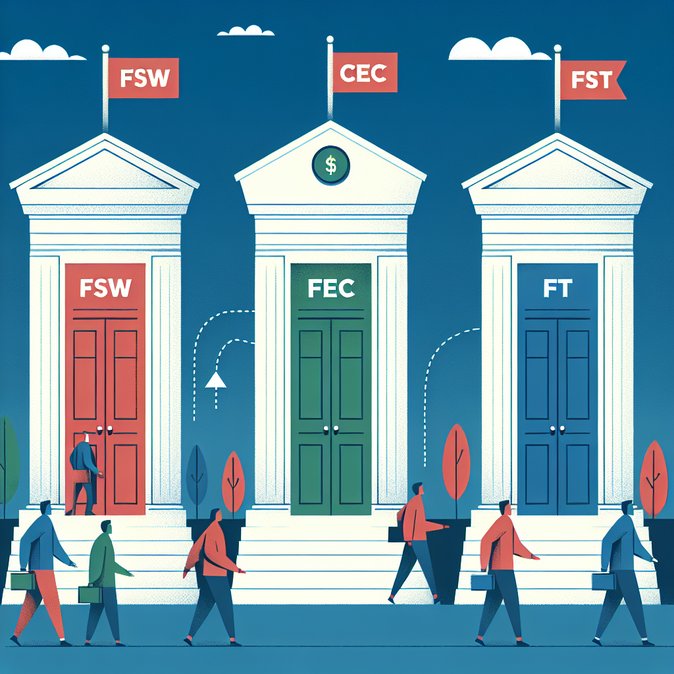
In a regulatory notice published late on 8 April 2026 and reported widely on 9 April, Immigration, Refugees and Citizenship Canada (IRCC) signalled that it intends to repeal the three core streams that have underpinned Express Entry since 2015—Federal Skilled Worker (FSW), Canadian Experience Class (CEC) and Federal Skilled Trades (FST)—and fold them into one umbrella category tentatively called the “Federal High-Skilled Class.” According to the Forward Regulatory Plan 2026-2028, the new pathway would keep Comprehensive Ranking System (CRS) points but streamline eligibility by requiring just one year of skilled work experience (whether gained in Canada or abroad) and language proficiency of at least CLB 7. IRCC argues that multiple sub-classes add administrative complexity and confuse applicants; internally, officers must apply different program delivery instructions even though most processing steps are identical.
![Ottawa proposes unifying Express Entry into a single ‘Federal High-Skilled Class’]()
Amid these impending changes, VisaHQ’s dedicated Canada immigration portal (https://www.visahq.com/canada/) can help both employers and applicants stay ahead of the curve. The platform aggregates real-time policy updates, offers interactive CRS calculators, and connects users with licensed consultants who can review documentation or flag new filing requirements—services that become especially valuable when the regulatory ground is shifting.
For employers, the overhaul could accelerate hiring. A single class means fewer candidate profiles stuck as “not eligible,” and IRCC says it will be able to run category-based draws—targeting occupations or French language ability—without being constrained by the current class structure. Consultants expect the first invitations under the new class to be issued as early as Q4 2027, subject to parliamentary approval of regulatory amendments. The downside is uncertainty for applicants already preparing under the existing rules. IRCC has confirmed that anyone who receives an Invitation to Apply (ITA) before the new class takes effect will be processed under legacy criteria, but profiles still in the pool may have to answer supplemental questions or update proof-of-funds. Mobility teams should therefore encourage high-scoring candidates to enter the pool now and monitor the public consultation set for Spring 2026. If enacted, this would be the most significant structural change to Canada’s flagship economic immigration system since its launch. Companies relying on the CEC for internal transferees or on FST draws for trades talent should map alternative timelines and budget for higher government fees—the regulatory notice hints at a cost-recovery increase once the unified class is live.

Amid these impending changes, VisaHQ’s dedicated Canada immigration portal (https://www.visahq.com/canada/) can help both employers and applicants stay ahead of the curve. The platform aggregates real-time policy updates, offers interactive CRS calculators, and connects users with licensed consultants who can review documentation or flag new filing requirements—services that become especially valuable when the regulatory ground is shifting.
For employers, the overhaul could accelerate hiring. A single class means fewer candidate profiles stuck as “not eligible,” and IRCC says it will be able to run category-based draws—targeting occupations or French language ability—without being constrained by the current class structure. Consultants expect the first invitations under the new class to be issued as early as Q4 2027, subject to parliamentary approval of regulatory amendments. The downside is uncertainty for applicants already preparing under the existing rules. IRCC has confirmed that anyone who receives an Invitation to Apply (ITA) before the new class takes effect will be processed under legacy criteria, but profiles still in the pool may have to answer supplemental questions or update proof-of-funds. Mobility teams should therefore encourage high-scoring candidates to enter the pool now and monitor the public consultation set for Spring 2026. If enacted, this would be the most significant structural change to Canada’s flagship economic immigration system since its launch. Companies relying on the CEC for internal transferees or on FST draws for trades talent should map alternative timelines and budget for higher government fees—the regulatory notice hints at a cost-recovery increase once the unified class is live.