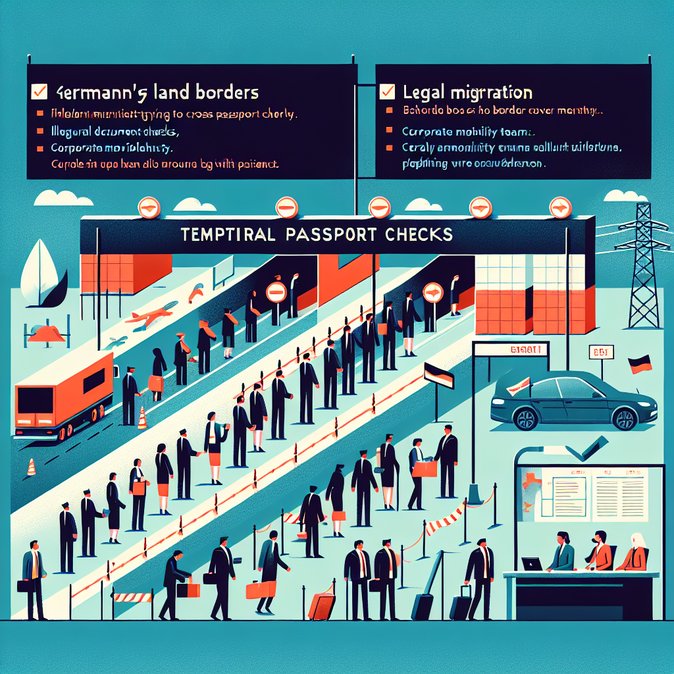
Germany’s coalition government has decided to prolong the re-introduced passport controls at its land borders with Poland, the Czech Republic, Austria, Denmark, the Netherlands, Belgium and Luxembourg until at least 15 September 2026. Chancellor Olaf Scholz said the extension is warranted by a 33 percent drop in irregular entries in 2025 and the arrest of almost 1,900 people-smugglers since controls were re-imposed in late 2024. Interior Minister Nancy Faeser stressed that the Schengen exemption remains “targeted and proportionate”, applying only to major road, rail and bus corridors where trafficking networks are most active. Although EU rules allow temporary checks for security reasons, Germany’s move is politically sensitive because freedom of movement is a core Schengen principle. Berlin has therefore notified the European Commission and pledged monthly data reviews.
![Germany Extends Land-Border Checks for Another Six Months]()
If travellers or corporate mobility managers need extra help navigating the evolving entry requirements, VisaHQ can streamline the process. The company’s portal (https://www.visahq.com/germany/) consolidates real-time information on visas, passports and supporting documents for Germany and neighbouring Schengen states, offering step-by-step assistance that minimises border delays and administrative headaches.
For corporate mobility managers the message is clear: cross-border commuters and logistics drivers will face periodic spot checks, so passports (or German ID cards for EU citizens) must be carried even on short hops to neighbouring countries. Companies that routinely send technicians from Polish or Czech sites into Germany should budget extra transit time and keep A1 portable social-security certificates on hand. With federal elections slated for February 2027, migration and security remain hot-button issues. The conservative CDU/CSU opposition accuses the government of “Schengen cherry-picking”, while the Greens warn that prolonged checks could damage supply chains. Businesses moving goods by truck already complain of queues of up to 45 minutes at the A4 near Görlitz; logistics lobby DSLV says every extra hour at the border costs roughly €80 per vehicle. Until Brussels is satisfied that the overall migration pressure has eased, companies should expect the controls to be renewed on a rolling basis. Mobility teams are advised to brief travellers, update corporate travel policies and monitor Federal Police advisories for pop-up checkpoints on secondary roads.
If travellers or corporate mobility managers need extra help navigating the evolving entry requirements, VisaHQ can streamline the process. The company’s portal (https://www.visahq.com/germany/) consolidates real-time information on visas, passports and supporting documents for Germany and neighbouring Schengen states, offering step-by-step assistance that minimises border delays and administrative headaches.
For corporate mobility managers the message is clear: cross-border commuters and logistics drivers will face periodic spot checks, so passports (or German ID cards for EU citizens) must be carried even on short hops to neighbouring countries. Companies that routinely send technicians from Polish or Czech sites into Germany should budget extra transit time and keep A1 portable social-security certificates on hand. With federal elections slated for February 2027, migration and security remain hot-button issues. The conservative CDU/CSU opposition accuses the government of “Schengen cherry-picking”, while the Greens warn that prolonged checks could damage supply chains. Businesses moving goods by truck already complain of queues of up to 45 minutes at the A4 near Görlitz; logistics lobby DSLV says every extra hour at the border costs roughly €80 per vehicle. Until Brussels is satisfied that the overall migration pressure has eased, companies should expect the controls to be renewed on a rolling basis. Mobility teams are advised to brief travellers, update corporate travel policies and monitor Federal Police advisories for pop-up checkpoints on secondary roads.