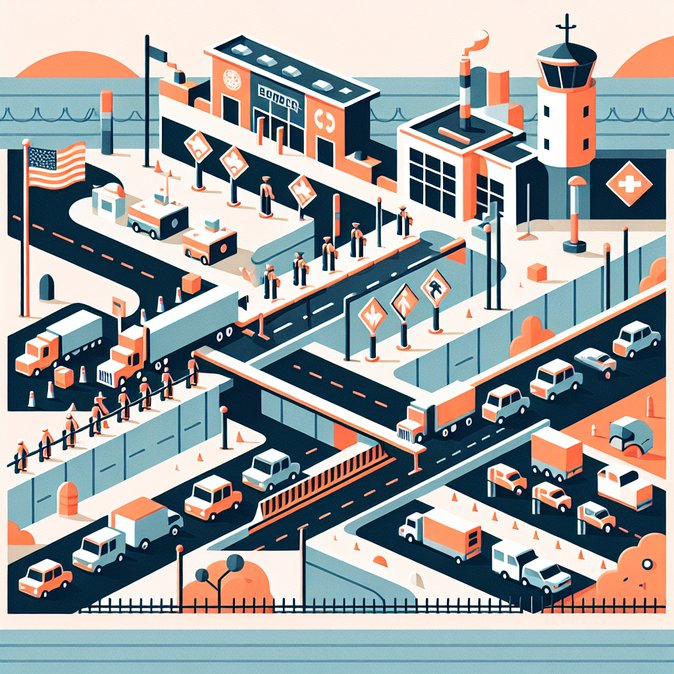
Germany’s Interior Minister Alexander Dobrindt confirmed late on 7 April that the temporary police checks re-introduced at all German land borders in 2023 will be prolonged a further six months, until at least 15 September 2026. The decision keeps stationary and roving controls in place along the entire 810-kilometre frontier with the Czech Republic, as well as with Poland, Switzerland, Austria and France. Although presented as a migration-control measure, the extension immediately affects the thousands of lorries, commuter buses and company cars that cross the D5 and D8 corridors every day. Czech exporters warn that even short, intermittent checks add up to hours of queuing, higher fuel consumption and mounting demurrage fees at just-in-time plants on both sides of the border.
![Germany extends border checks with Czech Republic until 15 September 2026, raising costs and delays for cross-border business]()
For travellers and logistics managers who also need to make sure their documentation is in order, VisaHQ can streamline the process. The service’s Czech Republic portal (https://www.visahq.com/czech-republic/) offers up-to-date advice on Schengen visa rules, digital entry registrations and invitation letters, helping drivers, couriers and business visitors cut down on paperwork even when physical border controls tighten.
Prague-based freight operators say average waiting times at the Rozvadov/Waidhaus and Krásný Les/Zinnwald crossings have doubled this week, with some drivers reporting two-kilometre tailbacks during the morning peak. Logistics group Česmad Bohemia estimates that each extra hour spent in a queue costs a heavy-goods vehicle about €85 in labour, fuel and refrigeration overheads. Firms supplying the German automotive and chemical clusters have already begun rescheduling dispatch windows or diverting via Poland, adding 90–120 kilometres per round trip. The European Commission is examining whether the continual renewals – first imposed during the 2015 migration crisis – breach Schengen rules that allow internal border checks only in exceptional circumstances. Ten of the 29 Schengen members now maintain some form of internal control, but Germany’s has lasted the longest. MEPs on the Parliament’s Civil Liberties Committee have hinted at infringement proceedings if Berlin does not present an exit strategy before the summer break. For Czech companies the commercial stakes are high: Germany absorbs roughly a third of Czech exports, and some 14,000 Czech residents commute daily for work. HR managers are advising cross-border staff to carry proof of employment and to allow extra time when travelling to client sites or training courses. Mobility teams are also updating Posted-Worker notifications, as random checks at the border can now be combined with on-the-spot labour inspections. While the Interior Ministry in Berlin insists that the controls remain “targeted and risk-based”, Czech hauliers fear another summer of disruption unless bilateral green-lane agreements or digital pre-clearance tools are introduced. The Czech government has not ruled out diplomatic pressure, but for now advises businesses to monitor the traffic-police portal and build buffer time into delivery contracts.

For travellers and logistics managers who also need to make sure their documentation is in order, VisaHQ can streamline the process. The service’s Czech Republic portal (https://www.visahq.com/czech-republic/) offers up-to-date advice on Schengen visa rules, digital entry registrations and invitation letters, helping drivers, couriers and business visitors cut down on paperwork even when physical border controls tighten.
Prague-based freight operators say average waiting times at the Rozvadov/Waidhaus and Krásný Les/Zinnwald crossings have doubled this week, with some drivers reporting two-kilometre tailbacks during the morning peak. Logistics group Česmad Bohemia estimates that each extra hour spent in a queue costs a heavy-goods vehicle about €85 in labour, fuel and refrigeration overheads. Firms supplying the German automotive and chemical clusters have already begun rescheduling dispatch windows or diverting via Poland, adding 90–120 kilometres per round trip. The European Commission is examining whether the continual renewals – first imposed during the 2015 migration crisis – breach Schengen rules that allow internal border checks only in exceptional circumstances. Ten of the 29 Schengen members now maintain some form of internal control, but Germany’s has lasted the longest. MEPs on the Parliament’s Civil Liberties Committee have hinted at infringement proceedings if Berlin does not present an exit strategy before the summer break. For Czech companies the commercial stakes are high: Germany absorbs roughly a third of Czech exports, and some 14,000 Czech residents commute daily for work. HR managers are advising cross-border staff to carry proof of employment and to allow extra time when travelling to client sites or training courses. Mobility teams are also updating Posted-Worker notifications, as random checks at the border can now be combined with on-the-spot labour inspections. While the Interior Ministry in Berlin insists that the controls remain “targeted and risk-based”, Czech hauliers fear another summer of disruption unless bilateral green-lane agreements or digital pre-clearance tools are introduced. The Czech government has not ruled out diplomatic pressure, but for now advises businesses to monitor the traffic-police portal and build buffer time into delivery contracts.
More From Czech Republic
View all
Czech airports surpass pre-pandemic passenger record as 2025 data show business travel rebound
Rail closure at Havířov will cut METRANS Ostrava terminal off from 10-12 April, disrupting Czech-German intermodal flows