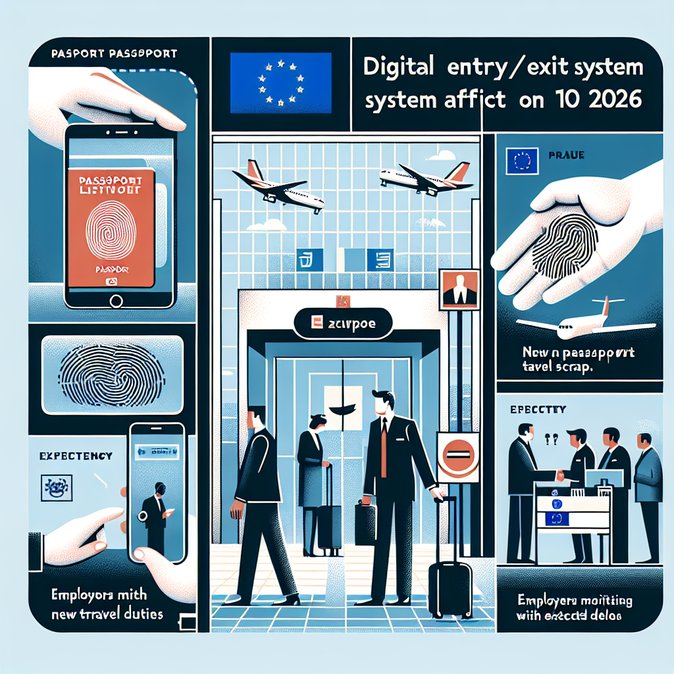
After almost six-months of phased testing, the European Union’s new Entry/Exit System (EES) will become mandatory at all external Schengen borders from Wednesday 10 April 2026. The final reminder, issued on 7 April by several travel and airline channels, means that every non-EU traveller—including Britons, Americans and other short-stay visitors arriving in Prague—will have their passport scanned and their biometric data (four fingerprints and a facial image) captured on first entry. Existing passport stamps will disappear. For Czech-based multinationals the most immediate impact is on posted workers and frequent business travellers who are third-country nationals. Because EES calculates the “90-days-in-180” rule automatically, any over-stay will be flagged in real time and could trigger fines or future Schengen bans. HR teams are therefore reviewing travel-tracking tools and reminding staff that weekend trips within the EU still count against the allowance.
![EU Entry/Exit System goes live on 10 April: what Czech travellers and employers must prepare for]()
While companies update their compliance processes, many are turning to specialist visa services for extra reassurance. VisaHQ, for instance, provides clear guidance on Schengen requirements and can handle Czech and wider EU visa applications for both employers and individual travellers; its online portal (https://www.visahq.com/czech-republic/) also offers day-counter tools and alert features that help users avoid accidental overstays.
Carriers serving Václav Havel Airport Prague will also feel the change. Airlines must verify that the traveller has not exceeded allowable Schengen time before boarding – a responsibility that pushes more data-sharing between carriers and border authorities. Industry bodies warn that check-in queues could lengthen in the first weeks of full deployment, particularly at airports that have yet to install enough biometric kiosks. Travellers transiting Prague on to another Schengen destination should note that biometrics are taken at the first point of entry. Business travellers connecting from long-haul flights into intra-EU services will therefore clear EES in Prague even if their final destination is Frankfurt or Warsaw. Companies are being advised to increase minimum connection windows and encourage staff to carry paper copies of itineraries in case systems slow.

While companies update their compliance processes, many are turning to specialist visa services for extra reassurance. VisaHQ, for instance, provides clear guidance on Schengen requirements and can handle Czech and wider EU visa applications for both employers and individual travellers; its online portal (https://www.visahq.com/czech-republic/) also offers day-counter tools and alert features that help users avoid accidental overstays.
Carriers serving Václav Havel Airport Prague will also feel the change. Airlines must verify that the traveller has not exceeded allowable Schengen time before boarding – a responsibility that pushes more data-sharing between carriers and border authorities. Industry bodies warn that check-in queues could lengthen in the first weeks of full deployment, particularly at airports that have yet to install enough biometric kiosks. Travellers transiting Prague on to another Schengen destination should note that biometrics are taken at the first point of entry. Business travellers connecting from long-haul flights into intra-EU services will therefore clear EES in Prague even if their final destination is Frankfurt or Warsaw. Companies are being advised to increase minimum connection windows and encourage staff to carry paper copies of itineraries in case systems slow.