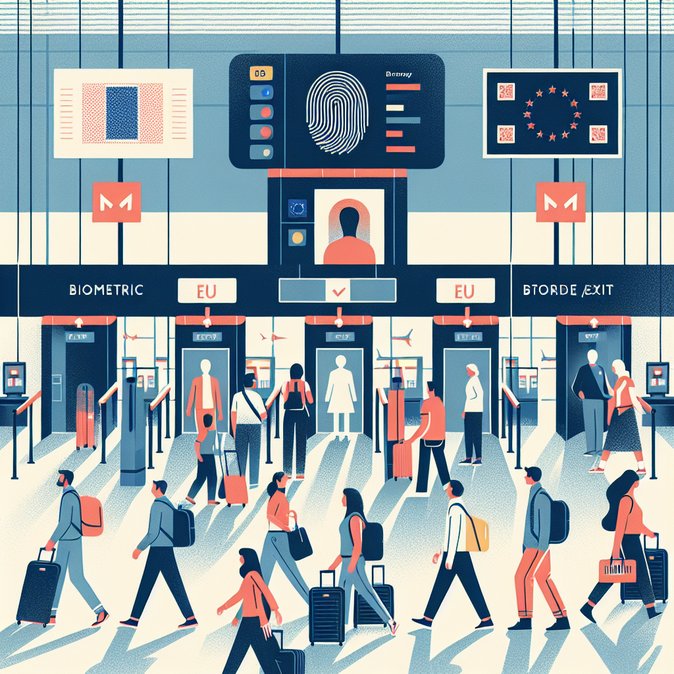
With the Easter holiday rush under way, the European Union’s new Entry/Exit System (EES) enters its last preparatory phase before becoming mandatory at all external Schengen border posts on 10 April 2026. An in-depth explainer published by Euronews on 6 April details how the biometric system will replace passport stamps with digital records of every non-EU traveller’s arrivals and departures, including fingerprints and facial images. Brussels Airport—where trial runs have already generated queues exceeding two hours at peak times—will be one of the highest-volume test cases. Under EES, third-country nationals visiting Belgium for business or tourism may spend up to 90 days in any 180-day period. The system will automatically calculate remaining stay days and flag overstays in real time, tightening compliance risk for assignees who shuttle frequently between headquarters and EU clients. EU and EEA citizens, as well as holders of Belgian residence permits, are exempt, but mixed-nationality families must ensure that non-EU members are biometrically enrolled. Airports Council International (ACI Europe) and Airlines for Europe warn that the end of phased registration on 31 March means border officers can no longer suspend EES during peak waves. Belgian carriers, including Brussels Airlines, advise travellers to arrive at least three hours early until passenger flows stabilise. Companies organising large meetings in Belgium over the summer should factor longer arrival windows into agendas.
![Final Countdown: EU Entry/Exit System Fully Activates on 10 April—What It Means for Travellers via Belgium]()
For travellers and corporate mobility planners who want to avoid last-minute surprises, VisaHQ offers an end-to-end visa and travel authorisation advisory service. Its Belgium portal (https://www.visahq.com/belgium/) provides real-time updates on Schengen entry rules, personalised notifications on the evolving EES/ETIAS rollout, and dedicated support for bulk enquiries—helping both occasional tourists and high-frequency business visitors stay compliant.
For global mobility managers, the silver lining is data reliability. Once fully operational, EES will allow Belgian authorities to issue more accurate Schengen-day printouts needed for single-permit renewals, and may speed up EU Blue Card applications by confirming lawful stay histories at the click of a mouse. However, privacy teams must review how long biometric templates are retained (up to three years after last exit) and update employee consent notices accordingly. Looking ahead, EES forms the technical backbone for ETIAS, the electronic travel authorisation that visa-exempt visitors—including Britons and Americans—will need from mid-2026. Firms that perfect traveller-data feeds for EES today will find the ETIAS transition far easier tomorrow.

For travellers and corporate mobility planners who want to avoid last-minute surprises, VisaHQ offers an end-to-end visa and travel authorisation advisory service. Its Belgium portal (https://www.visahq.com/belgium/) provides real-time updates on Schengen entry rules, personalised notifications on the evolving EES/ETIAS rollout, and dedicated support for bulk enquiries—helping both occasional tourists and high-frequency business visitors stay compliant.
For global mobility managers, the silver lining is data reliability. Once fully operational, EES will allow Belgian authorities to issue more accurate Schengen-day printouts needed for single-permit renewals, and may speed up EU Blue Card applications by confirming lawful stay histories at the click of a mouse. However, privacy teams must review how long biometric templates are retained (up to three years after last exit) and update employee consent notices accordingly. Looking ahead, EES forms the technical backbone for ETIAS, the electronic travel authorisation that visa-exempt visitors—including Britons and Americans—will need from mid-2026. Firms that perfect traveller-data feeds for EES today will find the ETIAS transition far easier tomorrow.