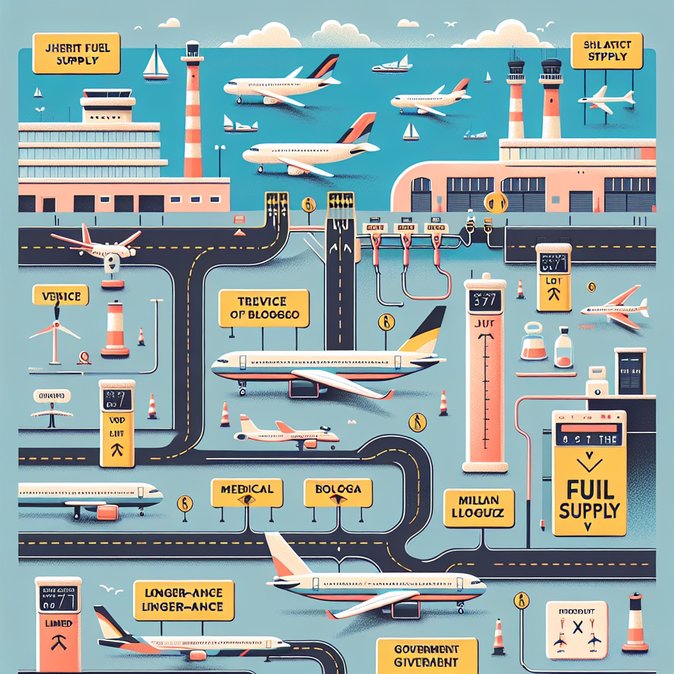
Italy’s business-travel network woke up on 6 April to the first large-scale jet-fuel restrictions seen in the country since the 2022 global energy crunch. NOTAMs issued overnight cap uplift at Milan Linate, Bologna, Venice-Marco Polo and Treviso to just 2,000 litres per aircraft until at least 9 April, with priority refuelling reserved for medical evacuations, state flights and long-haul services. The limits were confirmed by Air BP Italia after several carriers reported being unable to tanker sufficient fuel for domestic legs. Why now? According to airport operator SAVE and quoted logistics data, deliveries of kerosene from the Persian Gulf have slowed sharply since traffic through the Strait of Hormuz was disrupted in late March. With bunker vessels diverted or delayed, northern Italian depots have drawn down strategic stocks faster than expected over the busy Easter weekend. National inventories still cover roughly seven months of demand, but distribution bottlenecks mean northern hubs feel the pain first.
![Jet-fuel rationing hits four major Italian airports as supply squeeze deepens]()
If sudden route changes leave travellers needing updated documentation or rapid Schengen visa support, VisaHQ can step in. The company’s digital portal provides streamlined, same-day handling for Italian visas and passport renewals, shielding business and leisure passengers from administrative headaches. Full details are at https://www.visahq.com/italy/
Operational impact is immediate for airlines that base narrow-body fleets at the affected fields. Boeing 737-800s, for example, burn roughly 2.5 tonnes of fuel per flight hour; the 2,000-litre (≈1.6-tonne) ceiling leaves less than 60 minutes’ endurance once taxi and reserves are factored in. Carriers are therefore forced either to add technical stops—often in fuel-rich hubs such as Rome-Fiumicino or Zurich—or to swap equipment, lengthening itineraries and driving up costs. Low-cost operator Ryanair warned passengers of possible schedule changes and said the crisis, if prolonged, could jeopardise its summer programme. For corporate mobility managers the message is twofold: build extra connection time into itineraries this week and consider routing travellers through unaffected airports such as Milan Malpensa or Rome. Multinational firms running commuter shuttles between northern Italy and other European business centres may also need to renegotiate block-fuel agreements or accept ad-hoc price surcharges. Freight forwarders, meanwhile, report that high-value express cargo is already being shifted to road or rail to protect just-in-time supply chains. Longer-term, the episode exposes the vulnerability of Europe’s aviation fuel logistics to geopolitical shocks. Industry associations are urging the Italian government to accelerate a planned diversification strategy that would bring additional pipeline capacity from Mediterranean refineries and expand on-airport storage. Until that resilience is in place, airlines—and the companies that depend on them—face a new variable in their mobility risk calculus.

If sudden route changes leave travellers needing updated documentation or rapid Schengen visa support, VisaHQ can step in. The company’s digital portal provides streamlined, same-day handling for Italian visas and passport renewals, shielding business and leisure passengers from administrative headaches. Full details are at https://www.visahq.com/italy/
Operational impact is immediate for airlines that base narrow-body fleets at the affected fields. Boeing 737-800s, for example, burn roughly 2.5 tonnes of fuel per flight hour; the 2,000-litre (≈1.6-tonne) ceiling leaves less than 60 minutes’ endurance once taxi and reserves are factored in. Carriers are therefore forced either to add technical stops—often in fuel-rich hubs such as Rome-Fiumicino or Zurich—or to swap equipment, lengthening itineraries and driving up costs. Low-cost operator Ryanair warned passengers of possible schedule changes and said the crisis, if prolonged, could jeopardise its summer programme. For corporate mobility managers the message is twofold: build extra connection time into itineraries this week and consider routing travellers through unaffected airports such as Milan Malpensa or Rome. Multinational firms running commuter shuttles between northern Italy and other European business centres may also need to renegotiate block-fuel agreements or accept ad-hoc price surcharges. Freight forwarders, meanwhile, report that high-value express cargo is already being shifted to road or rail to protect just-in-time supply chains. Longer-term, the episode exposes the vulnerability of Europe’s aviation fuel logistics to geopolitical shocks. Industry associations are urging the Italian government to accelerate a planned diversification strategy that would bring additional pipeline capacity from Mediterranean refineries and expand on-airport storage. Until that resilience is in place, airlines—and the companies that depend on them—face a new variable in their mobility risk calculus.