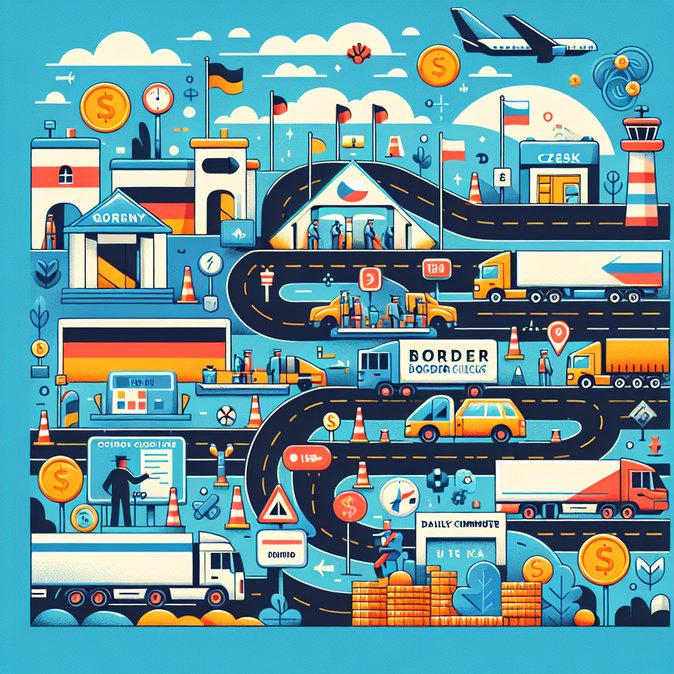
The stand-off between Berlin and Brussels over the re-imposition of Schengen border controls escalated at the weekend when German interior minister Alexander Dobrindt formally notified the European Commission that stationary checks on all land borders – including the busy 810-kilometre frontier with the Czech Republic – will remain in place until 15 September 2026. Although Germany first justified the controls in 2015 as an emergency response to irregular migration, they have now been rolled over more than 20 times. Czech road hauliers and manufacturing exporters complain that every additional document inspection or random vehicle search can add 30-90 minutes to a journey that must connect ‘just-in-time’ production facilities in Plzeň or Mladá Boleslav with assembly plants and distribution hubs in Bavaria and Saxony. CS CARGO and Česmad Bohemia estimate that waiting times and re-routing already cost the sector around €4 million a month in overtime and fuel.
![Germany’s extension of border checks until September 2026 puts pressure on Czech-German freight and commuters]()
For anyone who suddenly needs help securing the right travel papers under these shifting rules, VisaHQ can streamline the process. The firm’s Czech portal (https://www.visahq.com/czech-republic/) offers real-time advice on Schengen and Czech entry requirements, digitised application tools, and courier pick-ups—services that can be a lifesaver for cross-border drivers, HR departments and suppliers scrambling to adjust schedules.
The European Parliament’s Schengen Scrutiny Group argues that Berlin is stretching Article 25 of the Schengen Borders Code far beyond the six-month limit. Vice-president Margaritis Schinas confirmed on Sunday that the Commission is preparing a “proportionality test” that could trigger infringement proceedings if Germany cannot prove that fixed checks are still the least restrictive tool to tackle migration pressure. For Czech companies, the most immediate concern is Easter-week congestion. The controls coincide with temporary 13:00-22:00 truck bans on Czech motorways and with heavy-goods restrictions in Germany and Austria, turning the D5 and D8 corridors into choke points. Logistics planners are therefore advising clients to send sensitive cargo via the less-used border at Folmava or to move it the night before the curfew starts. In the medium term, compliance teams at multinationals such as Škoda Auto are modelling three scenarios: (1) controls disappear after September, restoring two-hour buffer times; (2) controls are converted into mobile patrols inside German territory, creating unpredictable spot checks; or (3) the Commission sues Germany, leading to years of legal limbo. Until clarity emerges, Czech HR and mobility managers are telling assignees to carry original passports and proof of residence even for routine cross-border commutes, while advising drivers to build a minimum one-hour contingency into delivery schedules.
For anyone who suddenly needs help securing the right travel papers under these shifting rules, VisaHQ can streamline the process. The firm’s Czech portal (https://www.visahq.com/czech-republic/) offers real-time advice on Schengen and Czech entry requirements, digitised application tools, and courier pick-ups—services that can be a lifesaver for cross-border drivers, HR departments and suppliers scrambling to adjust schedules.
The European Parliament’s Schengen Scrutiny Group argues that Berlin is stretching Article 25 of the Schengen Borders Code far beyond the six-month limit. Vice-president Margaritis Schinas confirmed on Sunday that the Commission is preparing a “proportionality test” that could trigger infringement proceedings if Germany cannot prove that fixed checks are still the least restrictive tool to tackle migration pressure. For Czech companies, the most immediate concern is Easter-week congestion. The controls coincide with temporary 13:00-22:00 truck bans on Czech motorways and with heavy-goods restrictions in Germany and Austria, turning the D5 and D8 corridors into choke points. Logistics planners are therefore advising clients to send sensitive cargo via the less-used border at Folmava or to move it the night before the curfew starts. In the medium term, compliance teams at multinationals such as Škoda Auto are modelling three scenarios: (1) controls disappear after September, restoring two-hour buffer times; (2) controls are converted into mobile patrols inside German territory, creating unpredictable spot checks; or (3) the Commission sues Germany, leading to years of legal limbo. Until clarity emerges, Czech HR and mobility managers are telling assignees to carry original passports and proof of residence even for routine cross-border commutes, while advising drivers to build a minimum one-hour contingency into delivery schedules.