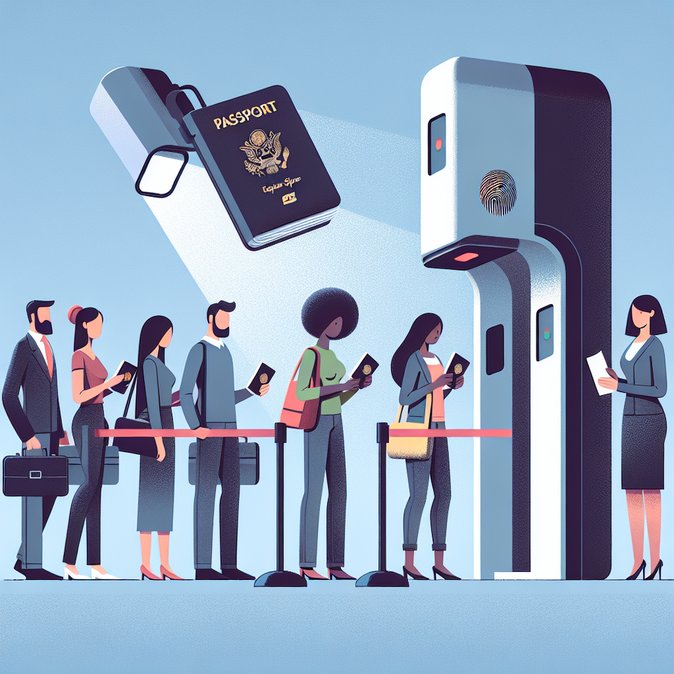
With less than a week to go before the EU’s Entry/Exit System (EES) becomes mandatory on 10 April, French authorities have quietly admitted that biometric registration will not be activated at Eurostar terminals, the Channel Tunnel shuttle in Folkestone/Coquelles and cross-Channel ferry ports. Most travellers entering France from the United Kingdom will therefore continue to have their passports manually stamped for "a few more weeks", an Interior-Ministry source told Connexion France. The EES, launched in October 2025, is designed to replace passport stamping with a single database that records fingerprints, a facial image and the precise time of each crossing for all non-EU visitors. Under EU rules France should already have fully deployed biometric kiosks, but officials say software glitches and space constraints at juxtaposed controls make the six-minute enrolment process unworkable over the busy Easter period.
![France confirms biometric EES checks delayed at Channel crossings days before EU deadline]()
For those unsure about how the shifting rules might affect upcoming trips, VisaHQ’s France portal (https://www.visahq.com/france/) offers up-to-date entry guidance, real-time notifications on EES activation dates and an assisted service for obtaining visas or residence permits. Their experts can walk both employers and individual travellers through documentation requirements, helping to avoid last-minute surprises when the biometric kiosks finally go live.
For corporate mobility managers the delay removes an immediate bottleneck—early tests suggested cars could queue for two to three hours at Calais once fingerprints were required—but it also prolongs uncertainty. Staff travelling by air into Paris-CDG, Lyon, Nice or Toulouse are already completing EES formalities, meaning companies must track days-in-country from two different data feeds. French police aux frontières will, for the time being, register car passengers manually without biometrics, preserving the legal fiction that EES is “operational” and buying time to stabilise hardware. Business travellers should still leave extra time at ports and carry proof of residence or onward itineraries, as manual checks remain rigorous. Employers are urged to audit travel-policy language so that assignees know when biometric data will be taken and how it is stored.

For those unsure about how the shifting rules might affect upcoming trips, VisaHQ’s France portal (https://www.visahq.com/france/) offers up-to-date entry guidance, real-time notifications on EES activation dates and an assisted service for obtaining visas or residence permits. Their experts can walk both employers and individual travellers through documentation requirements, helping to avoid last-minute surprises when the biometric kiosks finally go live.
For corporate mobility managers the delay removes an immediate bottleneck—early tests suggested cars could queue for two to three hours at Calais once fingerprints were required—but it also prolongs uncertainty. Staff travelling by air into Paris-CDG, Lyon, Nice or Toulouse are already completing EES formalities, meaning companies must track days-in-country from two different data feeds. French police aux frontières will, for the time being, register car passengers manually without biometrics, preserving the legal fiction that EES is “operational” and buying time to stabilise hardware. Business travellers should still leave extra time at ports and carry proof of residence or onward itineraries, as manual checks remain rigorous. Employers are urged to audit travel-policy language so that assignees know when biometric data will be taken and how it is stored.