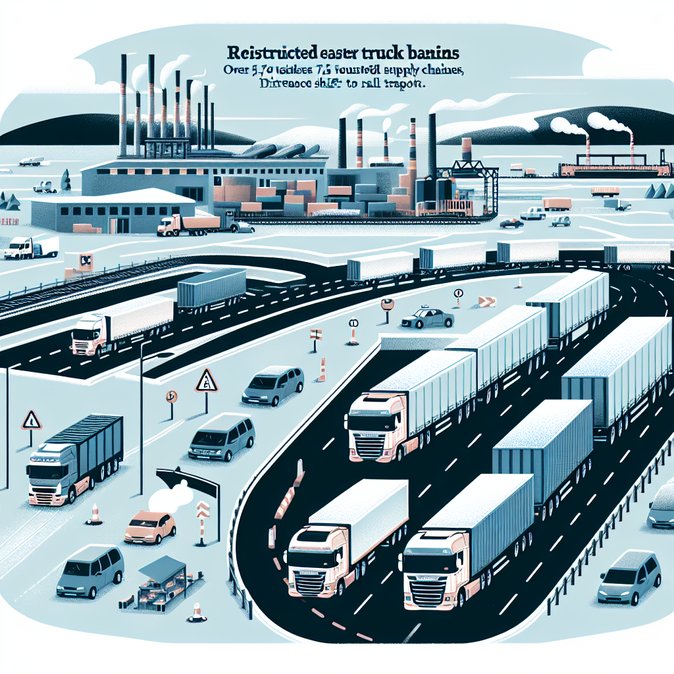
Austria’s long-standing public-holiday truck restrictions have returned in force for Easter Week—part of a coordinated series of 76 heavy-goods-vehicle (HGV) bans spanning fifteen European countries between 4 and 10 April 2026. According to the border-monitoring portal Nakordoni.eu, Tyrol activated its corridor ban on the A12 Inntal and A13 Brenner motorways from 07:00 on Saturday, 4 April, while nationwide Easter Sunday and Monday prohibitions bar vehicles over 7.5 tonnes from using Austrian motorways and expressways from 00:00 to 22:00. A further extended ban will apply on Good Friday, 10 April. The restrictions are intended to ease holiday traffic, enhance road safety and reduce bottlenecks at Alpine crossings, but they come at a cost for just-in-time supply chains. Logistics providers serving Austria’s automotive and high-tech clusters typically front-load deliveries before the weekend or reroute via rail piggy-back services to avoid fines that range from €150 to €5,000 per infringement. Forwarders moving perishables can claim exemptions under Austria’s ATP rules, yet capacity on temperature-controlled slots is already tight; market rates for refrigerated trailers on the Munich-Vienna lane reportedly rose 18 % in the week preceding Easter as shippers raced to beat the cut-off. Cross-border effects are equally pronounced.
![Easter Truck Bans Kick In: Austria Imposes 7.5-Tonne Restrictions Through April 10]()
In that context, VisaHQ’s Austria team (https://www.visahq.com/austria/) can step in to help: the platform streamlines applications for entry visas, work permits and residence documents for drivers, technicians and other mobile staff, allowing logistics firms to redeploy crews or shift loads onto alternative routes at short notice and with full compliance.
Germany, Italy and Slovenia apply complementary bans, meaning HGVs cannot legally transit the main north–south and east–west corridors for nearly two full days. The Federal Ministry for Climate Action notes that Austria’s rail-freight operators have scheduled an additional 24 RoLa (rolling highway) trains between Wörgl and Verona to absorb diverted traffic, but capacity is “close to saturation”. Companies that fail to secure RoLa slots may be forced to park trucks in designated holding areas—an outcome that can trigger demurrage charges and jeopardise just-in-sequence production lines. Mobility managers overseeing expatriate assignments in Austria should also factor in personal-vehicle congestion. With HGVs sidelined, passenger car volumes typically surge on the A1 Westautobahn and A2 Südautobahn as residents return from Easter visits; journey times on the Salzburg–Vienna sector can double, complicating Monday-morning commutes for cross-border workers living in Bavaria or South Moravia. Employers are advised to offer remote-work flexibility or overnight accommodation near worksites on 6 April to mitigate delays. Looking ahead, Austria’s Ministry of the Interior will deploy additional patrols at trucking hot-spots such as the Kufstein border to enforce the bans and to pilot new automated licence-plate recognition cameras that feed into the forthcoming EU Entry/Exit System (EES) database. Transport associations are lobbying for more dynamic, weather-responsive exemptions, arguing that blanket bans exacerbate emissions by forcing trucks to idle for extended periods. For now, however, the Easter prohibitions remain a fixed feature of the European mobility calendar—one that logistics planners ignore at their peril.

In that context, VisaHQ’s Austria team (https://www.visahq.com/austria/) can step in to help: the platform streamlines applications for entry visas, work permits and residence documents for drivers, technicians and other mobile staff, allowing logistics firms to redeploy crews or shift loads onto alternative routes at short notice and with full compliance.
Germany, Italy and Slovenia apply complementary bans, meaning HGVs cannot legally transit the main north–south and east–west corridors for nearly two full days. The Federal Ministry for Climate Action notes that Austria’s rail-freight operators have scheduled an additional 24 RoLa (rolling highway) trains between Wörgl and Verona to absorb diverted traffic, but capacity is “close to saturation”. Companies that fail to secure RoLa slots may be forced to park trucks in designated holding areas—an outcome that can trigger demurrage charges and jeopardise just-in-sequence production lines. Mobility managers overseeing expatriate assignments in Austria should also factor in personal-vehicle congestion. With HGVs sidelined, passenger car volumes typically surge on the A1 Westautobahn and A2 Südautobahn as residents return from Easter visits; journey times on the Salzburg–Vienna sector can double, complicating Monday-morning commutes for cross-border workers living in Bavaria or South Moravia. Employers are advised to offer remote-work flexibility or overnight accommodation near worksites on 6 April to mitigate delays. Looking ahead, Austria’s Ministry of the Interior will deploy additional patrols at trucking hot-spots such as the Kufstein border to enforce the bans and to pilot new automated licence-plate recognition cameras that feed into the forthcoming EU Entry/Exit System (EES) database. Transport associations are lobbying for more dynamic, weather-responsive exemptions, arguing that blanket bans exacerbate emissions by forcing trucks to idle for extended periods. For now, however, the Easter prohibitions remain a fixed feature of the European mobility calendar—one that logistics planners ignore at their peril.