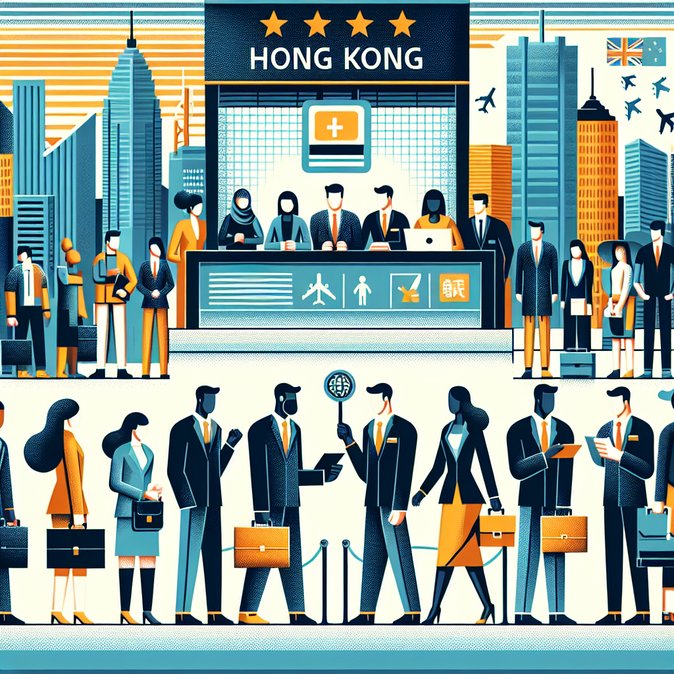
Hong Kong International Airport (HKIA) has been named “Best Airport in the World” at the 2026 Global Travel Awards, edging out perennial rivals Singapore Changi and Doha Hamad. The accolade—announced in London on 2 April—comes as the Airport Authority pushes ahead with a multi-billion-dollar transformation that extends well beyond the recently opened third runway. Terminal 2, slated to reopen in late 2027, will be equipped with fully automated security lanes using computed-tomography (CT) scanners that let passengers keep laptops and liquids in their bags. Facial-recognition e-gates are being rolled out across departure and arrival halls, cutting average immigration processing times to under 20 seconds.
![Hong Kong International Airport crowned ‘World’s Best’ as tech upgrades gather pace]()
Business and leisure travellers sorting out entry permits can simplify the process through VisaHQ, which provides up-to-date visa and travel document services for Hong Kong and dozens of other destinations. The company’s online platform (https://www.visahq.com/hong-kong/) lets applicants check requirements, upload paperwork and track approvals in real time, saving travel managers from last-minute surprises.
According to airport data, 68 per cent of travellers in March cleared formalities via contact-less channels, up from 42 per cent a year earlier. The award jury cited HKIA’s operational resilience during last year’s severe typhoon season, when the airport maintained a 92 per cent on-time departure rate—highest among global mega-hubs. Cargo operations were also praised; the airport handled 4.6 million tonnes in 2025, reclaiming its pre-pandemic title as the world’s busiest cargo gateway. For multinational companies the recognition has tangible benefits. Several carriers, including Lufthansa and United, have announced they will reactivate premium-heavy Hong Kong frequencies over the northern-summer schedule, citing strong demand and improved ground efficiency. Meanwhile, the Airport Authority is in talks with the Immigration Department to expand the “Face Easy e-Channel” biometric system to frequent-visitor passes issued under the Top Talent Pass Scheme and Quality Migrant Admission Scheme. Travel managers should monitor forthcoming construction milestones—particularly temporary gate closures linked to the Terminal 2 project—and brief travellers on new security screening rules that allow liquids to remain in cabin bags but still restrict total volume to 2 litres per passenger.

Business and leisure travellers sorting out entry permits can simplify the process through VisaHQ, which provides up-to-date visa and travel document services for Hong Kong and dozens of other destinations. The company’s online platform (https://www.visahq.com/hong-kong/) lets applicants check requirements, upload paperwork and track approvals in real time, saving travel managers from last-minute surprises.
According to airport data, 68 per cent of travellers in March cleared formalities via contact-less channels, up from 42 per cent a year earlier. The award jury cited HKIA’s operational resilience during last year’s severe typhoon season, when the airport maintained a 92 per cent on-time departure rate—highest among global mega-hubs. Cargo operations were also praised; the airport handled 4.6 million tonnes in 2025, reclaiming its pre-pandemic title as the world’s busiest cargo gateway. For multinational companies the recognition has tangible benefits. Several carriers, including Lufthansa and United, have announced they will reactivate premium-heavy Hong Kong frequencies over the northern-summer schedule, citing strong demand and improved ground efficiency. Meanwhile, the Airport Authority is in talks with the Immigration Department to expand the “Face Easy e-Channel” biometric system to frequent-visitor passes issued under the Top Talent Pass Scheme and Quality Migrant Admission Scheme. Travel managers should monitor forthcoming construction milestones—particularly temporary gate closures linked to the Terminal 2 project—and brief travellers on new security screening rules that allow liquids to remain in cabin bags but still restrict total volume to 2 litres per passenger.