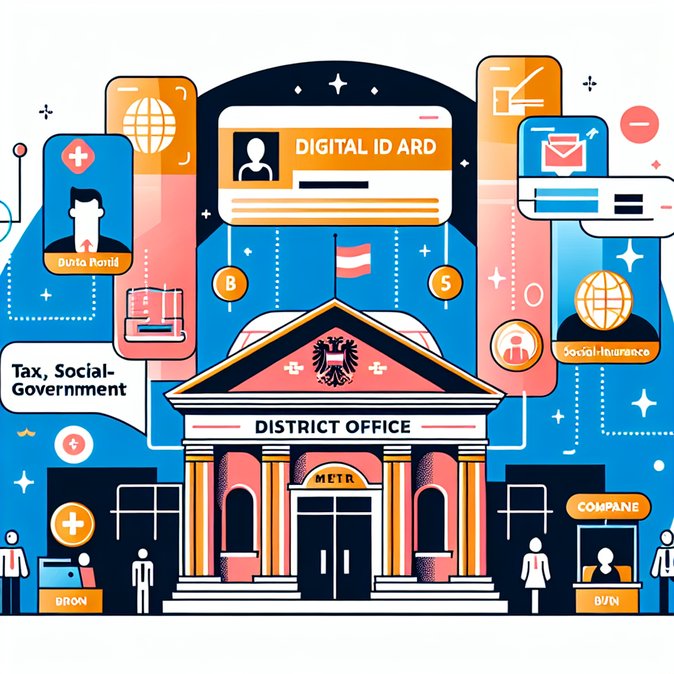
Foreign nationals living or working in Tirol can now obtain Austria’s secure digital identity card—ID Austria—at three additional district offices (Imst, Reutte and Lienz). The regional government rolled out the service on 1 April 2026 in response to mounting demand from employers who rely on cross-border commuters and expatriate staff. Until now, most non-Austrian residents had to travel to Innsbruck to activate ID Austria, a prerequisite for accessing e-government portals, filing tax returns, signing lease agreements and, increasingly, using automated passport gates.
![Tirol expands ID-Austria digital identity to foreign residents, cutting bureaucracy for cross-border talent]()
For applicants who would like extra help understanding eligibility rules or gathering the right paperwork, VisaHQ provides an easy-to-use online platform that guides users through Austrian visa and document requirements; its Austria page (https://www.visahq.com/austria/) offers fee estimators, live support, and end-to-end processing services that complement the new district-office option.
The new decentralised model is expected to save applicants several hours in travel time and accelerate onboarding for companies in Tirol’s tourism, life-science and advanced-manufacturing clusters. Officials stress that ID Austria is more than a login credential: it is the key to incoming EU border procedures such as the Entry/Exit System (EES) and—later—ETIAS. By linking biometric data with a qualified electronic signature, the platform enables friction-less proof of residence, driving-licence renewals, and even secure age verification for restricted-goods purchases. For HR and global-mobility teams, the change simplifies compliance. New hires can complete residence-registration steps online, authorise payroll deductions digitally, and sign tenancy agreements remotely—reducing the cost of relocation packages. Legal advisers recommend that employers update welcome packs to include step-by-step ID-Austria activation instructions and to budget time for the mandatory in-person identity check at district offices. Tirol’s move follows a federal push to upgrade more than 300,000 soon-to-expire Handy-Signatur certificates to the ID-Austria standard before mid-2026. If the pilot proves successful, other Austrian states are expected to extend issuance points for foreigners, underscoring the country’s strategy of using e-ID infrastructure to stay competitive in the global talent race.

For applicants who would like extra help understanding eligibility rules or gathering the right paperwork, VisaHQ provides an easy-to-use online platform that guides users through Austrian visa and document requirements; its Austria page (https://www.visahq.com/austria/) offers fee estimators, live support, and end-to-end processing services that complement the new district-office option.
The new decentralised model is expected to save applicants several hours in travel time and accelerate onboarding for companies in Tirol’s tourism, life-science and advanced-manufacturing clusters. Officials stress that ID Austria is more than a login credential: it is the key to incoming EU border procedures such as the Entry/Exit System (EES) and—later—ETIAS. By linking biometric data with a qualified electronic signature, the platform enables friction-less proof of residence, driving-licence renewals, and even secure age verification for restricted-goods purchases. For HR and global-mobility teams, the change simplifies compliance. New hires can complete residence-registration steps online, authorise payroll deductions digitally, and sign tenancy agreements remotely—reducing the cost of relocation packages. Legal advisers recommend that employers update welcome packs to include step-by-step ID-Austria activation instructions and to budget time for the mandatory in-person identity check at district offices. Tirol’s move follows a federal push to upgrade more than 300,000 soon-to-expire Handy-Signatur certificates to the ID-Austria standard before mid-2026. If the pilot proves successful, other Austrian states are expected to extend issuance points for foreigners, underscoring the country’s strategy of using e-ID infrastructure to stay competitive in the global talent race.