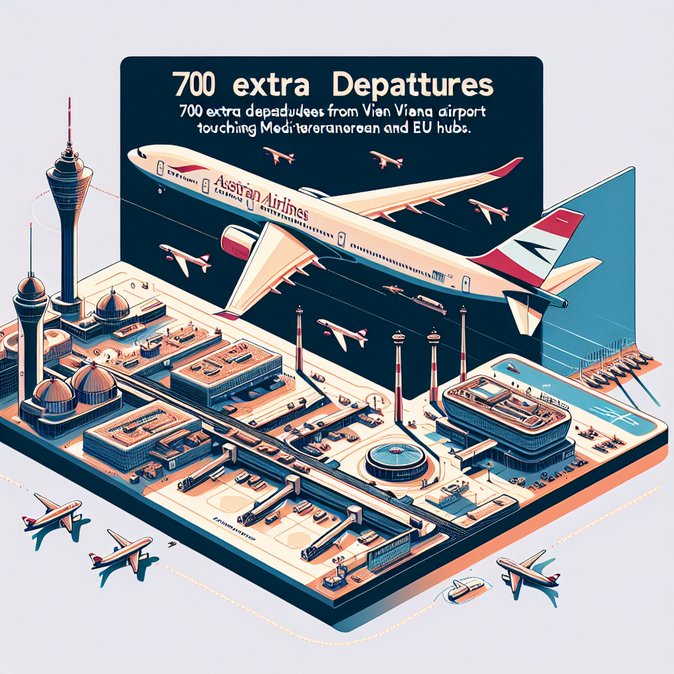
The Lufthansa Group unveiled an expansion plan late on 31 March that will put 1,600 additional flights into the market this summer, 700 of them operated by Austrian Airlines out of Vienna International Airport. According to aviation intelligence provider CAPA, the Austrian flag carrier will focus extra capacity on Mediterranean leisure routes—Spain, Greece and Italy—as well as high-frequency business shuttles to Frankfurt and Brussels.
![Lufthansa Group adds 700 extra Austrian Airlines flights from Vienna for summer 2026]()
At the documentation stage, VisaHQ can streamline the visa and travel compliance process for staff heading to Spain, Greece, Italy or any other market on the expanded route map. The company’s Austria portal (https://www.visahq.com/austria/) walks travellers through Entry-Exit System registration, e-visa rules and embassy appointments, giving mobility managers a single dashboard to monitor every application—an efficient complement to the surge in seat capacity out of Vienna.
For mobility managers the message is clear: short-haul seat availability out of Vienna will improve just as the EU Entry-Exit System threatens to slow border processing for non-EU travellers. Companies relocating staff to client sites on the Iberian Peninsula or shuttling executives to EU institutions can expect more direct frequencies and potentially softer fares. The additional flights coincide with Austrian Airlines’ fleet retrofit: eight A320neos entering service this quarter feature larger overhead bins that fit standard carry-on rollers vertically—reducing boarding times—and satellite Wi-Fi capable of supporting VPN connections. In the premium cabin, a simplified buy-on-board concept now includes pre-order meals compliant with Austrian tax rules for expatriate allowances. Vienna Airport operator VIE is re-opening sections of the refurbished Terminal 2 to handle the growth. Ground-handler Austrian Handling Services has hired 300 seasonal staff, while the airport police unit is adding two biometric enrolment lanes in anticipation of EES. Slot analysts warn, however, that early-morning congestion between 06:00 and 07:30 may worsen; employers are advised to book flexible fares or schedule meetings after 10:00. Beyond Austria, fellow group carriers will add 540 flights from Frankfurt and Munich, 100 from Zurich and 170 from Brussels. The network push reflects a bullish demand forecast—Lufthansa now plans 14,000 weekly connections to over 330 destinations in 100 countries during peak season, restoring the group’s capacity to 103 % of 2019 levels.

At the documentation stage, VisaHQ can streamline the visa and travel compliance process for staff heading to Spain, Greece, Italy or any other market on the expanded route map. The company’s Austria portal (https://www.visahq.com/austria/) walks travellers through Entry-Exit System registration, e-visa rules and embassy appointments, giving mobility managers a single dashboard to monitor every application—an efficient complement to the surge in seat capacity out of Vienna.
For mobility managers the message is clear: short-haul seat availability out of Vienna will improve just as the EU Entry-Exit System threatens to slow border processing for non-EU travellers. Companies relocating staff to client sites on the Iberian Peninsula or shuttling executives to EU institutions can expect more direct frequencies and potentially softer fares. The additional flights coincide with Austrian Airlines’ fleet retrofit: eight A320neos entering service this quarter feature larger overhead bins that fit standard carry-on rollers vertically—reducing boarding times—and satellite Wi-Fi capable of supporting VPN connections. In the premium cabin, a simplified buy-on-board concept now includes pre-order meals compliant with Austrian tax rules for expatriate allowances. Vienna Airport operator VIE is re-opening sections of the refurbished Terminal 2 to handle the growth. Ground-handler Austrian Handling Services has hired 300 seasonal staff, while the airport police unit is adding two biometric enrolment lanes in anticipation of EES. Slot analysts warn, however, that early-morning congestion between 06:00 and 07:30 may worsen; employers are advised to book flexible fares or schedule meetings after 10:00. Beyond Austria, fellow group carriers will add 540 flights from Frankfurt and Munich, 100 from Zurich and 170 from Brussels. The network push reflects a bullish demand forecast—Lufthansa now plans 14,000 weekly connections to over 330 destinations in 100 countries during peak season, restoring the group’s capacity to 103 % of 2019 levels.