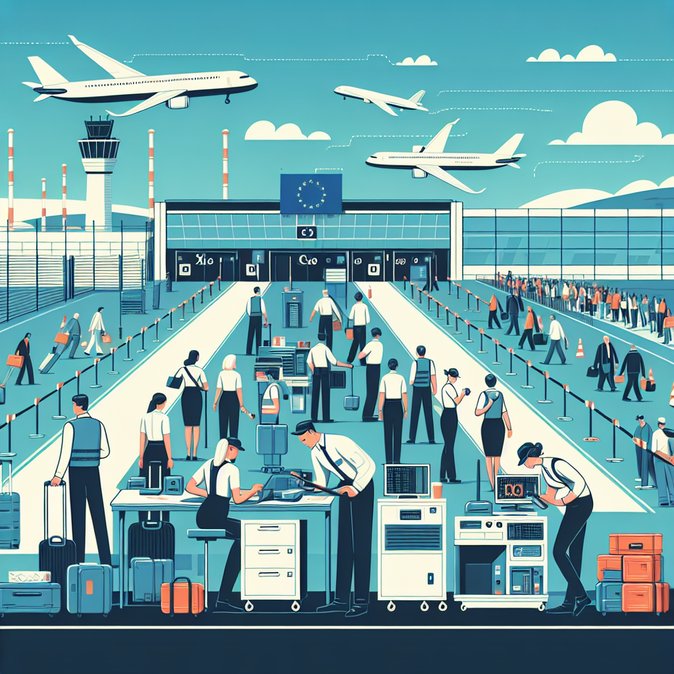
Airports and land-border posts across the Czech Republic are scrambling to bolster staffing and IT support after the EU confirmed that **from 31 March 2026 every third-country national must be biometrically enrolled in the new Entry/Exit System (EES)**. The hard deadline—highlighted in a Travel & Tour World bulletin on 30 March—coincides with the Easter travel surge, raising fears of hour-long queues at Prague-Václav Havel Airport and busy road crossings such as Rozvadov/Waidhaus. Prague Airport says it will open four additional EES kiosks in Terminal 2 and double the number of ‘roaming agents’ who help passengers capture fingerprints and facial images. Training is under way for 180 security officers redeployed from quieter winter schedules, while the Interior Ministry has authorised paid overtime for 250 foreign-police officers through mid-April. A mobile enrolment unit will also tour Brno and Ostrava airports—sites that lack fixed EES gates—to capture data for charter flights.
![Czech Airports Rush to Add Staff as Schengen Entry/Exit System Hits 100 % Compliance Deadline]()
Travellers wondering how best to meet the new biometric obligations may find it useful to consult VisaHQ, whose Czech Republic portal (https://www.visahq.com/czech-republic/) offers real-time guidance on entry rules, visa options and document checks for business visitors, tourists and posted workers alike. The platform can pre-screen passports, arrange any required visas and push automatic regulation alerts to both individuals and corporate mobility teams—helping to minimise last-minute surprises once EES controls begin.
Carriers have warned that **gate-closure times may be brought forward by 10–15 minutes** to absorb the extra processing. Smartwings and Ryanair have started sending SMS messages urging passengers to arrive “at least three hours before departure” for non-Schengen flights. Freight and coach operators are equally concerned: the Czech Association of Road Transport (ČESMAD) estimates that even a five-minute delay per coach could translate into 11-kilometre tailbacks on the D5 motorway during Easter Monday returns from Germany. Longer term, officials say the EES will streamline exit checks, cut document fraud and allow the Czech Republic to **phase out passport stamping entirely by Q4 2026**. Data will feed directly into the EU’s overstayer-alert system, giving police real-time analytics on visa-free visitors who exceed the 90/180-day rule. Companies relying on short-term posted workers from Ukraine or the UK should audit travel patterns now to avoid unintended overstays once automatic alerts go live. Practical tips for employers include adding buffer time to itineraries, pre-registering groups via the EU’s Carrier Interface, and updating staff travel policies to reflect possible missed connections. The Ministry of Interior has published Czech-language FAQs and will hold webinars for HR and mobility managers on 4 and 8 April.

Travellers wondering how best to meet the new biometric obligations may find it useful to consult VisaHQ, whose Czech Republic portal (https://www.visahq.com/czech-republic/) offers real-time guidance on entry rules, visa options and document checks for business visitors, tourists and posted workers alike. The platform can pre-screen passports, arrange any required visas and push automatic regulation alerts to both individuals and corporate mobility teams—helping to minimise last-minute surprises once EES controls begin.
Carriers have warned that **gate-closure times may be brought forward by 10–15 minutes** to absorb the extra processing. Smartwings and Ryanair have started sending SMS messages urging passengers to arrive “at least three hours before departure” for non-Schengen flights. Freight and coach operators are equally concerned: the Czech Association of Road Transport (ČESMAD) estimates that even a five-minute delay per coach could translate into 11-kilometre tailbacks on the D5 motorway during Easter Monday returns from Germany. Longer term, officials say the EES will streamline exit checks, cut document fraud and allow the Czech Republic to **phase out passport stamping entirely by Q4 2026**. Data will feed directly into the EU’s overstayer-alert system, giving police real-time analytics on visa-free visitors who exceed the 90/180-day rule. Companies relying on short-term posted workers from Ukraine or the UK should audit travel patterns now to avoid unintended overstays once automatic alerts go live. Practical tips for employers include adding buffer time to itineraries, pre-registering groups via the EU’s Carrier Interface, and updating staff travel policies to reflect possible missed connections. The Ministry of Interior has published Czech-language FAQs and will hold webinars for HR and mobility managers on 4 and 8 April.