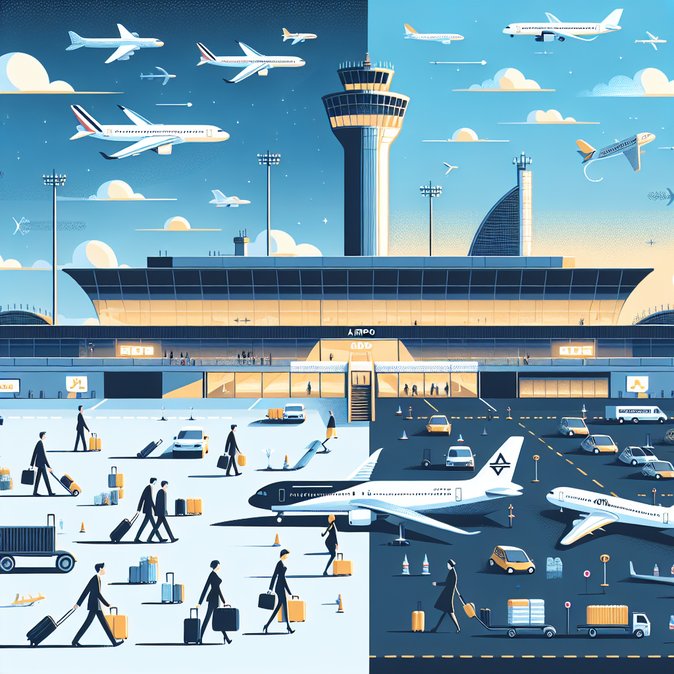
Airlines and travellers awoke this morning to confirmation that French air-traffic controllers have entered a new 48-hour strike, crippling operations at every major airport in the country and slowing over-flights across French airspace. France’s civil-aviation authority (DGAC) has mandated capacity cuts of up to 40 % at Paris-Charles-de-Gaulle and Orly, while regional hubs such as Nice, Marseille, Lyon and Toulouse have each been ordered to cancel between 30 % and 50 % of scheduled movements. Carriers were alerted late Thursday night, but many services were already airborne or in final preparations, leaving aircraft, crews and—most importantly—passengers out of position as the stoppage took effect at 06:00 Friday. Because one third of all European flights use French airspace at some point, the impact extends far beyond the country’s borders.
![French Air Traffic Control Strike Grounds Hundreds of Flights Across France and Europe]()
Amid this uncertainty, travellers who suddenly need to reroute through different countries—or adjust the validity dates on existing Schengen visas—can lean on VisaHQ’s online platform (https://www.visahq.com/france/) for rapid assistance. The company’s specialists expedite new transit or short-stay visas, handle embassy paperwork, and provide real-time status updates, helping passengers focus on rebooking flights instead of navigating consular bureaucracy.
Eurocontrol’s network-flow managers report holding patterns over northern Italy and Spain as traffic is rerouted around congested French sectors, while long-haul departures from the United States and the Gulf have been issued reroute packages that add up to 45 minutes to block time. Airlines are absorbing millions of euros in extra fuel and crew-duty costs, and many have announced pro-active cancellations for Saturday to prevent further knock-on delays. The strike has been called by France’s two largest air-traffic unions, the SNCTA and USAC-CGT, which argue that chronic staff shortages and ageing radar systems have made workloads “untenable.” Negotiations with the transport ministry broke down earlier this week when the government refused to guarantee a multi-year hiring plan tied to inflation-indexed pay increases. The walk-out comes at the start of France’s Easter-holiday peak, traditionally one of the busiest weekends for both business and leisure travel, and just 100 days before Paris hosts the 2026 G7 summit—an event that will already see ad-hoc flight restrictions and VIP operations. Practical fallout for corporates is immediate. Air France and easyJet have issued “flex tickets,” allowing passengers rebookings within 30 days; Ryanair has offered refunds but warned customers that alternative seats during the school break are scarce. Freight forwarders have shifted high-value consignments to trucking and rail, and several multinational firms—including two CAC-40 pharmaceutical groups—have postponed investor road-shows scheduled for Monday in Lyon and Toulouse. Under EU Regulation 261/2004, airlines are not obliged to pay compensation for strikes by third-party staff, but they must still offer rerouting or refunds, adding administrative strain to call-centres that were already stretched by last month’s Lufthansa stoppage. For mobility managers the advice is two-fold: keep travellers informed of rapidly changing flight status, and consider rail or road alternatives for intra-European hops under 1 000 km. Eurostar and Thalys have added limited extra capacity, but seats are selling out quickly. Travellers who must fly should build generous connection buffers and monitor DGAC communiqués; past experience suggests residual delays will linger 24–36 hours after controllers return to work. Looking ahead, union representatives have hinted at further action in April if talks do not progress—an unwelcome prospect as France races to implement the EU’s Entry/Exit System (EES) by 10 April, itself expected to slow border formalities.

Amid this uncertainty, travellers who suddenly need to reroute through different countries—or adjust the validity dates on existing Schengen visas—can lean on VisaHQ’s online platform (https://www.visahq.com/france/) for rapid assistance. The company’s specialists expedite new transit or short-stay visas, handle embassy paperwork, and provide real-time status updates, helping passengers focus on rebooking flights instead of navigating consular bureaucracy.
Eurocontrol’s network-flow managers report holding patterns over northern Italy and Spain as traffic is rerouted around congested French sectors, while long-haul departures from the United States and the Gulf have been issued reroute packages that add up to 45 minutes to block time. Airlines are absorbing millions of euros in extra fuel and crew-duty costs, and many have announced pro-active cancellations for Saturday to prevent further knock-on delays. The strike has been called by France’s two largest air-traffic unions, the SNCTA and USAC-CGT, which argue that chronic staff shortages and ageing radar systems have made workloads “untenable.” Negotiations with the transport ministry broke down earlier this week when the government refused to guarantee a multi-year hiring plan tied to inflation-indexed pay increases. The walk-out comes at the start of France’s Easter-holiday peak, traditionally one of the busiest weekends for both business and leisure travel, and just 100 days before Paris hosts the 2026 G7 summit—an event that will already see ad-hoc flight restrictions and VIP operations. Practical fallout for corporates is immediate. Air France and easyJet have issued “flex tickets,” allowing passengers rebookings within 30 days; Ryanair has offered refunds but warned customers that alternative seats during the school break are scarce. Freight forwarders have shifted high-value consignments to trucking and rail, and several multinational firms—including two CAC-40 pharmaceutical groups—have postponed investor road-shows scheduled for Monday in Lyon and Toulouse. Under EU Regulation 261/2004, airlines are not obliged to pay compensation for strikes by third-party staff, but they must still offer rerouting or refunds, adding administrative strain to call-centres that were already stretched by last month’s Lufthansa stoppage. For mobility managers the advice is two-fold: keep travellers informed of rapidly changing flight status, and consider rail or road alternatives for intra-European hops under 1 000 km. Eurostar and Thalys have added limited extra capacity, but seats are selling out quickly. Travellers who must fly should build generous connection buffers and monitor DGAC communiqués; past experience suggests residual delays will linger 24–36 hours after controllers return to work. Looking ahead, union representatives have hinted at further action in April if talks do not progress—an unwelcome prospect as France races to implement the EU’s Entry/Exit System (EES) by 10 April, itself expected to slow border formalities.