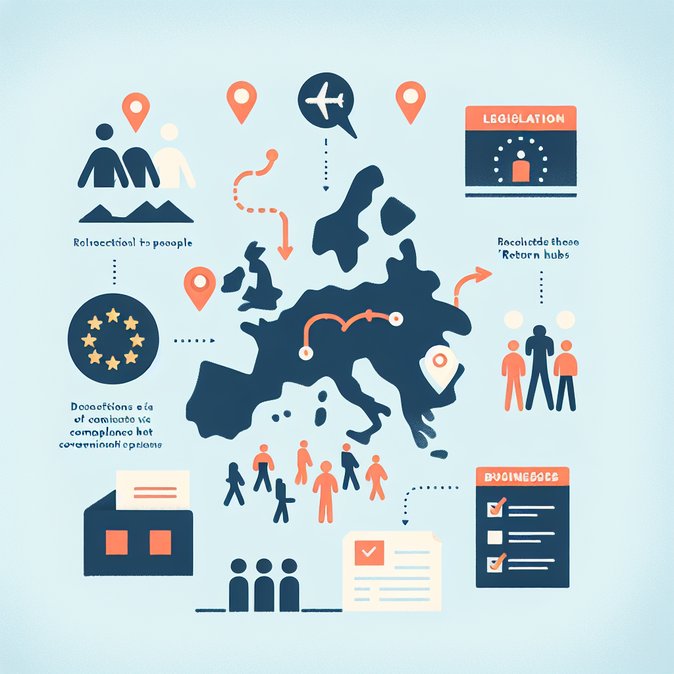
In a landmark vote in Brussels on 26 March 2026, Members of the European Parliament approved new legislation that paves the way for EU countries—including France—to transfer migrants whose asylum requests have been rejected to detention and processing centres located outside EU territory. The measure, carried by 389 votes to 206 with 32 abstentions, allows individual member-states or coalitions of states to negotiate bilateral agreements with third countries willing to host so-called “return hubs.” Right-wing and far-right parties joined forces to secure passage, while centrist and left-wing groups opposed the text. For France, a core destination and transit country on Europe’s western migration route, the bill represents both a political and operational turning-point. Interior Minister Gérald Darmanin welcomed the vote as “a pragmatic tool that will ease pressure on France’s asylum system,” noting that French prefectures are currently processing a record 160,000 asylum applications per year. Officials at the Ministry of the Interior confirmed that exploratory talks have already begun with Mauritania and Benin—countries with which Paris has long-standing security partnerships—about hosting facilities that would meet EU human-rights monitoring standards. Any agreement would still require approval by the French Parliament under the country’s 2024 immigration-integration law.
![EU Parliament backs offshore ‘return hubs’ for rejected migrants]()
For companies and individuals navigating this evolving landscape, VisaHQ’s dedicated France portal (https://www.visahq.com/france/) offers up-to-date guidance on visa categories, document checklists and application timelines, along with concierge services that can help minimise delays caused by the stricter controls outlined below.
Business travel and corporate mobility managers are watching closely. The new rules are designed to accelerate removals of people with no legal right to stay, but they also tighten documentation checks at EU external borders and foresee tougher penalties—fines as high as €25,000—on carriers that transport passengers lacking the correct visas or work permits. Multinational companies relocating staff to France may therefore face more rigorous vetting of supporting documents (employment contracts, diplomas, criminal-record extracts) at consulates and entry points. Travel-management firms are advising clients to build in longer lead times for work-permit issuance and to double-check document validity well before departure. Human-rights organisations such as La Cimade and Amnesty France condemned the vote, warning that outsourcing detention risks creating “legal black holes” where EU fundamental-rights standards are difficult to enforce. They pointed to France’s own experience running ‘zones d’attente’ at Charles-de-Gaulle and other airports, arguing that distance and lack of oversight often lead to sub-standard conditions. The European Commission has pledged to publish detailed guidance on safeguards—including independent monitoring and access to legal counsel—before the pact takes effect on 12 June 2026. Practically, nothing will change overnight for travellers or assignees entering France, but companies should prepare for a more security-driven environment. Once the broader EU Pact on Migration and Asylum enters into force next year, France is expected to align its national removal procedures with the new framework, potentially resulting in faster—but also more document-sensitive—border checks. HR teams should brief inbound staff on the heightened scrutiny, ensure compliance with Schengen 90/180-day rules, and keep contingency plans ready in case flight routes are disrupted by future negotiations with partner countries over return hubs.

For companies and individuals navigating this evolving landscape, VisaHQ’s dedicated France portal (https://www.visahq.com/france/) offers up-to-date guidance on visa categories, document checklists and application timelines, along with concierge services that can help minimise delays caused by the stricter controls outlined below.
Business travel and corporate mobility managers are watching closely. The new rules are designed to accelerate removals of people with no legal right to stay, but they also tighten documentation checks at EU external borders and foresee tougher penalties—fines as high as €25,000—on carriers that transport passengers lacking the correct visas or work permits. Multinational companies relocating staff to France may therefore face more rigorous vetting of supporting documents (employment contracts, diplomas, criminal-record extracts) at consulates and entry points. Travel-management firms are advising clients to build in longer lead times for work-permit issuance and to double-check document validity well before departure. Human-rights organisations such as La Cimade and Amnesty France condemned the vote, warning that outsourcing detention risks creating “legal black holes” where EU fundamental-rights standards are difficult to enforce. They pointed to France’s own experience running ‘zones d’attente’ at Charles-de-Gaulle and other airports, arguing that distance and lack of oversight often lead to sub-standard conditions. The European Commission has pledged to publish detailed guidance on safeguards—including independent monitoring and access to legal counsel—before the pact takes effect on 12 June 2026. Practically, nothing will change overnight for travellers or assignees entering France, but companies should prepare for a more security-driven environment. Once the broader EU Pact on Migration and Asylum enters into force next year, France is expected to align its national removal procedures with the new framework, potentially resulting in faster—but also more document-sensitive—border checks. HR teams should brief inbound staff on the heightened scrutiny, ensure compliance with Schengen 90/180-day rules, and keep contingency plans ready in case flight routes are disrupted by future negotiations with partner countries over return hubs.