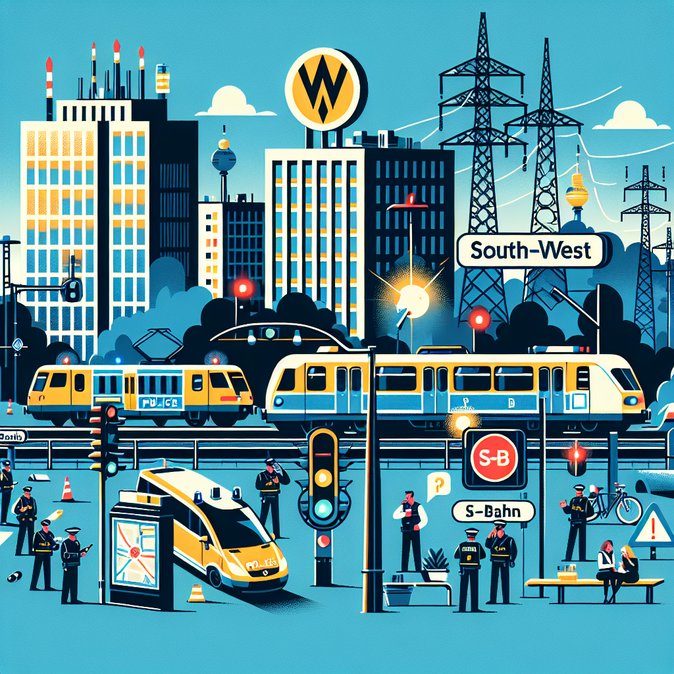
Passengers on Berlin’s southern S-Bahn ring faced unscheduled delays on 24 March as police raided 15 properties linked to January’s arson attack on the city’s power grid. According to the investigation chronicle on Wikipedia, the dawn operation spanned addresses in Berlin, Düsseldorf, Hamburg and Kyritz, targeting four suspects believed to be part of an anarcho-primitivist cell. While no arrests were immediately reported, the Bundeskriminalamt confirmed that electronic devices and travel documents had been seized. The sweep forced temporary closures of key road arteries and limited access to Lichterfelde-Ost station, prompting the S-Bahn operator to reroute or short-turn services on the S1 and S25 lines for nearly two hours. Airport transfer coaches using the A115 AVUS reported 30-minute detours, illustrating how security operations around critical infrastructure can ripple through urban mobility networks. January’s sabotage cut power to 45,000 households and triggered a six-day crisis that required Deutsche Bahn to cancel south-west suburban trains and suspend ticket sales for long-distance ICE services originating at Berlin Hbf.
![Berlin anti-sabotage raids disrupt commuter lines, spotlighting mobility risks to critical infrastructure]()
If your organisation’s staff or contractors need to adjust travel documents at short notice during such disruptions, VisaHQ can help. The company’s digital platform and Berlin support team (https://www.visahq.com/germany/) arrange German and Schengen visas swiftly, reducing administrative bottlenecks when plans suddenly change because of transport stoppages or security cordons.
Although full electrification was restored on 7 January, employers in the capital’s tech corridor have since revised their business-continuity plans to include alternative commuting allowances and hotel contingencies. This week’s police action reminds mobility managers that physical-security incidents can return with little notice. Companies running travel-risk programmes should update Berlin alerts, advise travellers to allow extra time when moving between inner-city offices and BER airport, and ensure expatriate emergency contacts are current. Facility-security teams may also wish to liaise with landlords to confirm backup power arrangements for serviced apartments and co-working spaces. For policymakers, the episode strengthens calls—most recently echoed by the Federation of German Industries (BDI)—to accelerate the Federal Interior Ministry’s Critical-Infrastructure Transport Resilience Strategy, currently stalled in inter-ministerial review.
If your organisation’s staff or contractors need to adjust travel documents at short notice during such disruptions, VisaHQ can help. The company’s digital platform and Berlin support team (https://www.visahq.com/germany/) arrange German and Schengen visas swiftly, reducing administrative bottlenecks when plans suddenly change because of transport stoppages or security cordons.
Although full electrification was restored on 7 January, employers in the capital’s tech corridor have since revised their business-continuity plans to include alternative commuting allowances and hotel contingencies. This week’s police action reminds mobility managers that physical-security incidents can return with little notice. Companies running travel-risk programmes should update Berlin alerts, advise travellers to allow extra time when moving between inner-city offices and BER airport, and ensure expatriate emergency contacts are current. Facility-security teams may also wish to liaise with landlords to confirm backup power arrangements for serviced apartments and co-working spaces. For policymakers, the episode strengthens calls—most recently echoed by the Federation of German Industries (BDI)—to accelerate the Federal Interior Ministry’s Critical-Infrastructure Transport Resilience Strategy, currently stalled in inter-ministerial review.