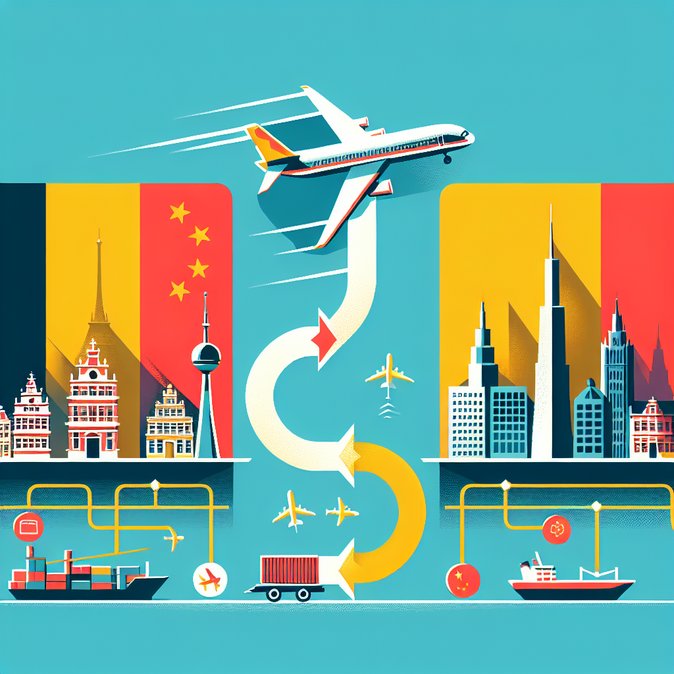
Air China’s inaugural Flight CA861 touched down at Brussels Airport (BRU) this morning, marking the launch of the carrier’s first non-stop passenger service between Beijing-Capital (PEK) and the Belgian capital. The new route will operate four times per week with Boeing 787-9 Dreamliners configured for business and economy cabins, adding more than 900 weekly seats in each direction. For Belgian companies, the service closes a long-recognised gap in connectivity with North-East Asia.
![Air China launches first direct Beijing–Brussels flights, deepening China-Belgium travel corridor]()
Whether you’re a Belgian executive heading to Beijing or a Chinese traveller planning meetings in Brussels, VisaHQ’s online platform can smooth the process of securing any required paperwork. Its Belgium portal (https://www.visahq.com/belgium/) provides real-time guidance on Chinese visas for EU nationals and Schengen or other permits for visitors, letting passengers sort documentation swiftly and avoid last-minute surprises.
Until now, most itineraries between Beijing and Brussels required transfers in Frankfurt, Paris or the Gulf, adding three to six hours to total journey times. Direct flights cut the trip to just over ten hours, enabling same-day connections to regional airports such as Antwerp and Liège and giving exporters a faster belly-cargo option for pharmaceuticals, high-tech components and perishables. Brussels Airport Company estimates that each long-haul route generates €70 million annually for the local economy once supply-chain and tourism multipliers are factored in. The timing also dovetails with China’s decision to extend its 15-day visa-free scheme for Belgian short-term business travellers through 2027. Travel-management firms say demand is already strong for April and May, driven by long-postponed sales calls and the spring Canton Fair. Air China vice-president Zhang Xin told reporters that forward bookings are “comfortably above 80 percent load factor” and hinted at a possible fifth weekly frequency from the winter timetable if demand holds. From a global-mobility perspective, the route simplifies rotation planning for multinationals that base regional managers in Brussels because of EU institutions. Employee-assignment specialists note that the new nonstop reduces duty-of-care risk by eliminating complex transfers and provides an additional carrier choice alongside Hainan Airlines’ existing Shenzhen-Brussels service. Travellers entering Belgium on the flight will still be subject to Schengen Entry/Exit System (EES) biometric checks now being piloted at Zaventem, so companies should allocate extra time on arrival during the first weeks of operation. Air China joins 22 other long-haul airlines at BRU and becomes the second mainland Chinese airline to serve Belgium directly. Aviation analysts view the launch as a sign that Brussels is regaining hub relevance lost during the pandemic years and expect other Asian carriers to follow as Europe–Asia traffic normalises.

Whether you’re a Belgian executive heading to Beijing or a Chinese traveller planning meetings in Brussels, VisaHQ’s online platform can smooth the process of securing any required paperwork. Its Belgium portal (https://www.visahq.com/belgium/) provides real-time guidance on Chinese visas for EU nationals and Schengen or other permits for visitors, letting passengers sort documentation swiftly and avoid last-minute surprises.
Until now, most itineraries between Beijing and Brussels required transfers in Frankfurt, Paris or the Gulf, adding three to six hours to total journey times. Direct flights cut the trip to just over ten hours, enabling same-day connections to regional airports such as Antwerp and Liège and giving exporters a faster belly-cargo option for pharmaceuticals, high-tech components and perishables. Brussels Airport Company estimates that each long-haul route generates €70 million annually for the local economy once supply-chain and tourism multipliers are factored in. The timing also dovetails with China’s decision to extend its 15-day visa-free scheme for Belgian short-term business travellers through 2027. Travel-management firms say demand is already strong for April and May, driven by long-postponed sales calls and the spring Canton Fair. Air China vice-president Zhang Xin told reporters that forward bookings are “comfortably above 80 percent load factor” and hinted at a possible fifth weekly frequency from the winter timetable if demand holds. From a global-mobility perspective, the route simplifies rotation planning for multinationals that base regional managers in Brussels because of EU institutions. Employee-assignment specialists note that the new nonstop reduces duty-of-care risk by eliminating complex transfers and provides an additional carrier choice alongside Hainan Airlines’ existing Shenzhen-Brussels service. Travellers entering Belgium on the flight will still be subject to Schengen Entry/Exit System (EES) biometric checks now being piloted at Zaventem, so companies should allocate extra time on arrival during the first weeks of operation. Air China joins 22 other long-haul airlines at BRU and becomes the second mainland Chinese airline to serve Belgium directly. Aviation analysts view the launch as a sign that Brussels is regaining hub relevance lost during the pandemic years and expect other Asian carriers to follow as Europe–Asia traffic normalises.