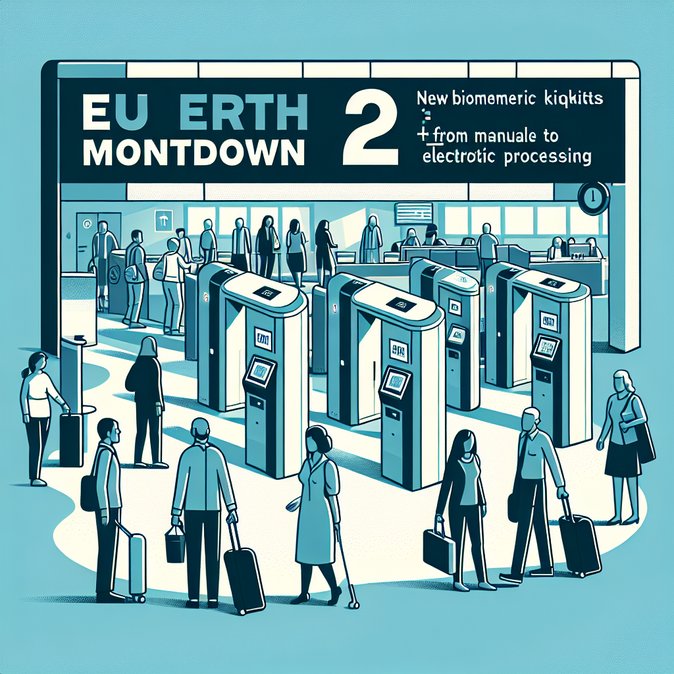
With exactly one month to go before the EU’s Entry/Exit System (EES) becomes mandatory on 10 April 2026, Austria’s two busiest international gateways—Vienna-Schwechat and Salzburg—have entered final commissioning of more than 200 self-service kiosks and e-gates designed to capture fingerprints and facial images of third-country nationals. Guidance notes published by the Interior Ministry on 15 March remind carriers that, from the go-live date, passport stamping for non-EU visitors will cease and airlines will be liable for fines if they present travellers whose biometric enrolment fails at the border.
![30-Day Countdown: Austrian Airports Accelerate Biometric Roll-out Ahead of EU Entry/Exit System Launch]()
To help organisations and individual travellers adapt to these stricter controls, VisaHQ offers end-to-end assistance—from obtaining Schengen visas that comply with the new cryptographic standards to clarifying biometric consent requirements. Its Austria-dedicated portal (https://www.visahq.com/austria/) features real-time checklists and digital application tools that let HR teams and passengers finalise paperwork before departure, minimising the chance of airport delays or carrier penalties.
Under the new regime, every arrival and departure by a non-EU, non-EFTA traveller will generate a digital record valid for three years or until the person’s 90-day allowance in any 180-day period is exhausted. Austria has opted for a "front-loaded" model in which biometric capture happens at airline check-in or bag-drop, followed by facial verification at automated border gates. Austrian Airlines, the Lufthansa Group’s technology pioneer, confirmed today that all Business Class and HON Circle passengers will have the option of a "document-free" path using stored enrolments created at the time of online check-in. The 30-day milestone is triggering practical changes for employers that rotate non-EU staff and contractors through Austria. Global mobility teams now need to collect biometric consent forms ahead of travel and warn employees that first-time enrolment could add 5-10 minutes to normal departure formalities. For inbound business travellers the bigger hurdle is ensuring that existing Schengen visa stickers were issued after 10 April 2025; older visas lack the cryptographic security elements required for seamless EES processing and may trigger manual, slower lanes. Airports Council International (Europe) estimates that EES will increase average processing times by 30 % during the initial bedding-in period, and Vienna has hired 150 temporary staff to assist passengers unfamiliar with the technology. The airport’s operator, Flughafen Wien AG, says the €6.5 million investment will pay off within three years through faster throughput and reduced staffing once the learning curve flattens. For companies moving talent across multiple EU hubs, Austria’s readiness is a bright spot. Frankfurt, Prague and Milan have signalled that full EES capacity may not be online until late summer, raising the risk of missed connections for itineraries mixing compliant and non-compliant airports. Travel managers should therefore map routings carefully, brief travellers on first-time enrolment requirements and build extra lead time into schedules until the system stabilises.

To help organisations and individual travellers adapt to these stricter controls, VisaHQ offers end-to-end assistance—from obtaining Schengen visas that comply with the new cryptographic standards to clarifying biometric consent requirements. Its Austria-dedicated portal (https://www.visahq.com/austria/) features real-time checklists and digital application tools that let HR teams and passengers finalise paperwork before departure, minimising the chance of airport delays or carrier penalties.
Under the new regime, every arrival and departure by a non-EU, non-EFTA traveller will generate a digital record valid for three years or until the person’s 90-day allowance in any 180-day period is exhausted. Austria has opted for a "front-loaded" model in which biometric capture happens at airline check-in or bag-drop, followed by facial verification at automated border gates. Austrian Airlines, the Lufthansa Group’s technology pioneer, confirmed today that all Business Class and HON Circle passengers will have the option of a "document-free" path using stored enrolments created at the time of online check-in. The 30-day milestone is triggering practical changes for employers that rotate non-EU staff and contractors through Austria. Global mobility teams now need to collect biometric consent forms ahead of travel and warn employees that first-time enrolment could add 5-10 minutes to normal departure formalities. For inbound business travellers the bigger hurdle is ensuring that existing Schengen visa stickers were issued after 10 April 2025; older visas lack the cryptographic security elements required for seamless EES processing and may trigger manual, slower lanes. Airports Council International (Europe) estimates that EES will increase average processing times by 30 % during the initial bedding-in period, and Vienna has hired 150 temporary staff to assist passengers unfamiliar with the technology. The airport’s operator, Flughafen Wien AG, says the €6.5 million investment will pay off within three years through faster throughput and reduced staffing once the learning curve flattens. For companies moving talent across multiple EU hubs, Austria’s readiness is a bright spot. Frankfurt, Prague and Milan have signalled that full EES capacity may not be online until late summer, raising the risk of missed connections for itineraries mixing compliant and non-compliant airports. Travel managers should therefore map routings carefully, brief travellers on first-time enrolment requirements and build extra lead time into schedules until the system stabilises.