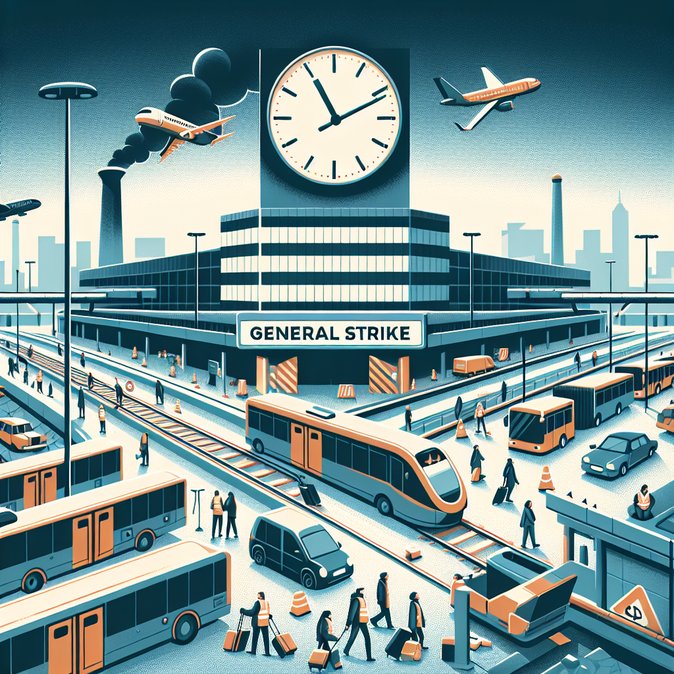
Belgium awoke on 12 March to the country’s first nationwide general strike of 2026, as the three main union confederations – FGTB/ABVV, CSC/ACV and CGSLB/ACLVB – walked out in protest at federal pension and wage-indexation reforms. From 00:00 local time the unions’ “day of action” shuttered key transport infrastructure, prompting Brussels Airport to take the unprecedented step of cancelling every outbound passenger flight. A NOTAM issued by air-traffic-control service Skeyes set the airport’s departure slots to zero, while inbound services were reduced to a trickle to keep runway occupancy and ground-handling needs to an absolute minimum. Brussels South Charleroi Airport followed suit, announcing a full 24-hour closure.
For companies with staff on the move, the impact was immediate. AirHelp estimates that more than 650 scheduled departures and arrivals were scrubbed, displacing roughly 95,000 travellers and creating an economic hit of €9-€12 million in direct costs and missed connections. Business-travel programmes were forced into real-time triage: duty-of-care teams scrambled to rebook staff via Amsterdam, Paris or Frankfurt, while global mobility managers advised assignees to defer non-essential trips entirely.
Although strike days are not uncommon in Belgium, the blanket shutdown of departing flights is rare and underscores the leverage airport-based unions now wield in multi-sector actions. Beyond aviation, StrikeTracker data show severe knock-on disruption across Belgian public transport. STIB/MIVB metros in Brussels ran a skeletal service; De Lijn buses and trams in Flanders reported staffing gaps of up to 60 percent; and TEC networks in Wallonia warned of “very limited” operations. Road users faced rolling tunnel closures as marchers converged on the European Quarter, forcing perimeter diversions and hour-long tailbacks on the E40 and R0 ring.
Many government offices, schools and municipal services closed or switched to minimum service, delaying residence-permit collections and other immigration formalities.
![Belgium’s 24-hour general strike grounds all flights at Brussels and Charleroi airports]()
For travellers who suddenly require visa extensions, replacements or other documentation tweaks, VisaHQ can provide a fast back-up. Through its Belgium portal (https://www.visahq.com/belgium/) the service offers live requirement checks, digital document uploads and courier filings, keeping mobility on track when consular counters are shut by industrial action.
The unions framed the strike as a warning shot against what they call the Arizona coalition’s “austerity in disguise.” Employer groups, by contrast, put the daily economic loss at €25 million and urged both government and unions to adopt compulsory minimum-service rules for critical infrastructure.
With additional sector-specific strikes already announced for later in March, multinational companies are revisiting contingency plans, including remote-work policies, extended per-diem allowances for stranded travellers and the use of courier visas where in-person consular appointments have been cancelled. Practically, travellers still in Belgium are urged to check airline apps before heading to the airport and to anticipate a slow restart on 13 March as crews and aircraft reposition. Global mobility teams should alert expatriates arriving this weekend that residence-registration deadlines may shift, and that postal delivery of biometric cards could be delayed by several days.
While the strike officially ends at midnight, its ripple effects will linger well into the weekend, making flexibility and proactive communication essential for business continuity.
For companies with staff on the move, the impact was immediate. AirHelp estimates that more than 650 scheduled departures and arrivals were scrubbed, displacing roughly 95,000 travellers and creating an economic hit of €9-€12 million in direct costs and missed connections. Business-travel programmes were forced into real-time triage: duty-of-care teams scrambled to rebook staff via Amsterdam, Paris or Frankfurt, while global mobility managers advised assignees to defer non-essential trips entirely.
Although strike days are not uncommon in Belgium, the blanket shutdown of departing flights is rare and underscores the leverage airport-based unions now wield in multi-sector actions. Beyond aviation, StrikeTracker data show severe knock-on disruption across Belgian public transport. STIB/MIVB metros in Brussels ran a skeletal service; De Lijn buses and trams in Flanders reported staffing gaps of up to 60 percent; and TEC networks in Wallonia warned of “very limited” operations. Road users faced rolling tunnel closures as marchers converged on the European Quarter, forcing perimeter diversions and hour-long tailbacks on the E40 and R0 ring.
Many government offices, schools and municipal services closed or switched to minimum service, delaying residence-permit collections and other immigration formalities.

For travellers who suddenly require visa extensions, replacements or other documentation tweaks, VisaHQ can provide a fast back-up. Through its Belgium portal (https://www.visahq.com/belgium/) the service offers live requirement checks, digital document uploads and courier filings, keeping mobility on track when consular counters are shut by industrial action.
The unions framed the strike as a warning shot against what they call the Arizona coalition’s “austerity in disguise.” Employer groups, by contrast, put the daily economic loss at €25 million and urged both government and unions to adopt compulsory minimum-service rules for critical infrastructure.
With additional sector-specific strikes already announced for later in March, multinational companies are revisiting contingency plans, including remote-work policies, extended per-diem allowances for stranded travellers and the use of courier visas where in-person consular appointments have been cancelled. Practically, travellers still in Belgium are urged to check airline apps before heading to the airport and to anticipate a slow restart on 13 March as crews and aircraft reposition. Global mobility teams should alert expatriates arriving this weekend that residence-registration deadlines may shift, and that postal delivery of biometric cards could be delayed by several days.
While the strike officially ends at midnight, its ripple effects will linger well into the weekend, making flexibility and proactive communication essential for business continuity.