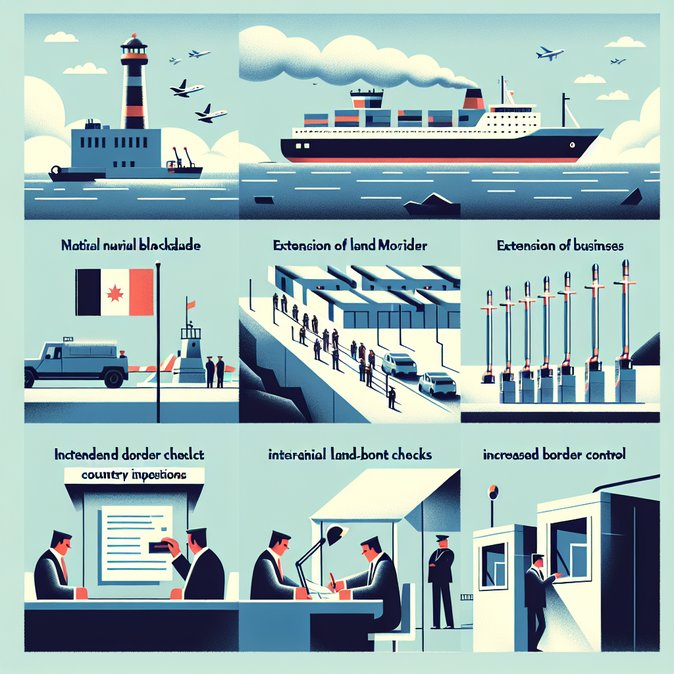
Advocacy network Migreurop’s latest press review, published 10 March, spotlights a draft Italian immigration bill that would authorise six-month “security blockades” of territorial waters—including vessel confiscation and heavy fines for non-compliance. Approved by cabinet on 11 February, the measure also proposes expedited expulsions, stricter family-reunification rules and reduced safeguards for unaccompanied minors, anticipating tougher EU asylum rules due later this year. The review places Italy’s initiative in a broader European context: since 2024, ten Schengen members—including Italy—have re-introduced internal border controls citing security threats and irregular migration. Germany last month prolonged its land-border checks with Austria, Denmark and others until September 2026, while France maintains de-facto controls dating back to 2015.
![NGO Report Highlights Italy’s Draft ‘Naval Blockade’ Bill as Schengen States Extend Internal Border Checks]()
For those trying to stay ahead of these shifting entry requirements, VisaHQ can simplify the process: its dedicated Italy page (https://www.visahq.com/italy/) provides real-time visa guidance, appointment scheduling, and document-check services, helping companies and their staff avoid surprises at reinforced checkpoints.
For multinationals, the convergence of maritime interdiction powers and land-border spot-checks means workers transiting between EU assignments face higher document scrutiny despite nominal free movement. Mobile project teams entering Italy by van from France, for instance, have reported hour-long waits and on-the-spot proof-of-accommodation requests. Companies should brief employees to carry employment contracts and A1 social-security certificates even on short hops. The proposed Italian law, if passed, could also impact corporate social-responsibility obligations: vessels chartered for offshore engineering projects might fall under the blockade provisions, incurring penalties if found rescuing migrants without prompt coordination with Italian authorities. Legal counsels are urging firms with Mediterranean shipping operations to review duty-of-care and SAR (search-and-rescue) protocols. Parliament is expected to open committee hearings after Easter; observers predict fierce debate over compliance with international maritime law and the UN Refugee Convention.
For those trying to stay ahead of these shifting entry requirements, VisaHQ can simplify the process: its dedicated Italy page (https://www.visahq.com/italy/) provides real-time visa guidance, appointment scheduling, and document-check services, helping companies and their staff avoid surprises at reinforced checkpoints.
For multinationals, the convergence of maritime interdiction powers and land-border spot-checks means workers transiting between EU assignments face higher document scrutiny despite nominal free movement. Mobile project teams entering Italy by van from France, for instance, have reported hour-long waits and on-the-spot proof-of-accommodation requests. Companies should brief employees to carry employment contracts and A1 social-security certificates even on short hops. The proposed Italian law, if passed, could also impact corporate social-responsibility obligations: vessels chartered for offshore engineering projects might fall under the blockade provisions, incurring penalties if found rescuing migrants without prompt coordination with Italian authorities. Legal counsels are urging firms with Mediterranean shipping operations to review duty-of-care and SAR (search-and-rescue) protocols. Parliament is expected to open committee hearings after Easter; observers predict fierce debate over compliance with international maritime law and the UN Refugee Convention.