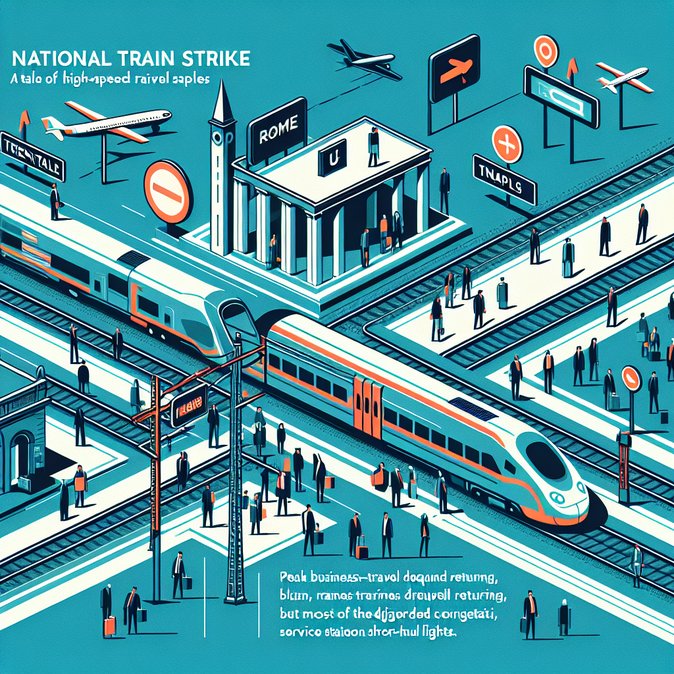
Italy’s private high-speed operator Italo has confirmed that all on-board and ground staff will walk out from 09:01 to 16:59 on Wednesday, 11 March, after talks with the UILT-UIL transport union broke down over pay progression, roster fatigue and safety staffing ratios. (wantedinrome.com)
Although Italian law obliges rail companies to guarantee services during the commuter peaks (06:00-09:00 and 18:00-21:00), much of the day’s premium Milan–Rome and Turin–Naples frequencies sit outside those windows. Corporate travellers who normally rely on the 2-hour, city-centre-to-city-centre link have been told to expect cancellations, truncated timetables and rolling delays that could spill into 12 March. Italo has published a list of “treni garantiti” and opened a free change/refund channel via its call-centre (060708) and app. (wantedinrome.com)
Whether you’re a delegate rushing to Milan Fashion Week or a business traveller re-routing via Florence, VisaHQ can remove at least one layer of complexity by expediting your Italian visa online, arranging invitation letters and overnight courier return of passports. Check the simple step-by-step tools at https://www.visahq.com/italy/ so you’re free to focus on back-up transport plans rather than paperwork.
![Nation-wide Italo high-speed rail strike on 11 March to squeeze Italy’s business corridors]()
Disruption will ripple beyond rail. Trenitalia’s rival Frecciarossa services are already showing 80-90 % seat load factors for 11 March, while Rome-Milan shuttle flights on ITA Airways and easyJet saw a 14 % price jump within two hours of the strike notice, according to online fare trackers. Ground-transport associations warn that taxi ranks at Roma Termini and Milano Centrale could see queues of up to one hour as visitors scramble for alternatives.
For mobility managers the strike collides awkwardly with Milan Fashion Week’s closing set-up and Rome’s European Space Conference, both heavy on time-sensitive delegate movements. Companies with assignment kick-offs this week are re-routing assignees through Bologna or Florence and booking hotel day-rooms near Linate to reduce same-day transfer risk.
The Ministry of Transport’s strike calendar shows no further national rail actions this month, but unions have threatened “escalating measures” if contract talks do not restart by 20 March. Employers should therefore keep contingency plans on standby through Easter.
Although Italian law obliges rail companies to guarantee services during the commuter peaks (06:00-09:00 and 18:00-21:00), much of the day’s premium Milan–Rome and Turin–Naples frequencies sit outside those windows. Corporate travellers who normally rely on the 2-hour, city-centre-to-city-centre link have been told to expect cancellations, truncated timetables and rolling delays that could spill into 12 March. Italo has published a list of “treni garantiti” and opened a free change/refund channel via its call-centre (060708) and app. (wantedinrome.com)
Whether you’re a delegate rushing to Milan Fashion Week or a business traveller re-routing via Florence, VisaHQ can remove at least one layer of complexity by expediting your Italian visa online, arranging invitation letters and overnight courier return of passports. Check the simple step-by-step tools at https://www.visahq.com/italy/ so you’re free to focus on back-up transport plans rather than paperwork.

Disruption will ripple beyond rail. Trenitalia’s rival Frecciarossa services are already showing 80-90 % seat load factors for 11 March, while Rome-Milan shuttle flights on ITA Airways and easyJet saw a 14 % price jump within two hours of the strike notice, according to online fare trackers. Ground-transport associations warn that taxi ranks at Roma Termini and Milano Centrale could see queues of up to one hour as visitors scramble for alternatives.
For mobility managers the strike collides awkwardly with Milan Fashion Week’s closing set-up and Rome’s European Space Conference, both heavy on time-sensitive delegate movements. Companies with assignment kick-offs this week are re-routing assignees through Bologna or Florence and booking hotel day-rooms near Linate to reduce same-day transfer risk.
The Ministry of Transport’s strike calendar shows no further national rail actions this month, but unions have threatened “escalating measures” if contract talks do not restart by 20 March. Employers should therefore keep contingency plans on standby through Easter.