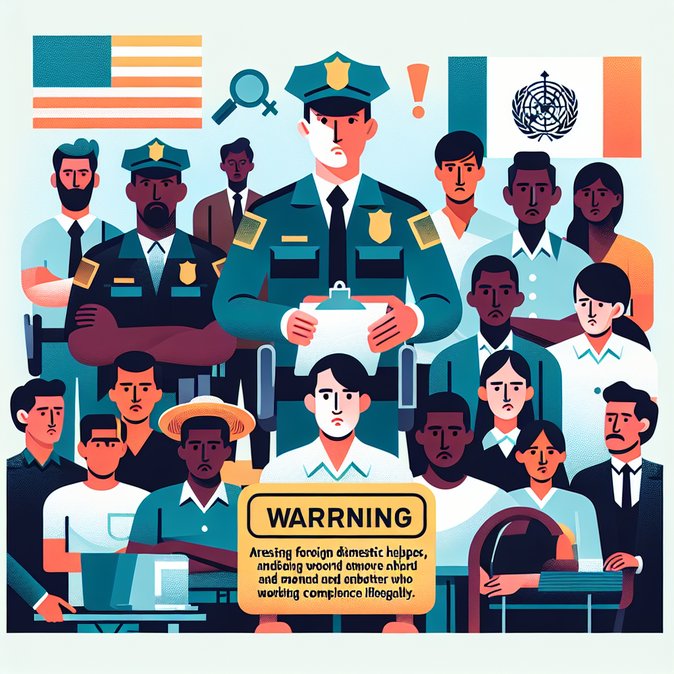
Hong Kong’s Immigration Department (ImmD) completed a three-day territory-wide operation codenamed “Swordfish” on March 10 that led to the arrest of 14 suspected illegal workers—almost all foreign domestic helpers—and six employers. Officers raided 19 sites ranging from restaurants and retail outlets to care homes and guesthouses, zeroing in on helpers who were moonlighting outside the households that sponsor their visas.
The crackdown is the first large-scale helper-focused sweep since stiffer employer penalties came into force in January, raising maximum fines to HK $500,000 and jail terms to 10 years for hiring someone “not lawfully employable.” Investigators say most of the arrested helpers were found performing massage, dish-washing and other commercial tasks that fall outside the strictly defined “domestic duties” permitted under Hong Kong’s standard helper contract.
More than 340,000 foreign domestic helpers—primarily from the Philippines and Indonesia—live and work in Hong Kong. Mobility consultants warn that the city’s tight labour market is pushing some employers to “borrow” helpers for part-time shifts, unaware that both parties risk prosecution. “With the new penalty grid, the financial and reputational exposure for companies is far higher,” notes Grace Wong, Asia immigration lead at a Fortune 500 manufacturer.
![Hong Kong Immigration Raid Nets 20 for Foreign-Helper Work Breaches]()
For global mobility managers the message is clear: do regular right-to-work checks, keep auditable records and remind assignees that helpers may not lawfully work outside their registered address—even for charity events or business guests. The ImmD has also stepped up trafficking-in-persons (TIP) screening during raids, a move welcomed by NGOs monitoring forced-labour risks in supply chains.
Visa and work-authorisation rules can be daunting even for seasoned HR teams. VisaHQ (https://www.visahq.com/hong-kong/) offers on-the-ground expertise in Hong Kong, helping companies verify right-to-work status, obtain the correct permits and stay updated on policy shifts like the tougher penalties highlighted above.
Employers who discover they have inadvertently breached the rules are advised to seek legal counsel immediately and, where appropriate, make a voluntary disclosure to the ImmD. Anonymous reports of suspected illegal employment can be filed via the department’s 24-hour hotline or online portal.
The crackdown is the first large-scale helper-focused sweep since stiffer employer penalties came into force in January, raising maximum fines to HK $500,000 and jail terms to 10 years for hiring someone “not lawfully employable.” Investigators say most of the arrested helpers were found performing massage, dish-washing and other commercial tasks that fall outside the strictly defined “domestic duties” permitted under Hong Kong’s standard helper contract.
More than 340,000 foreign domestic helpers—primarily from the Philippines and Indonesia—live and work in Hong Kong. Mobility consultants warn that the city’s tight labour market is pushing some employers to “borrow” helpers for part-time shifts, unaware that both parties risk prosecution. “With the new penalty grid, the financial and reputational exposure for companies is far higher,” notes Grace Wong, Asia immigration lead at a Fortune 500 manufacturer.

For global mobility managers the message is clear: do regular right-to-work checks, keep auditable records and remind assignees that helpers may not lawfully work outside their registered address—even for charity events or business guests. The ImmD has also stepped up trafficking-in-persons (TIP) screening during raids, a move welcomed by NGOs monitoring forced-labour risks in supply chains.
Visa and work-authorisation rules can be daunting even for seasoned HR teams. VisaHQ (https://www.visahq.com/hong-kong/) offers on-the-ground expertise in Hong Kong, helping companies verify right-to-work status, obtain the correct permits and stay updated on policy shifts like the tougher penalties highlighted above.
Employers who discover they have inadvertently breached the rules are advised to seek legal counsel immediately and, where appropriate, make a voluntary disclosure to the ImmD. Anonymous reports of suspected illegal employment can be filed via the department’s 24-hour hotline or online portal.