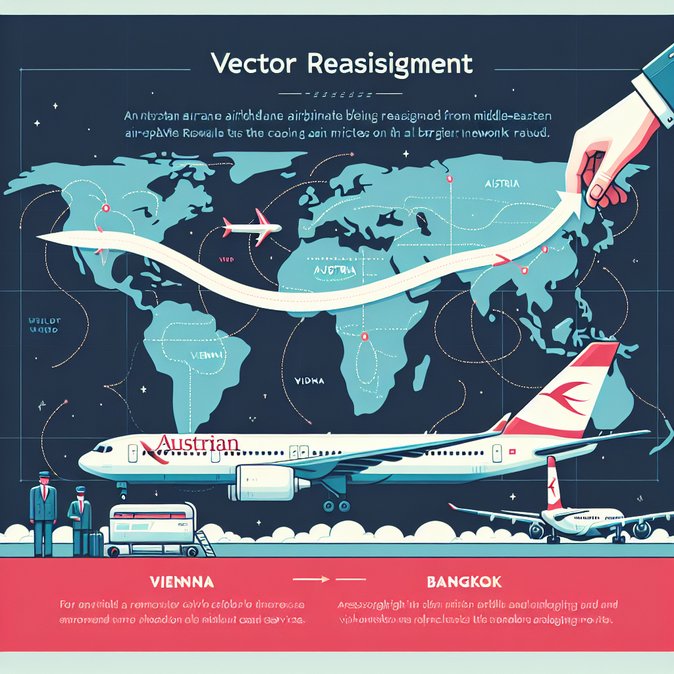
The Lufthansa Group issued an operational bulletin showing that Austrian Airlines is bolstering its Vienna–Bangkok schedule with a string of ad-hoc flights beginning 9 March 2026 (OS 1108 BKK-VIE 05:00-10:45). Additional rotations follow on 10, 12, 13 and 15 March, using wide-body 777-200ER aircraft originally rostered for suspended Tel Aviv and Tehran services. The carrier says the move helps reposition crews and equipment stranded by Middle-East air-space closures while offering relief to leisure operators and corporates shifting conferences from the Gulf to Thailand. Forward bookings on the Bangkok route are up 28 % week-on-week, according to GDS data, and average fares in premium economy have risen 14 %.
![Austrian Airlines adds extra Vienna–Bangkok rotations from 9 March as Middle-East reroutes squeeze capacity]()
For travellers suddenly re-routing or booking onto these extra Vienna–Bangkok services, VisaHQ can streamline the visa side of the equation. Its Austrian portal (https://www.visahq.com/austria/) lets passengers, travel managers and crew verify Thai entry rules, obtain e-visas for multiple destinations and track approvals in real time—minimising disruption while timetables remain in flux.
Travel managers should brace for knock-on effects: displaced passengers from cancelled Middle-East flights are being rebooked onto Asian services, tightening seat inventory. Companies with marine and energy rotations through Vienna may need to authorise higher-fare buckets or alternative routings via Istanbul or Doha (once reopened). Meanwhile, Lufthansa and Swiss are adding Singapore and Cape Town extras, illustrating a broader strategy of redeploying capacity away from conflict zones. Should the Gulf closure continue, analysts expect Vienna Airport’s Asia share of long-haul movements to exceed 40 % for the first time since 2019. Austrian Airlines cautions that further adjustments are possible and urges passengers to keep contact details updated for automatic rebooking notifications.

For travellers suddenly re-routing or booking onto these extra Vienna–Bangkok services, VisaHQ can streamline the visa side of the equation. Its Austrian portal (https://www.visahq.com/austria/) lets passengers, travel managers and crew verify Thai entry rules, obtain e-visas for multiple destinations and track approvals in real time—minimising disruption while timetables remain in flux.
Travel managers should brace for knock-on effects: displaced passengers from cancelled Middle-East flights are being rebooked onto Asian services, tightening seat inventory. Companies with marine and energy rotations through Vienna may need to authorise higher-fare buckets or alternative routings via Istanbul or Doha (once reopened). Meanwhile, Lufthansa and Swiss are adding Singapore and Cape Town extras, illustrating a broader strategy of redeploying capacity away from conflict zones. Should the Gulf closure continue, analysts expect Vienna Airport’s Asia share of long-haul movements to exceed 40 % for the first time since 2019. Austrian Airlines cautions that further adjustments are possible and urges passengers to keep contact details updated for automatic rebooking notifications.