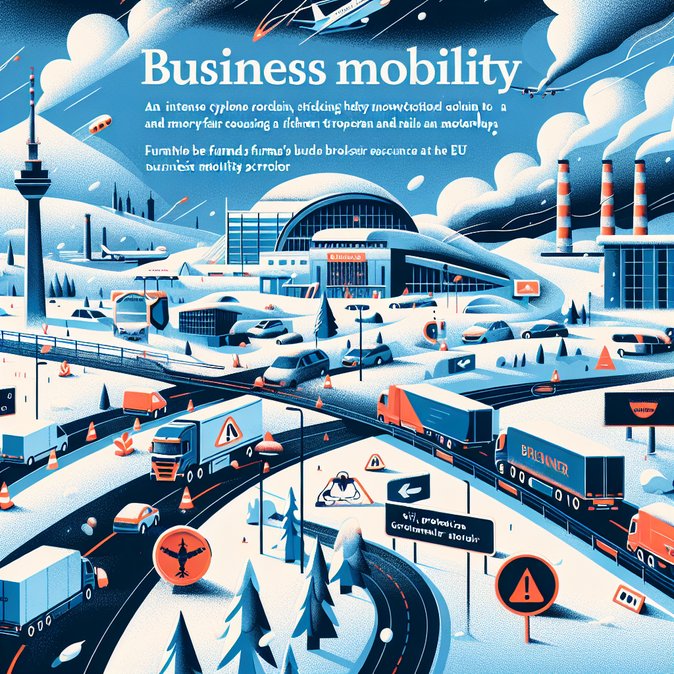
A vigorous cyclone of polar origin swept across the central Mediterranean on 8 March 2026, pushing an unusually cold airmass over the Italian peninsula and triggering snowfall at elevations that rarely see flakes in early spring. Meteo Giornale meteorologist Federico De Michelis warned that the system, which originated days earlier near the Balearic Islands, would plunge temperatures well below seasonal norms and generate strong south-easterly winds that carried Saharan dust as far north as the North Sea. By mid-afternoon on Sunday, regional civil-protection offices in Lombardy, Emilia-Romagna and Tuscany had activated orange-level weather alerts after reports of snow settling at 300 metres in the Apennines and sleet mixing with rain on sections of the A1 motorway near Modena.
![Polar Cyclone Brings Low-Level Snow to Italy, Disrupting Air and Road Travel]()
Amid such fluid travel conditions, VisaHQ can streamline at least one critical variable: paperwork. Through its online platform (https://www.visahq.com/italy/), the company expedites Italian visas and other travel documents, tracks regulatory shifts like the forthcoming Entry/Exit System, and pushes real-time status alerts—giving business-travel coordinators vital lead time when sudden weather forces last-minute rerouting.
The Italian National Civil Aviation Authority (ENAC) said airlines operating into Milan Linate, Bologna and Florence had requested additional fuel reserves or tactical diversions, while ground-handling companies raced to reposition de-icing equipment that is normally mothballed in March. Railway infrastructure manager RFI imposed precautionary 30 km/h speed restrictions through the Giovi and Porrettana passes, lengthening Intercity journey times on the critical Milan-Rome corridor by up to 45 minutes. Business-travel managers faced an immediate cascade of schedule changes. A survey by the Italian Business Travel Association (AITMM) indicated that 61 % of member companies postponed Monday-morning client meetings or switched them to video, citing uncertainty about early-week mobility. Logistics operators were equally hard-hit: FIAP, Italy’s federation of road hauliers, reported 8-kilometre queues of north-bound trucks at the Vipiteno Brenner gate after authorities temporarily limited the passage of heavy goods vehicles over 7.5 tonnes to prevent jack-knifing on icy surfaces. While forecasters expect the polar trough to exit into the Balkans late Monday, the episode underscores the growing volatility that carriers and corporates must factor into spring travel plans. ENAC reiterated that the upcoming Entry/Exit System (EES) biometric checks, planned for October, will make punctual arrivals at border posts even more critical; travellers arriving late because of weather-related diversions risk longer queues as Italy transitions to the new regime. Companies with time-sensitive assignments are therefore advised to build additional lay-over buffers and monitor not only strike calendars but also rapid-onset weather anomalies that now routinely upend European mobility.

Amid such fluid travel conditions, VisaHQ can streamline at least one critical variable: paperwork. Through its online platform (https://www.visahq.com/italy/), the company expedites Italian visas and other travel documents, tracks regulatory shifts like the forthcoming Entry/Exit System, and pushes real-time status alerts—giving business-travel coordinators vital lead time when sudden weather forces last-minute rerouting.
The Italian National Civil Aviation Authority (ENAC) said airlines operating into Milan Linate, Bologna and Florence had requested additional fuel reserves or tactical diversions, while ground-handling companies raced to reposition de-icing equipment that is normally mothballed in March. Railway infrastructure manager RFI imposed precautionary 30 km/h speed restrictions through the Giovi and Porrettana passes, lengthening Intercity journey times on the critical Milan-Rome corridor by up to 45 minutes. Business-travel managers faced an immediate cascade of schedule changes. A survey by the Italian Business Travel Association (AITMM) indicated that 61 % of member companies postponed Monday-morning client meetings or switched them to video, citing uncertainty about early-week mobility. Logistics operators were equally hard-hit: FIAP, Italy’s federation of road hauliers, reported 8-kilometre queues of north-bound trucks at the Vipiteno Brenner gate after authorities temporarily limited the passage of heavy goods vehicles over 7.5 tonnes to prevent jack-knifing on icy surfaces. While forecasters expect the polar trough to exit into the Balkans late Monday, the episode underscores the growing volatility that carriers and corporates must factor into spring travel plans. ENAC reiterated that the upcoming Entry/Exit System (EES) biometric checks, planned for October, will make punctual arrivals at border posts even more critical; travellers arriving late because of weather-related diversions risk longer queues as Italy transitions to the new regime. Companies with time-sensitive assignments are therefore advised to build additional lay-over buffers and monitor not only strike calendars but also rapid-onset weather anomalies that now routinely upend European mobility.