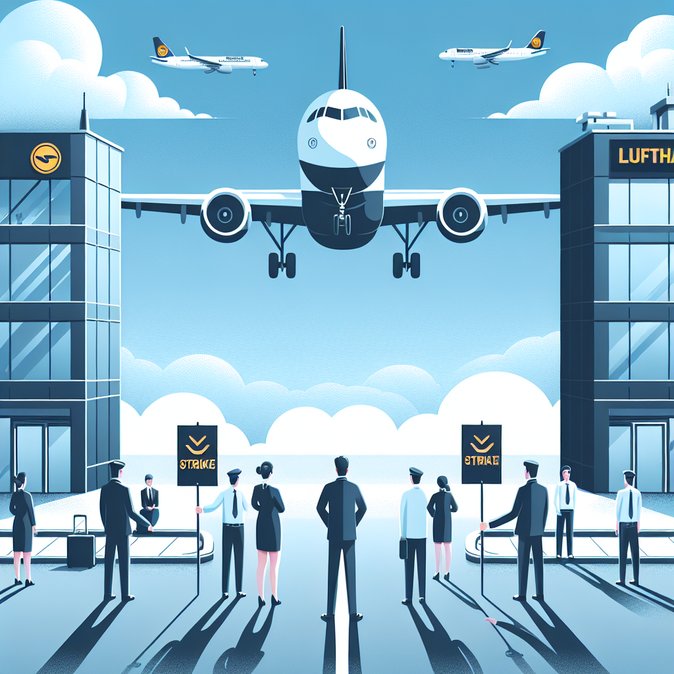
Shares in Deutsche Lufthansa AG slid to €8.21 in early Frankfurt trading on 8 March 2026 after financial portal Börse-Global flagged ‘intensifying labour disputes’ at two subsidiaries and ongoing rerouting costs linked to the Iran war. Although the carrier posted record 2025 revenues of €39.6 billion last week, analysts warn that looming pilot strikes at Eurowings and Lufthansa CityLine could ground up to 30 % of intra-European capacity if ballots translate into industrial action later this month.
At Eurowings, pilots are voting until 16 March on strike authorisation after negotiations over a pension framework collapsed. CityLine’s situation is even more acute: 99 % of cockpit crew have already endorsed strike action, demanding 3.3 % annual pay rises back-dated to 2024. Any stoppage would choke critical feeder traffic into Frankfurt and Munich hubs—precisely the flights global mobility managers rely on for smooth long-haul connections.
Compounding the labour uncertainty, Lufthansa is still re-routing Asian and African services to avoid Iranian, Iraqi and parts of UAE airspace. Detours of up to 90 minutes have inflated fuel burn and triggered secondary delays. Direct flights to Tel Aviv, Tehran and Beirut remain suspended through at least 8 March, prompting corporate duty-of-care teams to re-book travellers via Athens, Istanbul or Rome.
![Lufthansa Confronts Dual Strike Threats and Middle-East Detours, Undermining Network Stability]()
Amid such abrupt itinerary changes, travellers may find themselves transiting unexpected countries at short notice—sometimes without the requisite paperwork. VisaHQ can step in here: through its dedicated Germany portal (https://www.visahq.com/germany/), the service can obtain Schengen and third-country transit visas quickly, track multiple applications for corporate travel departments, and generally smooth the documentation headaches that arise when routes are redrawn overnight.
For multinationals with German headquarters the stakes are high. A two-day Eurowings strike last month pushed re-routing costs for some companies above €200,000, according to TMC BCD Travel. Organisations should therefore build contingencies into March travel plans: flexible fares, dual-approved routings via Amsterdam or Zurich, and rail connections as back-ups for intra-Germany hops.
From a policy perspective, the disputes highlight the fragile equilibrium between labour rights and Germany’s bid to remain a premium global hub. Federal Transport Minister Jens Spahn called on both sides to ‘find a swift compromise’ but has ruled out compulsory arbitration for now. Investors, meanwhile, watch for clarity at Lufthansa’s AGM on 12 May.
At Eurowings, pilots are voting until 16 March on strike authorisation after negotiations over a pension framework collapsed. CityLine’s situation is even more acute: 99 % of cockpit crew have already endorsed strike action, demanding 3.3 % annual pay rises back-dated to 2024. Any stoppage would choke critical feeder traffic into Frankfurt and Munich hubs—precisely the flights global mobility managers rely on for smooth long-haul connections.
Compounding the labour uncertainty, Lufthansa is still re-routing Asian and African services to avoid Iranian, Iraqi and parts of UAE airspace. Detours of up to 90 minutes have inflated fuel burn and triggered secondary delays. Direct flights to Tel Aviv, Tehran and Beirut remain suspended through at least 8 March, prompting corporate duty-of-care teams to re-book travellers via Athens, Istanbul or Rome.
Amid such abrupt itinerary changes, travellers may find themselves transiting unexpected countries at short notice—sometimes without the requisite paperwork. VisaHQ can step in here: through its dedicated Germany portal (https://www.visahq.com/germany/), the service can obtain Schengen and third-country transit visas quickly, track multiple applications for corporate travel departments, and generally smooth the documentation headaches that arise when routes are redrawn overnight.
For multinationals with German headquarters the stakes are high. A two-day Eurowings strike last month pushed re-routing costs for some companies above €200,000, according to TMC BCD Travel. Organisations should therefore build contingencies into March travel plans: flexible fares, dual-approved routings via Amsterdam or Zurich, and rail connections as back-ups for intra-Germany hops.
From a policy perspective, the disputes highlight the fragile equilibrium between labour rights and Germany’s bid to remain a premium global hub. Federal Transport Minister Jens Spahn called on both sides to ‘find a swift compromise’ but has ruled out compulsory arbitration for now. Investors, meanwhile, watch for clarity at Lufthansa’s AGM on 12 May.