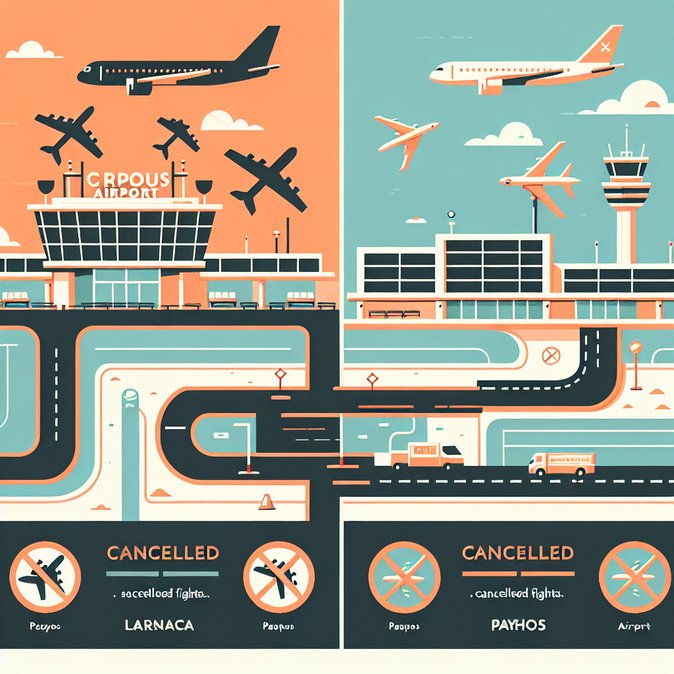
Cyprus’s two international gateways offered travellers a study in contrasts on Sunday 8 March. Hermes Airports, the island’s operator, confirmed that Larnaca International Airport scrubbed 39 flights—21 arrivals and 18 departures—after airlines pulled services to Israel, Lebanon, Qatar and the United Arab Emirates amid the second week of the Iran war.
Paphos Airport, whose Sunday schedule is dominated by UK and continental European leisure routes, ran a full programme without disruption. The split continues a pattern seen all week: carriers more exposed to Middle Eastern connections are consolidating at Paphos, while risk-assessing each Larnaca rotation on a rolling basis.
Travel-management companies (TMCs) are now advising clients to use Paphos as the default entry point for non-essential travel and to confirm Larnaca departures no earlier than 12 hours before scheduled take-off. Some corporates have introduced ‘dynamic fly lists’, approving Larnaca only once an airline re-issues an operational notice.
![Larnaca Cancels 39 Middle-East Flights While Paphos Operates Normally]()
Travellers caught in the uncertainty should also review their documentation: VisaHQ’s Cyprus portal (https://www.visahq.com/cyprus/) can fast-track visa applications, provide up-to-date entry requirements and offer emergency courier services, reducing one more variable when itineraries are already in flux.
The cancellations also complicate cargo: forwarders say perishables exports routed through Larnaca—especially halloumi and early-season citrus—face delays of up to 48 hours and higher rates as space tightens on the few flights still operating.
Hermes has published real-time dashboards for both airports, but acknowledges that the window between a flight turning green and turning red “can now be measured in minutes”, leaving little room for same-day contingency planning.
Paphos Airport, whose Sunday schedule is dominated by UK and continental European leisure routes, ran a full programme without disruption. The split continues a pattern seen all week: carriers more exposed to Middle Eastern connections are consolidating at Paphos, while risk-assessing each Larnaca rotation on a rolling basis.
Travel-management companies (TMCs) are now advising clients to use Paphos as the default entry point for non-essential travel and to confirm Larnaca departures no earlier than 12 hours before scheduled take-off. Some corporates have introduced ‘dynamic fly lists’, approving Larnaca only once an airline re-issues an operational notice.

Travellers caught in the uncertainty should also review their documentation: VisaHQ’s Cyprus portal (https://www.visahq.com/cyprus/) can fast-track visa applications, provide up-to-date entry requirements and offer emergency courier services, reducing one more variable when itineraries are already in flux.
The cancellations also complicate cargo: forwarders say perishables exports routed through Larnaca—especially halloumi and early-season citrus—face delays of up to 48 hours and higher rates as space tightens on the few flights still operating.
Hermes has published real-time dashboards for both airports, but acknowledges that the window between a flight turning green and turning red “can now be measured in minutes”, leaving little room for same-day contingency planning.