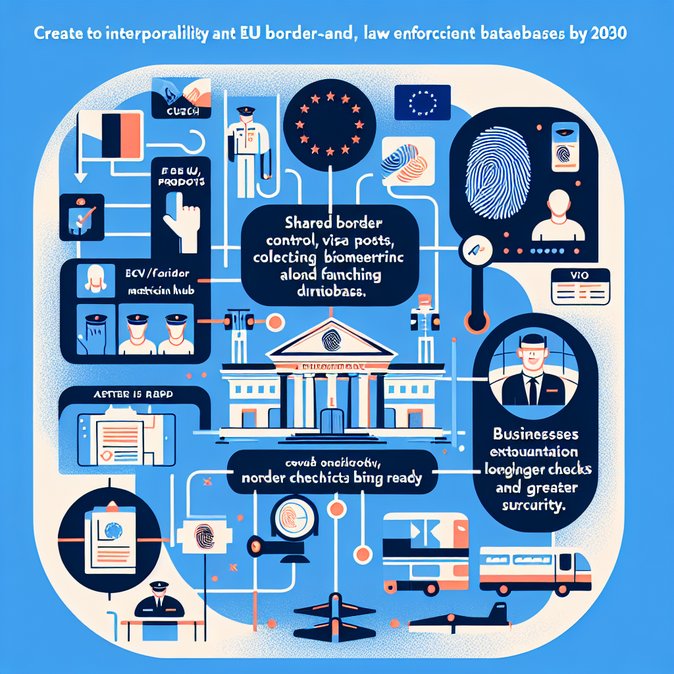
The European Union took a decisive step toward fully biometric management of its external borders on 7 March 2026 when the EU-LISA agency released the long-awaited “Interoperability Roadmap 2026-2030.” The strategy describes how the Schengen Information System (SIS II), Eurodac, the Visa Information System (VIS), the new Entry/Exit System (EES) and the European Criminal Records Information System for Third-Country Nationals (ECRIS-TCN) will be fused through a shared Biometric Matching Service and Common Identity Repository. For Czechia, the roadmap means that every short-stay visa-holder—and, once ETIAS launches later this year, every visa-exempt traveller—will have fingerprints and a facial template captured at the first crossing of an EU external border. Border officers at Václav Havel Airport Prague and the country’s road and rail frontier points will query a single biometric “super-database” rather than a patchwork of national and EU systems. The Justice and Home Affairs Council is asking member states to complete national connectivity tests by October; the Czech Interior Ministry has already earmarked CZK 620 million (€25 m) for hardware upgrades at Prague’s airport and three land crossings. Corporate mobility teams will need to brief travellers on longer first-entry processing times and on the data-protection ramifications of the new regime. Because the roadmap also enables cross-system “multiple-identity” detection, any inconsistencies between an assignee’s prior Schengen visa applications and their current residence-permit data could now trigger an alert. Czech companies that routinely move staff across the EU’s external border—particularly automotive firms with test facilities in Turkey and IT outsourcers rotating talent from India—should audit HR files for data accuracy before the EES goes live on 10 April.
![EU publishes 2030 ‘Interoperability Roadmap’, linking all Schengen border-control databases to facial-recognition super-system]()
To help organisations and individual travellers stay ahead of these checks, VisaHQ’s Czech Republic portal (https://www.visahq.com/czech-republic/) offers end-to-end support: real-time visa requirement updates, biometric appointment scheduling and pre-submission data reviews that flag inconsistencies before they can trigger alerts at the border.
A controversial annex to the roadmap proposes an Enhanced Border Security Partnership (EBSP) with the United States. To keep Czech citizens in the US Visa Waiver Program, Prague would have to grant automated, hit/no-hit access for US authorities to fingerprints and facial images stored in national police files. The government has said it will consult parliament before signing, but business organisations, including the Czech Chamber of Commerce, are already warning of potential privacy push-back that could slow adoption and complicate trans-Atlantic travel planning. In the medium term, the roadmap promises faster visa processing thanks to a fully digital “EU-VAP” portal that will route Schengen and long-stay visa applications to the appropriate member state. Czech consulates in India and the Philippines have volunteered as pilot posts from 2027. For large Czech employers, the shift should shorten lead times once initial teething problems subside—but only if corporate sponsors adapt internal workflows to a visa system that will verify applicant data against six separate EU databases in real time.

To help organisations and individual travellers stay ahead of these checks, VisaHQ’s Czech Republic portal (https://www.visahq.com/czech-republic/) offers end-to-end support: real-time visa requirement updates, biometric appointment scheduling and pre-submission data reviews that flag inconsistencies before they can trigger alerts at the border.
A controversial annex to the roadmap proposes an Enhanced Border Security Partnership (EBSP) with the United States. To keep Czech citizens in the US Visa Waiver Program, Prague would have to grant automated, hit/no-hit access for US authorities to fingerprints and facial images stored in national police files. The government has said it will consult parliament before signing, but business organisations, including the Czech Chamber of Commerce, are already warning of potential privacy push-back that could slow adoption and complicate trans-Atlantic travel planning. In the medium term, the roadmap promises faster visa processing thanks to a fully digital “EU-VAP” portal that will route Schengen and long-stay visa applications to the appropriate member state. Czech consulates in India and the Philippines have volunteered as pilot posts from 2027. For large Czech employers, the shift should shorten lead times once initial teething problems subside—but only if corporate sponsors adapt internal workflows to a visa system that will verify applicant data against six separate EU databases in real time.