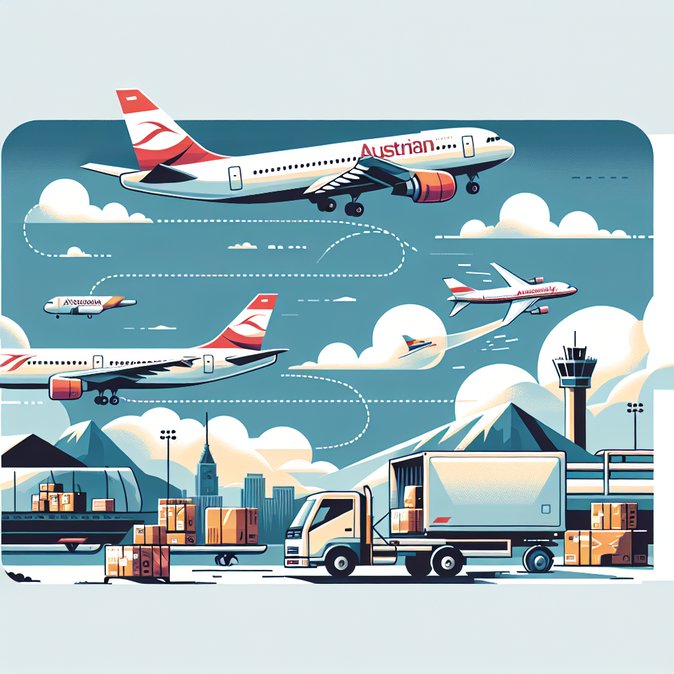
With key Middle-East corridors still closed after last week’s U.S.–Israeli strikes on Iran, Austrian Airlines (OS) has redeployed wide-body capacity to Thailand. A 6 March bulletin on the Lufthansa Group’s corporate portal confirmed four additional rotations between Vienna and Bangkok on 7, 9, 10 and 12 March, all operated by 777-200ER aircraft. The carrier said further frequencies are “under evaluation” for the second half of the month, depending on how long overflight bans for Iran, Iraq, Jordan and Israel remain in force.
For corporate travel managers the move provides much-needed lift on one of Asia’s busiest hub-to-hub markets just as demand spikes ahead of Songkran. OS is waiving re-issue fees for passengers re-routed off cancelled Tel Aviv, Beirut and Tehran services who are willing to travel via Bangkok onward to regional points such as Ho Chi Minh City, Kuala Lumpur or Sydney using Star Alliance partners. Cargo customers can also shift time-critical consignments—pharma, automotive spares, fashion samples—onto the Bangkok flights, although unit load device (ULD) allocations will be capped at five tonnes per sector to prioritise humanitarian relief.
![Austrian Airlines adds extra Vienna–Bangkok flights as Middle-East airspace remains restricted]()
Austrian Airlines estimates that the detours around Middle-East hot zones add 45–60 minutes to block time on services to Dubai, Doha and Muscat that are still operating. By contrast, Bangkok can be reached on a polar-easterly track that skirts Russian airspace—a routing Austria negotiated under a government-to-government exemption in February 2024. The airline is briefing crews daily on contingency alternates should geopolitical conditions deteriorate.
Travel arrangers seeking to keep pace with rapidly changing visa rules can lean on VisaHQ’s Austria portal (https://www.visahq.com/austria/) for real-time entry guidance and fast online applications. Whether travelers require a multiple-entry Thai visa, transit paperwork for onward journeys, or simply need status tracking in one dashboard, VisaHQ streamlines the process—an invaluable aid when flight plans shift overnight due to airspace closures.
Companies with expatriate staff in Southeast Asia should alert travellers that Thai immigration is strictly enforcing remaining proof-of-funds and onward-ticket rules now that visa-on-arrival volumes are surging. Mobility teams may also wish to monitor potential knock-on effects at Vienna Airport where security staff have warned of overtime limits if passenger peaks move from early-morning Middle-East banks to late-evening Asia departures.
For corporate travel managers the move provides much-needed lift on one of Asia’s busiest hub-to-hub markets just as demand spikes ahead of Songkran. OS is waiving re-issue fees for passengers re-routed off cancelled Tel Aviv, Beirut and Tehran services who are willing to travel via Bangkok onward to regional points such as Ho Chi Minh City, Kuala Lumpur or Sydney using Star Alliance partners. Cargo customers can also shift time-critical consignments—pharma, automotive spares, fashion samples—onto the Bangkok flights, although unit load device (ULD) allocations will be capped at five tonnes per sector to prioritise humanitarian relief.

Austrian Airlines estimates that the detours around Middle-East hot zones add 45–60 minutes to block time on services to Dubai, Doha and Muscat that are still operating. By contrast, Bangkok can be reached on a polar-easterly track that skirts Russian airspace—a routing Austria negotiated under a government-to-government exemption in February 2024. The airline is briefing crews daily on contingency alternates should geopolitical conditions deteriorate.
Travel arrangers seeking to keep pace with rapidly changing visa rules can lean on VisaHQ’s Austria portal (https://www.visahq.com/austria/) for real-time entry guidance and fast online applications. Whether travelers require a multiple-entry Thai visa, transit paperwork for onward journeys, or simply need status tracking in one dashboard, VisaHQ streamlines the process—an invaluable aid when flight plans shift overnight due to airspace closures.
Companies with expatriate staff in Southeast Asia should alert travellers that Thai immigration is strictly enforcing remaining proof-of-funds and onward-ticket rules now that visa-on-arrival volumes are surging. Mobility teams may also wish to monitor potential knock-on effects at Vienna Airport where security staff have warned of overtime limits if passenger peaks move from early-morning Middle-East banks to late-evening Asia departures.