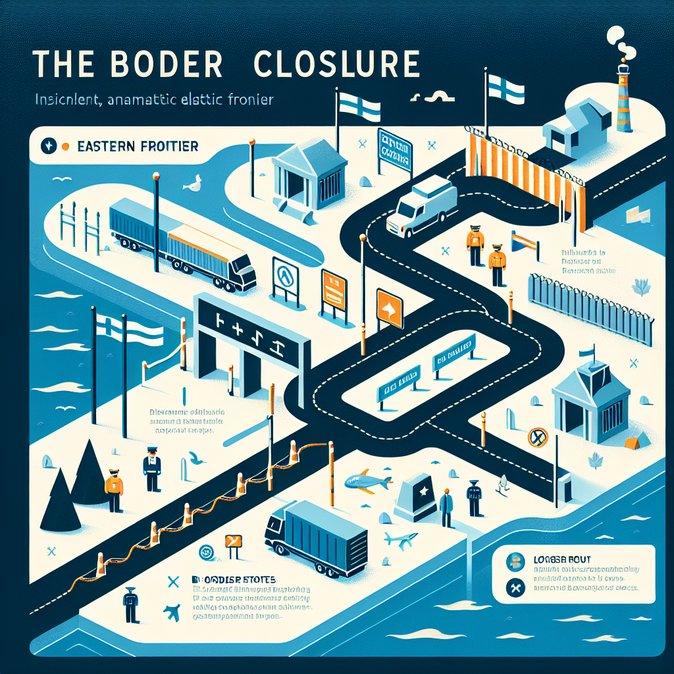
The government has begun giving redundancy notices to customs and border-guard employees posted at eastern crossing points, after officials conceded there is no realistic prospect of reopening the frontier with Russia in the medium term. Finland sealed all eight road and rail checkpoints in November 2023, blaming Moscow for funnelling asylum-seekers towards the Schengen border. What was initially presented as a temporary measure has now lasted 28 months and paralysed operations at Vaalimaa, Nuijamaa, Imatra and other busy stations that once processed up to 5 million travellers a year. Customs spokesperson Mika Hietanen told Russian news-wire **news.mail.ru** that staff have been seconded to ports and airports for more than a year, “but the workload imbalance is unsustainable, so posts that have no foreseeable purpose must be eliminated.”
![Finland starts laying-off border staff as Russia crossings stay shut]()
For individual travellers and corporate mobility planners seeking clarity on visa requirements amid these shifting routes, services like VisaHQ can streamline the process. Their Finland portal (https://www.visahq.com/finland/) offers up-to-date guidance on Schengen entry rules, Baltic transit visas, and alternative itineraries, helping passengers avoid costly mistakes while the eastern land borders remain shut.
The first wave of layoffs—expected to affect several dozen officers—will be followed by a broader restructuring this spring. The Border Guard estimates that only the cargo-rail terminal at Vainikkala and the secondary Niirala crossing in North Karelia will remain minimally staffed for humanitarian or diplomatic exceptions. For companies that relied on the 1 300-kilometre land route to move goods between the EU and northwest Russia, the announcement confirms that diversions via Estonia, Latvia or sea freight will remain the norm through 2026 and beyond. Finnish logistics firms say trucking costs on alternative itineraries have risen 20–35 percent since the closure, while just-in-time supply chains for timber, paper and seafood have been completely redesigned. Business-travel managers are being urged to update corporate travel policies that still list St Petersburg–Helsinki overland transfers as an approved option. “Any employee who tries to cross by road will simply be turned back,” warns risk-consultancy NorthCheck. “Ensure itineraries use air or sea links that do not transit Russian territory, and double-check Schengen visa validity when re-routing via the Baltics.”
For individual travellers and corporate mobility planners seeking clarity on visa requirements amid these shifting routes, services like VisaHQ can streamline the process. Their Finland portal (https://www.visahq.com/finland/) offers up-to-date guidance on Schengen entry rules, Baltic transit visas, and alternative itineraries, helping passengers avoid costly mistakes while the eastern land borders remain shut.
The first wave of layoffs—expected to affect several dozen officers—will be followed by a broader restructuring this spring. The Border Guard estimates that only the cargo-rail terminal at Vainikkala and the secondary Niirala crossing in North Karelia will remain minimally staffed for humanitarian or diplomatic exceptions. For companies that relied on the 1 300-kilometre land route to move goods between the EU and northwest Russia, the announcement confirms that diversions via Estonia, Latvia or sea freight will remain the norm through 2026 and beyond. Finnish logistics firms say trucking costs on alternative itineraries have risen 20–35 percent since the closure, while just-in-time supply chains for timber, paper and seafood have been completely redesigned. Business-travel managers are being urged to update corporate travel policies that still list St Petersburg–Helsinki overland transfers as an approved option. “Any employee who tries to cross by road will simply be turned back,” warns risk-consultancy NorthCheck. “Ensure itineraries use air or sea links that do not transit Russian territory, and double-check Schengen visa validity when re-routing via the Baltics.”