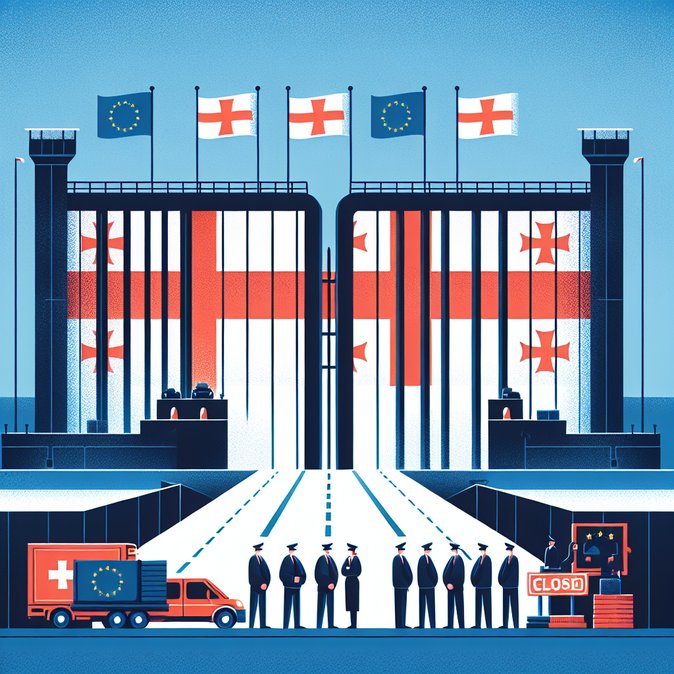
Announced in Brussels on 6 March, the EU’s decision to suspend visa-free access for Georgian diplomatic and service passport-holders marks the first time the Union has partially pulled the plug on a country within its post-Soviet visa-liberalisation scheme. Foreign-policy chief Kaja Kallas said the step was “a proportionate response to democratic back-sliding and intimidation of opposition voices.” The suspension enters force on 16 March 2026 and will be reviewed every six months. Although the measure targets fewer than 7,000 passports, it sends a strong signal about the conditionality that now attaches to Schengen-area access. From a mobility standpoint, Belgian companies that routinely host Georgian officials – for EU-funded projects or aviation safety exchanges, for example – will now have to budget extra processing time and costs for Type-C Schengen visas.
![EU suspends visa-free travel for Georgian diplomats after contentious reforms]()
For Belgian-based mobility teams seeking help with those new requirements, VisaHQ’s Brussels desk can streamline Type-C Schengen filings. Via its online portal (https://www.visahq.com/belgium/), travellers can lock in appointments, upload documents and track application status in real time, reducing HR follow-up and minimising delays that might otherwise derail time-sensitive assignments.
HR teams must also verify that family-member dependants travelling on service passports fall under the suspension. Belgian Foreign Minister Maxime Prévot welcomed the decision, calling it “evidence that values and visas go hand in hand.” Migration lawyers, however, note that retaliation by Tbilisi cannot be ruled out: Georgia could re-introduce e-visa requirements for EU technical experts or delay work-permit approvals, disrupting in-bound assignments. For globally mobile staff, the key takeaway is planning. Airline crews positioning through Brussels on short rotations and project managers attending EU-sponsored workshops must secure appointments at the Belgian consulate in Tbilisi immediately; lead times are already creeping above 20 days. Companies should also update invitation letters to emphasise the ‘essential’ nature of travel, a factor Belgian consular officers weigh when issuing limited-territorial visas if Schengen slots run out. Longer term, the case underscores the EU’s growing willingness to weaponise mobility privileges – a trend mobility policy teams will need to bake into risk matrices when projecting talent flows from politically sensitive markets.

For Belgian-based mobility teams seeking help with those new requirements, VisaHQ’s Brussels desk can streamline Type-C Schengen filings. Via its online portal (https://www.visahq.com/belgium/), travellers can lock in appointments, upload documents and track application status in real time, reducing HR follow-up and minimising delays that might otherwise derail time-sensitive assignments.
HR teams must also verify that family-member dependants travelling on service passports fall under the suspension. Belgian Foreign Minister Maxime Prévot welcomed the decision, calling it “evidence that values and visas go hand in hand.” Migration lawyers, however, note that retaliation by Tbilisi cannot be ruled out: Georgia could re-introduce e-visa requirements for EU technical experts or delay work-permit approvals, disrupting in-bound assignments. For globally mobile staff, the key takeaway is planning. Airline crews positioning through Brussels on short rotations and project managers attending EU-sponsored workshops must secure appointments at the Belgian consulate in Tbilisi immediately; lead times are already creeping above 20 days. Companies should also update invitation letters to emphasise the ‘essential’ nature of travel, a factor Belgian consular officers weigh when issuing limited-territorial visas if Schengen slots run out. Longer term, the case underscores the EU’s growing willingness to weaponise mobility privileges – a trend mobility policy teams will need to bake into risk matrices when projecting talent flows from politically sensitive markets.