
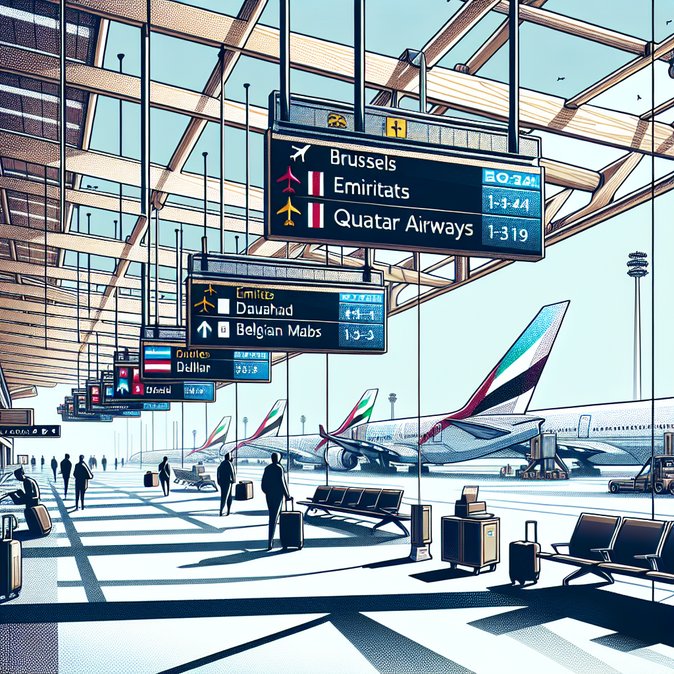
Business and leisure travellers flying in and out of Belgium continue to feel the ripple-effects of the rapidly escalating United-States/Israel–Iran confrontation. On 3 March 2026 Brussels Airport confirmed that it had **no passenger or cargo repatriation flights scheduled from the Gulf or Israel** and that ten departures and arrivals to Abu Dhabi, Dubai, Doha and Tel Aviv were cancelled. The decision follows widespread air-space closures by the United Arab Emirates, Qatar and several Gulf neighbours after Iranian missile strikes on Israeli targets on 1 March. Emirates, Etihad and Qatar Airways have begun limited repatriation services to London, Paris and Madrid, but have **excluded Brussels until regional flight corridors are judged safe**.
![Brussels Airport keeps Middle-East routes grounded as Iran conflict widens]()
For travellers now scrambling to reroute or extend their stays, VisaHQ’s Brussels portal (https://www.visahq.com/belgium/) can fast-track any unexpected visa or travel-document adjustments. Whether it’s securing emergency Schengen extensions, arranging transit permits for alternative hubs, or tracking real-time application status for stranded staff, the service provides Belgium-based passengers and corporations with rapid, expert assistance that helps keep disruptions to a minimum.
Travel organiser TUI Belgium said 111 of its customers remain stranded in Dubai and that all new departures to the emirate are suspended until 9 March. For multinational firms headquartered in or routing through Belgium, the disruption is having three immediate consequences: 1. Supply-chain delays for high-value cargo that normally transits via Dubai’s DXB hub before trucking into Belgium under temporary admission procedures. 2. A spike in short-notice duty-of-care requests as corporate security teams locate employees attending trade fairs or construction projects in the Gulf. 3. Re-routing of executive itineraries through Frankfurt, Paris-CDG or Amsterdam, adding cost and two-to-four hours to journey times. Belgium’s Federal Public Service (FPS) Mobility has so far **avoided imposing additional domestic security checks**, but the Interior Ministry has activated its crisis cell to monitor developments and liaise with EU partners should further retaliatory strikes trigger Schengen-wide aviation measures. Companies that routinely send staff to Dubai, Doha or Tel Aviv are being advised to **update travel risk assessments, verify insurance clauses that exclude war-risk airspace, and prepare for extended remote working** if field personnel cannot be repatriated quickly. With Middle-East routes accounting for roughly 7 % of Brussels Airport’s pre-conflict long-haul traffic, analysts say every week of suspension translates into a €4-6 million revenue hit for airlines and ground-handlers. While the situation remains fluid, airport management has warned that **slot reallocations for the busy Easter period cannot be ruled out** if the crisis drags on, potentially affecting cargo charters and the re-launch of summer schedules.
For travellers now scrambling to reroute or extend their stays, VisaHQ’s Brussels portal (https://www.visahq.com/belgium/) can fast-track any unexpected visa or travel-document adjustments. Whether it’s securing emergency Schengen extensions, arranging transit permits for alternative hubs, or tracking real-time application status for stranded staff, the service provides Belgium-based passengers and corporations with rapid, expert assistance that helps keep disruptions to a minimum.
Travel organiser TUI Belgium said 111 of its customers remain stranded in Dubai and that all new departures to the emirate are suspended until 9 March. For multinational firms headquartered in or routing through Belgium, the disruption is having three immediate consequences: 1. Supply-chain delays for high-value cargo that normally transits via Dubai’s DXB hub before trucking into Belgium under temporary admission procedures. 2. A spike in short-notice duty-of-care requests as corporate security teams locate employees attending trade fairs or construction projects in the Gulf. 3. Re-routing of executive itineraries through Frankfurt, Paris-CDG or Amsterdam, adding cost and two-to-four hours to journey times. Belgium’s Federal Public Service (FPS) Mobility has so far **avoided imposing additional domestic security checks**, but the Interior Ministry has activated its crisis cell to monitor developments and liaise with EU partners should further retaliatory strikes trigger Schengen-wide aviation measures. Companies that routinely send staff to Dubai, Doha or Tel Aviv are being advised to **update travel risk assessments, verify insurance clauses that exclude war-risk airspace, and prepare for extended remote working** if field personnel cannot be repatriated quickly. With Middle-East routes accounting for roughly 7 % of Brussels Airport’s pre-conflict long-haul traffic, analysts say every week of suspension translates into a €4-6 million revenue hit for airlines and ground-handlers. While the situation remains fluid, airport management has warned that **slot reallocations for the busy Easter period cannot be ruled out** if the crisis drags on, potentially affecting cargo charters and the re-launch of summer schedules.