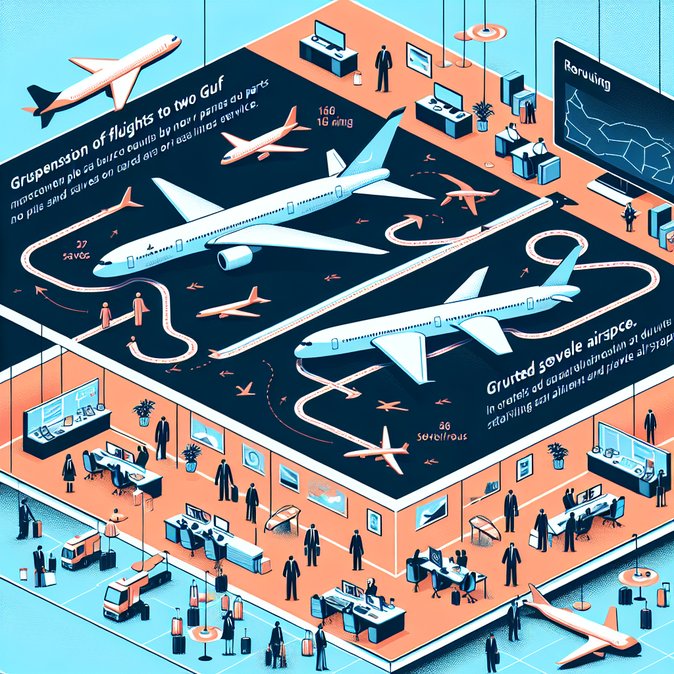
India’s two largest international carriers extended widespread flight suspensions for a second straight day on 2 March 2026 after Iran-centred hostilities again forced the closure of large swathes of Middle-East airspace.
Air India confirmed that every service to the United Arab Emirates, Saudi Arabia, Qatar and Israel remains grounded until 23:59 IST on Monday. The network-wide pause has also crept into Europe: nonstop rotations from Delhi and Mumbai to London, Paris, Frankfurt and Vienna—as well as sectors onward to Toronto—were axed after revised routings around the Gulf pushed crew-duty limits beyond regulatory thresholds.
IndiGo, which normally operates more than 65 daily round-trips to the Gulf, cancelled 162 Middle-East services and scrapped long-haul flights to London, Amsterdam and Manchester. Both airlines said re-accommodation options are severely constrained because alternative routings via the Red Sea add up to three hours and require tech stops for narrow-body aircraft.
![Air India and IndiGo cancel hundreds of flights as Middle-East airspace closures spill over to Europe]()
If your team suddenly needs transit or entry documents for unexpected detours, VisaHQ can streamline the process. Their India portal (https://www.visahq.com/india/) offers rapid eVisa and transit-permit processing for alternative hubs such as Muscat, Nairobi and Tbilisi, complete with real-time tracking and expert support—helping travellers stay compliant even as flight plans keep shifting.
For corporate mobility managers the disruption could not come at a worse time. India’s fiscal-year-end closing drives a seasonal spike in short-notice travel by finance, audit and project-management teams. Multinationals have already activated split-site contingencies—redirecting staff via Muscat, Nairobi or Tbilisi—and instructed travellers to build in 48-hour buffers around meetings.
Practical advice: check flight status on airline apps before heading to the airport, expect long queues at refund desks, and keep boarding passes and emails as evidence for duty-of-care and travel-insurance claims. Travellers transiting India should note that domestic connections are operating normally but minimum connection times have been extended by an hour to absorb knock-on delays.
Air India confirmed that every service to the United Arab Emirates, Saudi Arabia, Qatar and Israel remains grounded until 23:59 IST on Monday. The network-wide pause has also crept into Europe: nonstop rotations from Delhi and Mumbai to London, Paris, Frankfurt and Vienna—as well as sectors onward to Toronto—were axed after revised routings around the Gulf pushed crew-duty limits beyond regulatory thresholds.
IndiGo, which normally operates more than 65 daily round-trips to the Gulf, cancelled 162 Middle-East services and scrapped long-haul flights to London, Amsterdam and Manchester. Both airlines said re-accommodation options are severely constrained because alternative routings via the Red Sea add up to three hours and require tech stops for narrow-body aircraft.

If your team suddenly needs transit or entry documents for unexpected detours, VisaHQ can streamline the process. Their India portal (https://www.visahq.com/india/) offers rapid eVisa and transit-permit processing for alternative hubs such as Muscat, Nairobi and Tbilisi, complete with real-time tracking and expert support—helping travellers stay compliant even as flight plans keep shifting.
For corporate mobility managers the disruption could not come at a worse time. India’s fiscal-year-end closing drives a seasonal spike in short-notice travel by finance, audit and project-management teams. Multinationals have already activated split-site contingencies—redirecting staff via Muscat, Nairobi or Tbilisi—and instructed travellers to build in 48-hour buffers around meetings.
Practical advice: check flight status on airline apps before heading to the airport, expect long queues at refund desks, and keep boarding passes and emails as evidence for duty-of-care and travel-insurance claims. Travellers transiting India should note that domestic connections are operating normally but minimum connection times have been extended by an hour to absorb knock-on delays.