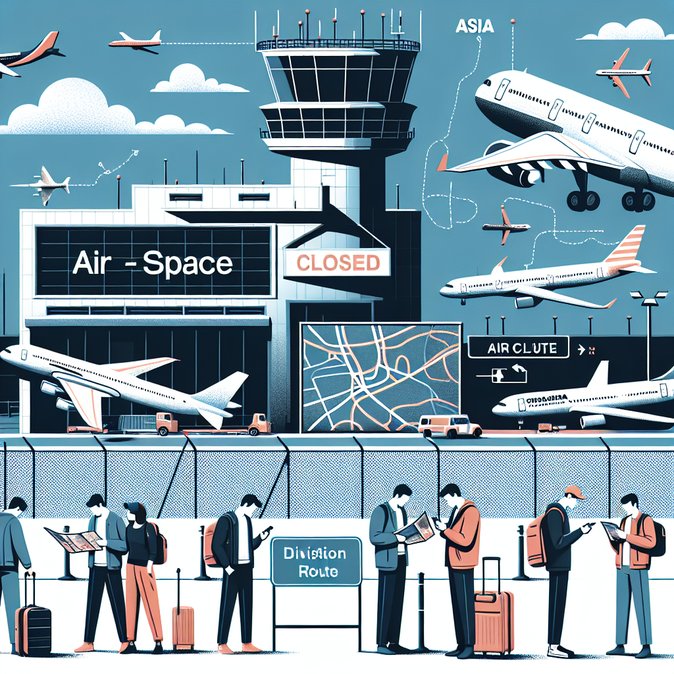
Escalating hostilities between the US-Israel coalition and Iran triggered blanket air-space closures across Qatar, the United Arab Emirates and parts of Iran overnight, forcing Emirates, Etihad and Qatar Airways to cancel services that carry the bulk of Australia-Europe traffic. Foreign Minister Penny Wong cautioned that there are “limits” to what Canberra can do for the estimated 115,000 Australians currently in the region after dozens of aircraft were diverted or stranded. (theguardian.com)
Hundreds of travellers slept on terminal floors at Sydney Airport over the weekend as returning flights failed to materialise during the city’s busy Mardi Gras period. Virgin Australia confirmed that seven Qatar-operated codeshares were cancelled on Sunday and five more on Monday, while Qantas said its Europe services remain unaffected because they bypass Gulf hubs. (theguardian.com)
In parallel, the Department of Foreign Affairs and Trade updated Smartraveller advisories, raising Israel, Iran, Lebanon, Qatar, the UAE and Yemen to “Do Not Travel” and urging Australians to reconsider transits through Jordan, Oman and Saudi Arabia. The site warns that further missile exchanges could prompt new closures “with little or no notice” and advises travellers to hold flexible tickets and comprehensive insurance. (smartraveller.gov.au)
![Middle-East conflict grounds Gulf hub flights; DFAT issues ‘do not travel’ alerts]()
Amid the shifting advisories and flight rerouting, travellers trying to piece together last-minute itineraries may also need to juggle entry-visa requirements for replacement transit points. VisaHQ’s Australia portal (https://www.visahq.com/australia/) offers a fast way to check restrictions and secure e-visas for Singapore, Thailand, Malaysia and dozens of other fallback hubs, streamlining paperwork while airlines scramble to rebook seats.
Business-travel managers are scrambling to re-route executives through Singapore, Bangkok and Kuala Lumpur, but seats are scarce and flight times are lengthening as aircraft skirt Iranian and Iraqi airspace. Freight forwarders report early signs of a capacity squeeze on high-value belly-hold cargo, with spot rates out of Australia to Europe already up 12 per cent since Friday.
Experts say the disruption exposes Australia’s reliance on Middle-Eastern megahubs and underscores the strategic value of forthcoming ultra-long-haul “Project Sunrise” non-stops to London and New York. In the meantime, corporates are revisiting travel-risk policies, updating crisis-response trees and instructing staff to register with DFAT before departure.
Hundreds of travellers slept on terminal floors at Sydney Airport over the weekend as returning flights failed to materialise during the city’s busy Mardi Gras period. Virgin Australia confirmed that seven Qatar-operated codeshares were cancelled on Sunday and five more on Monday, while Qantas said its Europe services remain unaffected because they bypass Gulf hubs. (theguardian.com)
In parallel, the Department of Foreign Affairs and Trade updated Smartraveller advisories, raising Israel, Iran, Lebanon, Qatar, the UAE and Yemen to “Do Not Travel” and urging Australians to reconsider transits through Jordan, Oman and Saudi Arabia. The site warns that further missile exchanges could prompt new closures “with little or no notice” and advises travellers to hold flexible tickets and comprehensive insurance. (smartraveller.gov.au)
Amid the shifting advisories and flight rerouting, travellers trying to piece together last-minute itineraries may also need to juggle entry-visa requirements for replacement transit points. VisaHQ’s Australia portal (https://www.visahq.com/australia/) offers a fast way to check restrictions and secure e-visas for Singapore, Thailand, Malaysia and dozens of other fallback hubs, streamlining paperwork while airlines scramble to rebook seats.
Business-travel managers are scrambling to re-route executives through Singapore, Bangkok and Kuala Lumpur, but seats are scarce and flight times are lengthening as aircraft skirt Iranian and Iraqi airspace. Freight forwarders report early signs of a capacity squeeze on high-value belly-hold cargo, with spot rates out of Australia to Europe already up 12 per cent since Friday.
Experts say the disruption exposes Australia’s reliance on Middle-Eastern megahubs and underscores the strategic value of forthcoming ultra-long-haul “Project Sunrise” non-stops to London and New York. In the meantime, corporates are revisiting travel-risk policies, updating crisis-response trees and instructing staff to register with DFAT before departure.