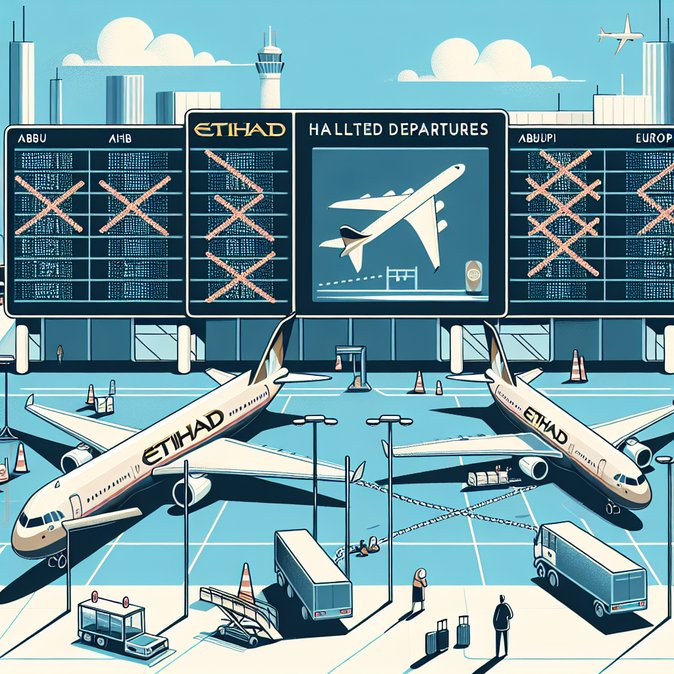
Travel chaos rippled through global aviation early Sunday after Etihad Airways suspended every outbound flight from Abu Dhabi’s Zayed International Airport until 2:00 p.m. local time (4:00 a.m. EST). The carrier cited “regional airspace closures” following overnight U.S. and Israeli strikes on Iranian missile sites and Tehran’s retaliatory salvos toward Gulf shipping lanes.
Although the United Arab Emirates is not directly involved in hostilities, NOTAMs issued by the UAE General Civil Aviation Authority restricted civilian traffic over large swathes of the Gulf, forcing carriers to divert or cancel flights. Etihad’s blanket halt is its most sweeping operational pause since the 2021 COVID wave.
Amid the disruption, travelers who suddenly need to modify itineraries—or secure fresh travel documents—can turn to VisaHQ. Its online portal (https://www.visahq.com/united-states/) offers real-time visa guidance, expedited processing, and 24/7 support, helping passengers stay compliant with shifting entry rules while they seek alternative routes.
![Etihad Airways Grounds All Abu Dhabi Departures Until Afternoon After U.S.–Iran–Israel Escalation]()
For U.S. travellers, the knock-on effect is immediate: Etihad’s twice-daily New York JFK and daily Washington Dulles services are grounded, with equipment and crews stranded in Abu Dhabi. Codeshare partners American Airlines and JetBlue have waived change fees for passengers ticketed through March 4.
Corporate travel managers with Middle East routings should prepare for multi-day delays. Re-routing via Europe remains possible but adds four to six hours and higher fares. Shippers of time-sensitive cargo—including pharmaceutical temperature-controlled freight—are warning of backlogs at Frankfurt, Istanbul and Athens, the main diversion points.
Industry analysts note that while Gulf carriers have robust contingency plans, simultaneous closures of Iranian, Iraqi and Emirati airspace leave few safe corridors, and U.S. carriers have already pulled crews from Dubai and Doha layovers. The duration of Etihad’s suspension remains contingent on geopolitical developments, making real-time monitoring essential.
Although the United Arab Emirates is not directly involved in hostilities, NOTAMs issued by the UAE General Civil Aviation Authority restricted civilian traffic over large swathes of the Gulf, forcing carriers to divert or cancel flights. Etihad’s blanket halt is its most sweeping operational pause since the 2021 COVID wave.
Amid the disruption, travelers who suddenly need to modify itineraries—or secure fresh travel documents—can turn to VisaHQ. Its online portal (https://www.visahq.com/united-states/) offers real-time visa guidance, expedited processing, and 24/7 support, helping passengers stay compliant with shifting entry rules while they seek alternative routes.

For U.S. travellers, the knock-on effect is immediate: Etihad’s twice-daily New York JFK and daily Washington Dulles services are grounded, with equipment and crews stranded in Abu Dhabi. Codeshare partners American Airlines and JetBlue have waived change fees for passengers ticketed through March 4.
Corporate travel managers with Middle East routings should prepare for multi-day delays. Re-routing via Europe remains possible but adds four to six hours and higher fares. Shippers of time-sensitive cargo—including pharmaceutical temperature-controlled freight—are warning of backlogs at Frankfurt, Istanbul and Athens, the main diversion points.
Industry analysts note that while Gulf carriers have robust contingency plans, simultaneous closures of Iranian, Iraqi and Emirati airspace leave few safe corridors, and U.S. carriers have already pulled crews from Dubai and Doha layovers. The duration of Etihad’s suspension remains contingent on geopolitical developments, making real-time monitoring essential.