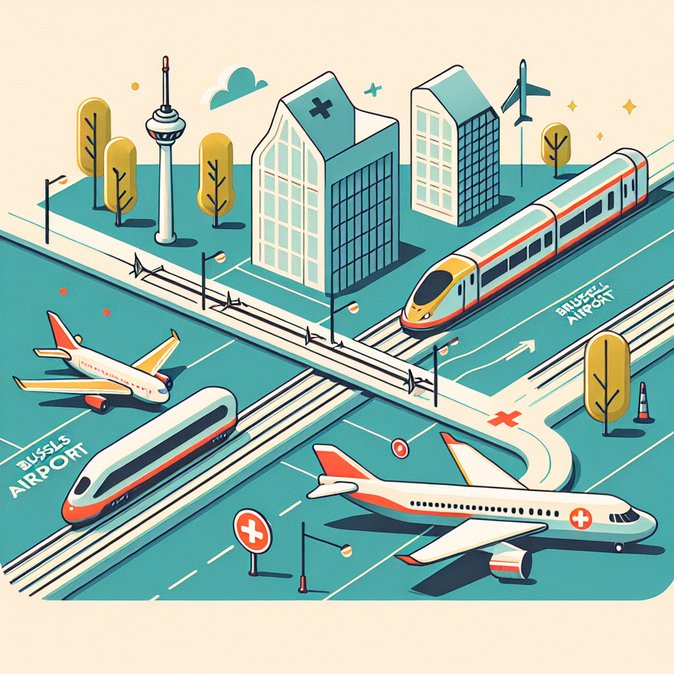
Belgium has secured its first direct international high-speed rail service to Brussels Airport, a move hailed by mobility experts as a game-changer for sustainable business travel. Announced on 1 March 2026 by Deutsche Bahn (DB) and Brussels Airlines, the new ICE connection will run Cologne–Aachen–Liège–Leuven–Brussels Airport–Antwerp and back, slashing the Cologne-airport journey to roughly two hours. Under a codeshare agreement, the train will carry a Brussels Airlines flight number and be bookable on the airline’s website and global distribution systems.
![New high-speed rail link will connect Brussels Airport with Cologne from September 2026]()
Whether you’re a frequent flyer connecting onward from Brussels or a business traveller hopping on the new ICE service, VisaHQ can simplify the paperwork. Its Belgium portal (https://www.visahq.com/belgium/) lets passengers quickly check entry rules, complete visa applications online and track approvals—streamlining the process so the rail-air journey is as seamless on the administrative side as it is on the tracks.
This enables through-ticketing, mileage accrual on the Miles & More programme, and re-protection of passengers in the event of rail or flight delays—an integration model similar to Lufthansa’s Rail&Fly product in Germany. For corporate mobility managers the link offers a lower-carbon substitute for short-haul feeder flights and a time-competitive alternative to road travel. DB calculates that a Cologne-Brussels Airport round-trip by rail generates 32 kg of CO₂ equivalents, versus about 140 kg for the same trip by car and 220 kg by plane. Companies pursuing science-based emission targets can therefore cut Scope 3 travel footprints without sacrificing connectivity. Brussels Airport chief executive Arnaud Feist said the service strengthens the hub’s intermodal strategy, noting that 40 % of the airport’s 9 million annual transfer passengers start or end their journey within 300 km. Adding Cologne brings access to one of Germany’s largest catchment areas and integrates with DB’s wider ICE network, including connections to Frankfurt and Munich. Operational details are still being finalised with Belgian infrastructure manager Infrabel, but the partners envisage four daily return services timed to feed the morning and late-afternoon banks of long-haul flights. Ticket sales are expected to open in May. Travel-policy teams should watch for updated fare ladders and ensure online-booking tools recognise the rail segments as preferred options for intra-European trips.

Whether you’re a frequent flyer connecting onward from Brussels or a business traveller hopping on the new ICE service, VisaHQ can simplify the paperwork. Its Belgium portal (https://www.visahq.com/belgium/) lets passengers quickly check entry rules, complete visa applications online and track approvals—streamlining the process so the rail-air journey is as seamless on the administrative side as it is on the tracks.
This enables through-ticketing, mileage accrual on the Miles & More programme, and re-protection of passengers in the event of rail or flight delays—an integration model similar to Lufthansa’s Rail&Fly product in Germany. For corporate mobility managers the link offers a lower-carbon substitute for short-haul feeder flights and a time-competitive alternative to road travel. DB calculates that a Cologne-Brussels Airport round-trip by rail generates 32 kg of CO₂ equivalents, versus about 140 kg for the same trip by car and 220 kg by plane. Companies pursuing science-based emission targets can therefore cut Scope 3 travel footprints without sacrificing connectivity. Brussels Airport chief executive Arnaud Feist said the service strengthens the hub’s intermodal strategy, noting that 40 % of the airport’s 9 million annual transfer passengers start or end their journey within 300 km. Adding Cologne brings access to one of Germany’s largest catchment areas and integrates with DB’s wider ICE network, including connections to Frankfurt and Munich. Operational details are still being finalised with Belgian infrastructure manager Infrabel, but the partners envisage four daily return services timed to feed the morning and late-afternoon banks of long-haul flights. Ticket sales are expected to open in May. Travel-policy teams should watch for updated fare ladders and ensure online-booking tools recognise the rail segments as preferred options for intra-European trips.