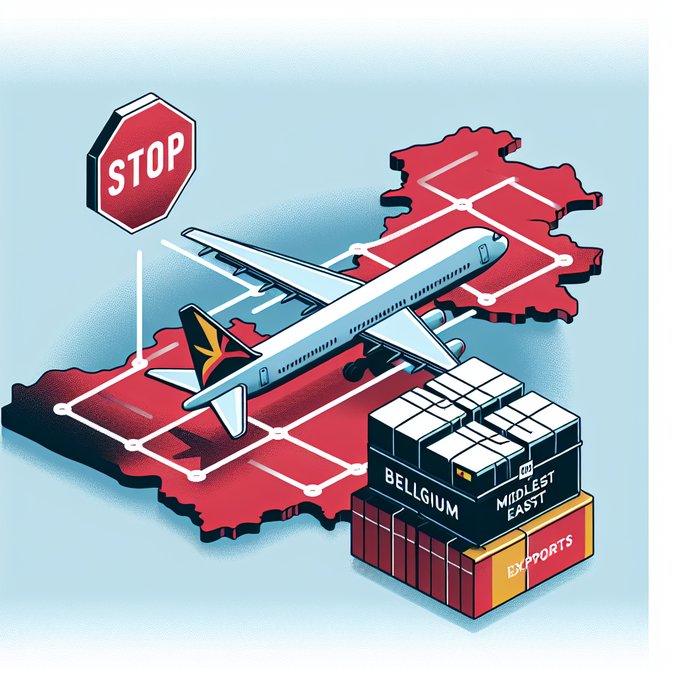
Belgium’s travel trade woke up on 28 February to the industry’s worst-case scenario: a cascading shutdown of Middle-East airspace that forced most long-haul carriers to axe or divert flights with almost no notice. Trade journal TravMagazine reports that Emirates, Qatar Airways, Etihad, KLM, Lufthansa and Turkish Airlines all wiped weekend rotations that connect hundreds of Belgians daily to Africa, Asia and Australia. Brussels Airport’s departure boards showed both of Emirates’ Dubai services and Qatar Airways’ Doha flight cancelled outright. Lufthansa pulled Dubai, Beirut and Muscat; KLM pre-emptively shelved its Amsterdam–Riyadh tag flight. The airlines cite crew-safety rules and insurance exclusions that automatically kick in when over-flight permissions are withdrawn.
Why does this matter for Belgium? Although few Gulf carriers serve Brussels nonstop, they are a lifeline for connecting traffic. Belgian holiday-makers heading to Thailand via Dubai, business executives flying to India through Doha, and NGO staff transiting to East Africa all rely on those hubs. With the Gulf now a no-go zone, itineraries are being rerouted via Central Asia or Southern Europe, inflating travel times by up to five hours and busting corporate travel budgets already strained by peak-summer fares. Travel management companies (TMCs) say Saturday was spent re-protecting passengers on scarce alternative seats. Some firms are implementing a temporary moratorium on non-essential travel that involves the Middle-East corridor.
![Mass flight cancellations hit Belgian travellers as carriers scrub Middle-East routes]()
Amid this turbulence, travellers who suddenly need fresh transit permissions or visa extensions can turn to VisaHQ’s Belgian portal (https://www.visahq.com/belgium/). The agency fast-tracks applications, secures emergency overstay letters and advises on documentation for replacement routings that bypass the Gulf, shaving precious hours off an otherwise stressful reroute.
Shippers of high-value pharmaceuticals from Belgium’s life-sciences cluster face similar headaches as belly-hold capacity evaporates. Belgian mobility teams with staff on assignment in the Gulf are advising employees to remain in place until flight schedules stabilise. Immigration advisors caution that overstaying visas due to involuntary trip extensions could become an issue and recommend early liaison with local authorities. Analysts expect a gradual recovery once conflict-zone bulletins are lifted, but warn that insurance premiums on over-flight routes are likely to rise, keeping fares high well into Q2.
Why does this matter for Belgium? Although few Gulf carriers serve Brussels nonstop, they are a lifeline for connecting traffic. Belgian holiday-makers heading to Thailand via Dubai, business executives flying to India through Doha, and NGO staff transiting to East Africa all rely on those hubs. With the Gulf now a no-go zone, itineraries are being rerouted via Central Asia or Southern Europe, inflating travel times by up to five hours and busting corporate travel budgets already strained by peak-summer fares. Travel management companies (TMCs) say Saturday was spent re-protecting passengers on scarce alternative seats. Some firms are implementing a temporary moratorium on non-essential travel that involves the Middle-East corridor.
Amid this turbulence, travellers who suddenly need fresh transit permissions or visa extensions can turn to VisaHQ’s Belgian portal (https://www.visahq.com/belgium/). The agency fast-tracks applications, secures emergency overstay letters and advises on documentation for replacement routings that bypass the Gulf, shaving precious hours off an otherwise stressful reroute.
Shippers of high-value pharmaceuticals from Belgium’s life-sciences cluster face similar headaches as belly-hold capacity evaporates. Belgian mobility teams with staff on assignment in the Gulf are advising employees to remain in place until flight schedules stabilise. Immigration advisors caution that overstaying visas due to involuntary trip extensions could become an issue and recommend early liaison with local authorities. Analysts expect a gradual recovery once conflict-zone bulletins are lifted, but warn that insurance premiums on over-flight routes are likely to rise, keeping fares high well into Q2.