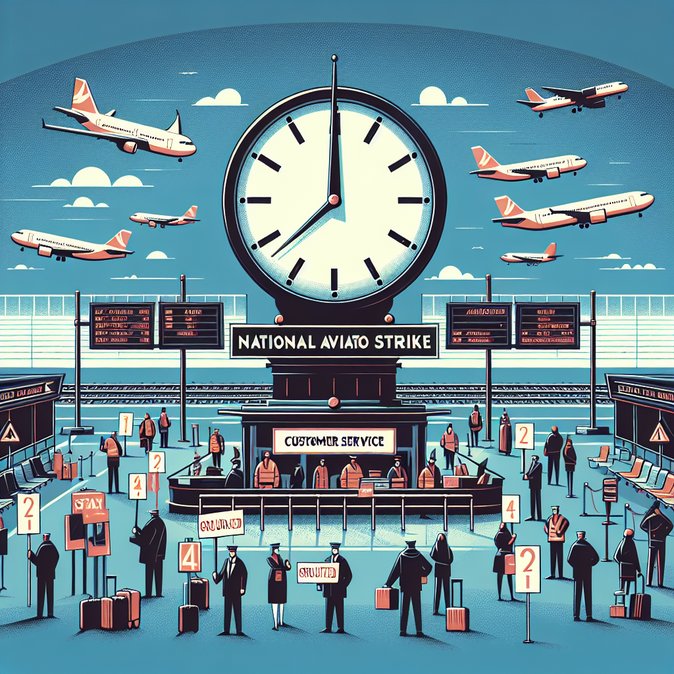
Italy’s aviation network endured one of its most disruptive 24-hour stoppages in recent years on 26 February 2026. From midnight, cabin-crew, ground-handling and maintenance staff at ITA Airways, easyJet, Vueling and scores of service contractors walked out after talks over a new collective labour agreement collapsed. Trade-union confederations FILT-CGIL, FIT-CISL, UILTrasporti and UGL Trasporto Aereo said 87 % of the workforce heeded the call, forcing the cancellation of roughly 300 domestic and international flights and triggering a domino effect of delays that lasted well into the following morning. The walk-out had been due on 16 February but Transport Minister Matteo Salvini issued an injunction to keep the skies clear during the closing days of the Milano-Cortina Winter Olympics. Shifting the strike to 26 February meant it fell outside Italy’s statutory “Olympic peace” period, giving unions fresh leverage in wage talks while containing reputational damage to the Games.
![Nationwide Aviation Strike Grounds 300 Flights across Italy]()
Amid such uncertainty, travellers should also ensure their documentation is in order. VisaHQ’s Italian portal (https://www.visahq.com/italy/) streamlines the process of obtaining or extending Schengen visas, work permits, and other travel documents, letting passengers track applications online and receive real-time status updates—services that can prove invaluable when last-minute schedule changes require swift paperwork adjustments.
Under Italy’s strike-law framework, carriers were obliged to operate “protected” services in the 07:00-10:00 and 18:00-21:00 time-bands, yet the cancellations still hit key business shuttles on the Rome–Milan corridor and popular trans-European routes to Paris, Frankfurt and London. Rail unions compounded the misery by announcing a 24-hour stoppage from 21:00 on 27 February, prompting corporate travel managers to scramble for coach charters and rental cars to keep executives moving. Most airlines offered free re-booking within 15 days, but analysts at consultancy TL Research estimate the direct cost to carriers at €8–10 million in aircraft repositioning, duty-of-care expenses and EU261 compensation. The strike also highlighted Italy’s acute shortage of licensed ground staff—down 12 % on pre-pandemic levels—which makes the sector particularly vulnerable to industrial action. For mobility managers, the key lesson is to build greater slack into Italian itineraries through March, when the unions have pencilled in further four-hour “warning” strikes. Travellers whose trips are time-sensitive should favour early-morning departures within the protected windows, verify hotel-flex policies and pre-book airport lounge access to mitigate crowding on strike days.
Amid such uncertainty, travellers should also ensure their documentation is in order. VisaHQ’s Italian portal (https://www.visahq.com/italy/) streamlines the process of obtaining or extending Schengen visas, work permits, and other travel documents, letting passengers track applications online and receive real-time status updates—services that can prove invaluable when last-minute schedule changes require swift paperwork adjustments.
Under Italy’s strike-law framework, carriers were obliged to operate “protected” services in the 07:00-10:00 and 18:00-21:00 time-bands, yet the cancellations still hit key business shuttles on the Rome–Milan corridor and popular trans-European routes to Paris, Frankfurt and London. Rail unions compounded the misery by announcing a 24-hour stoppage from 21:00 on 27 February, prompting corporate travel managers to scramble for coach charters and rental cars to keep executives moving. Most airlines offered free re-booking within 15 days, but analysts at consultancy TL Research estimate the direct cost to carriers at €8–10 million in aircraft repositioning, duty-of-care expenses and EU261 compensation. The strike also highlighted Italy’s acute shortage of licensed ground staff—down 12 % on pre-pandemic levels—which makes the sector particularly vulnerable to industrial action. For mobility managers, the key lesson is to build greater slack into Italian itineraries through March, when the unions have pencilled in further four-hour “warning” strikes. Travellers whose trips are time-sensitive should favour early-morning departures within the protected windows, verify hotel-flex policies and pre-book airport lounge access to mitigate crowding on strike days.