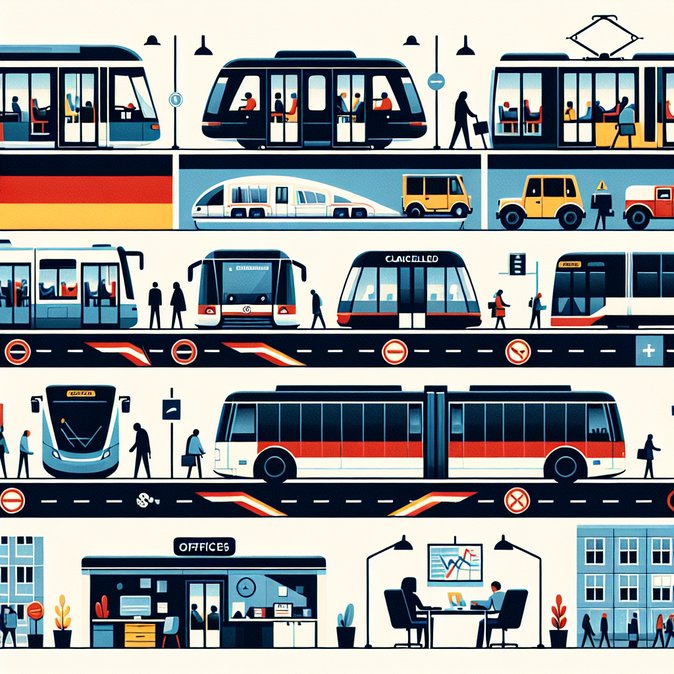
On 25 February the German public-sector union ver.di confirmed a 48-hour nationwide strike across municipal bus, tram and U-Bahn systems for 27–28 February, aiming to ratchet up pressure in stalled wage talks covering 100,000 workers. While S-Bahn and long-distance Deutsche Bahn services are exempt, cross-border regional trains, FlixBus services and airport feeder buses used by Czech residents are likely to be cancelled or severely reduced, particularly on the Dresden–Prague and Munich–Prague corridors. Czech Railways (ČD) says it will attempt to keep EuroCity services to Berlin and Hamburg running but warns of cascading delays once passengers displaced from local services flood mainline stations. Companies with employees commuting into Bavaria or Saxony should expect longer journey times and consider temporary remote-work arrangements.
![German Nationwide Transport Strike Announced for 27-28 February – Czech Commuters Face Two-Day Disruption]()
If the strike obliges you to adjust itineraries or reroute through alternative hubs, make sure your paperwork keeps pace: VisaHQ (https://www.visahq.com/czech-republic/) can fast-track Czech and third-country visa applications, arrange extensions, and provide real-time status updates, helping mobility managers and individual travellers avoid administrative snags while transport links remain unpredictable.
Freight forwarders moving Czech automotive components to German plants on overnight road shuttles anticipate congestion around border crossings as commuters shift to private cars. Prague-based tour operators have already re-routed weekend city-break coaches to Nuremberg and Salzburg, while several MICE agencies told clients to avoid booking transfers that rely on German urban public transport. Travel-risk consultants advise obtaining e-vignettes in advance for Czech company cars and adding at least 60 minutes to itineraries for potential traffic jams at Czech–German frontier points such as Rozvadov and Královec. Although the strike is scheduled to last only two days, ver.di has hinted at rolling actions in March if no breakthrough is reached. Mobility managers should monitor union channels, brief travelling staff on contingency rail tickets, and pre-purchase flexible hotel rates in case meetings in Berlin or Munich over-run into the weekend.

If the strike obliges you to adjust itineraries or reroute through alternative hubs, make sure your paperwork keeps pace: VisaHQ (https://www.visahq.com/czech-republic/) can fast-track Czech and third-country visa applications, arrange extensions, and provide real-time status updates, helping mobility managers and individual travellers avoid administrative snags while transport links remain unpredictable.
Freight forwarders moving Czech automotive components to German plants on overnight road shuttles anticipate congestion around border crossings as commuters shift to private cars. Prague-based tour operators have already re-routed weekend city-break coaches to Nuremberg and Salzburg, while several MICE agencies told clients to avoid booking transfers that rely on German urban public transport. Travel-risk consultants advise obtaining e-vignettes in advance for Czech company cars and adding at least 60 minutes to itineraries for potential traffic jams at Czech–German frontier points such as Rozvadov and Královec. Although the strike is scheduled to last only two days, ver.di has hinted at rolling actions in March if no breakthrough is reached. Mobility managers should monitor union channels, brief travelling staff on contingency rail tickets, and pre-purchase flexible hotel rates in case meetings in Berlin or Munich over-run into the weekend.