Germany’s federal interior minister Alexander Dobrindt confirmed in the early hours of 24 February that the temporary controls on the German-Polish land border will be prolonged for another six months, from 15 March until at least 15 September 2026. The checks, re-introduced in October 2023 amid a spike in irregular migration along the Balkan route and the Belarus “hybrid” corridor, were due to lapse next month but will now remain in force through the peak summer travel season.
Although the measure is taken unilaterally by Berlin, its practical effects are felt most acutely on the Polish side. In the twin city of Frankfurt (Oder)–Słubice, where some 10,000 people commute across the Oder River each day, mayor Axel Strasser warned that repeated extensions risk “embedding what should be an exceptional tool into everyday life.” Spot checks can add 30-45 minutes to the crossing at rush hour, disrupting cross-border supply chains, delaying just-in-time deliveries of car parts from Lower Silesia, and forcing companies to budget for overtime or overnight accommodation when drivers miss delivery windows.
For travelers needing help navigating the evolving document landscape, VisaHQ’s Poland portal (https://www.visahq.com/poland/) can simplify the process by clarifying up-to-date ID, visa, and assignment-letter requirements and by issuing real-time alerts whenever German-Polish border regulations change. Commuters and project-based staff can upload their paperwork in advance and receive confirmations that often help expedite spot checks.
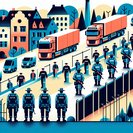
![German Interior Ministry Extends Temporary Border Checks with Poland, Local Leaders Warn of Business Impact]()
Business-travel managers are likewise concerned. According to the Polish-German Chamber of Commerce, at least 1,200 Polish technicians travel weekly to German client sites on A1/A12 motorway corridors. Each additional inspection day can translate into lost billable hours and breach-of-contract penalties if service-level agreements are missed. Multinationals have started issuing “border delay clauses” in purchase orders and advising travellers to carry both passports and proof of assignment letters to accelerate spot checks.
Legally, the Schengen Borders Code allows a member state to re-introduce internal border controls only in exceptional circumstances and for renewable periods of up to six months. Brussels has signalled growing unease with the German practice, but has so far stopped short of opening infringement proceedings. Dobrindt justified the move by citing a 22 percent year-on-year rise in detections of people smugglers along the Polish frontier in 2025 and claimed that daily irregular entries fell by “more than a third” whenever controls were in place.
For mobility professionals the takeaway is clear: until structural EU asylum reforms come into force, ad-hoc border checks may remain part of the travel landscape. Employers should build extra buffer time into itineraries, remind posted workers that national ID cards are required even on same-day trips, and keep watching for further extensions when the current authorisation expires in mid-September.
Although the measure is taken unilaterally by Berlin, its practical effects are felt most acutely on the Polish side. In the twin city of Frankfurt (Oder)–Słubice, where some 10,000 people commute across the Oder River each day, mayor Axel Strasser warned that repeated extensions risk “embedding what should be an exceptional tool into everyday life.” Spot checks can add 30-45 minutes to the crossing at rush hour, disrupting cross-border supply chains, delaying just-in-time deliveries of car parts from Lower Silesia, and forcing companies to budget for overtime or overnight accommodation when drivers miss delivery windows.
For travelers needing help navigating the evolving document landscape, VisaHQ’s Poland portal (https://www.visahq.com/poland/) can simplify the process by clarifying up-to-date ID, visa, and assignment-letter requirements and by issuing real-time alerts whenever German-Polish border regulations change. Commuters and project-based staff can upload their paperwork in advance and receive confirmations that often help expedite spot checks.

Business-travel managers are likewise concerned. According to the Polish-German Chamber of Commerce, at least 1,200 Polish technicians travel weekly to German client sites on A1/A12 motorway corridors. Each additional inspection day can translate into lost billable hours and breach-of-contract penalties if service-level agreements are missed. Multinationals have started issuing “border delay clauses” in purchase orders and advising travellers to carry both passports and proof of assignment letters to accelerate spot checks.
Legally, the Schengen Borders Code allows a member state to re-introduce internal border controls only in exceptional circumstances and for renewable periods of up to six months. Brussels has signalled growing unease with the German practice, but has so far stopped short of opening infringement proceedings. Dobrindt justified the move by citing a 22 percent year-on-year rise in detections of people smugglers along the Polish frontier in 2025 and claimed that daily irregular entries fell by “more than a third” whenever controls were in place.
For mobility professionals the takeaway is clear: until structural EU asylum reforms come into force, ad-hoc border checks may remain part of the travel landscape. Employers should build extra buffer time into itineraries, remind posted workers that national ID cards are required even on same-day trips, and keep watching for further extensions when the current authorisation expires in mid-September.