
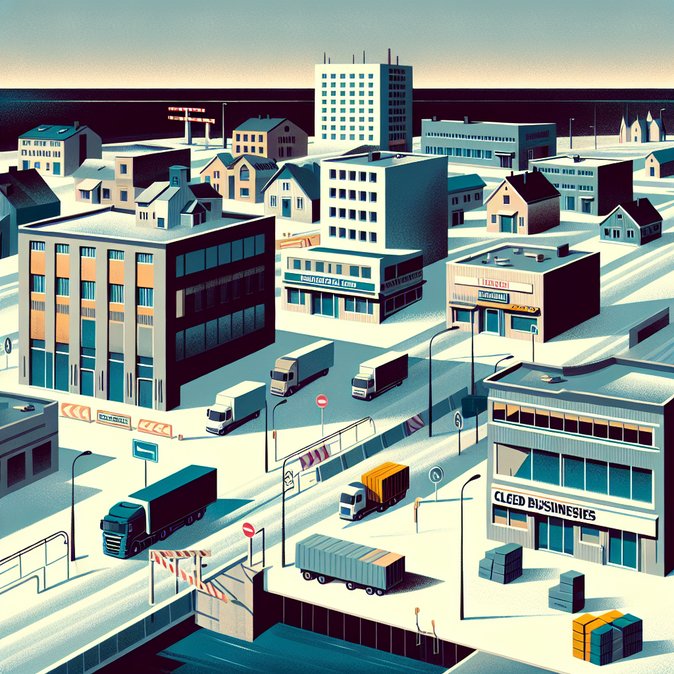
Tohmajärvi, a small municipality in North Karelia, used to thrum with cross-border traffic. At its peak almost two million crossings a year passed through the nearby Niirala checkpoint. Since Finland shut all eight road crossings with Russia in December 2023 to curb what Helsinki calls Moscow’s “weaponised migration”, the traffic has fallen to zero—and so have local revenues. On 24 February 2026 an in-depth field report circulated globally through more than 20 outlets summarised the new reality. Petrol stations stand deserted, cafés are boarded up and supermarkets have lost half their turnover because their Russian clientele has vanished. Unemployment in the municipality has soared to 18.2 %—nearly double the national rate—and young people are leaving for bigger cities.
![Finland’s Russia-border communities brace for long-term closure as economic pain eclipses security fears]()
Against this backdrop, those still travelling for work or study can benefit from dedicated visa facilitation services. VisaHQ, for instance, maintains a comprehensive Finland section (https://www.visahq.com/finland/) that guides applicants through the latest requirements, offers document-checking and courier options, and helps employers secure the residence permits they need to attract new talent into struggling border regions.
Even renewable-energy investors cancelled a planned wind-farm when the Border Guard said turbine blades would interfere with new surveillance radars being installed on the 362-million-euro, 200-kilometre security fence now under construction. Yet residents interviewed by AFP journalists said their greatest worry is economic, not military. While Finland’s NATO membership and expanded defence budget have reassured them on security, the disappearance of Russian customers threatens the viability of everything from B&Bs to haulage firms. The Finnish Institute of International Affairs warns of a “new periphery” forming along the 1,340-km frontier, where labour shortages in health care and construction collide with record local joblessness because Russian cross-border workers can no longer commute. For corporate mobility managers the biggest takeaway is that the eastern regions will depend on foreign—not Russian—talent if they are to revive. Employers are already lobbying for faster processing of work-based residence permits and targeted tax incentives to attract EU specialists willing to relocate to sparsely populated Karelia and Kainuu. Logistics firms have shifted export routes to the ports of Kotka and Hamina, lengthening delivery times to Asia by three days. In Helsinki, lawmakers are divided over how long the closure should remain in place. The Interior Ministry says reopening “is not on the table” until Moscow stops funnelling asylum seekers to the border, something the Kremlin denies. Meanwhile, the Border Guard’s budget request for 2027 includes another €120 million to extend the fence northwards. Unless the geopolitical climate changes, Finnish-Russian land mobility is set to remain frozen—and the towns that once thrived on it must reinvent their economies or fade away.
Against this backdrop, those still travelling for work or study can benefit from dedicated visa facilitation services. VisaHQ, for instance, maintains a comprehensive Finland section (https://www.visahq.com/finland/) that guides applicants through the latest requirements, offers document-checking and courier options, and helps employers secure the residence permits they need to attract new talent into struggling border regions.
Even renewable-energy investors cancelled a planned wind-farm when the Border Guard said turbine blades would interfere with new surveillance radars being installed on the 362-million-euro, 200-kilometre security fence now under construction. Yet residents interviewed by AFP journalists said their greatest worry is economic, not military. While Finland’s NATO membership and expanded defence budget have reassured them on security, the disappearance of Russian customers threatens the viability of everything from B&Bs to haulage firms. The Finnish Institute of International Affairs warns of a “new periphery” forming along the 1,340-km frontier, where labour shortages in health care and construction collide with record local joblessness because Russian cross-border workers can no longer commute. For corporate mobility managers the biggest takeaway is that the eastern regions will depend on foreign—not Russian—talent if they are to revive. Employers are already lobbying for faster processing of work-based residence permits and targeted tax incentives to attract EU specialists willing to relocate to sparsely populated Karelia and Kainuu. Logistics firms have shifted export routes to the ports of Kotka and Hamina, lengthening delivery times to Asia by three days. In Helsinki, lawmakers are divided over how long the closure should remain in place. The Interior Ministry says reopening “is not on the table” until Moscow stops funnelling asylum seekers to the border, something the Kremlin denies. Meanwhile, the Border Guard’s budget request for 2027 includes another €120 million to extend the fence northwards. Unless the geopolitical climate changes, Finnish-Russian land mobility is set to remain frozen—and the towns that once thrived on it must reinvent their economies or fade away.
More From Finland
View all
Night-time closure of Estonia–Russia crossings from 24 Feb 2026 triggers rerouting for Finnish hauliers

Finnish Supreme Court clarifies that children ‘in transit’ may have no habitual residence under Hague rules