
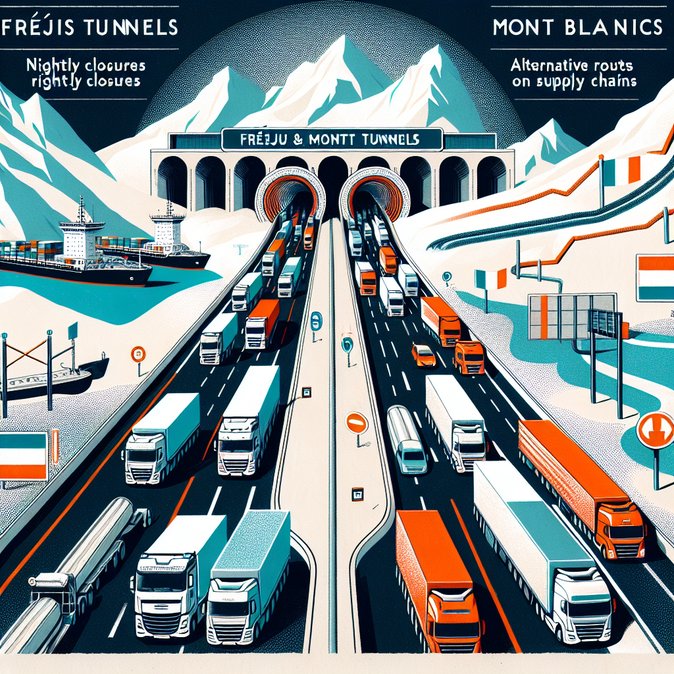
International road hauliers face fresh scheduling challenges as a series of short night-time closures at the Fréjus road tunnel started on Monday 23 February 2026, part of a maintenance cycle that also affects the Mont Blanc tunnel later in the week. Although each closure lasts only 45 minutes, logistics operators warn that just one missed slot can cascade into hours of waiting because access roads in the Savoie and Piedmont Alps offer limited parking or turning space. The French Transport Ministry coordinated the timetable with Italian authorities to minimise daytime disruption, but freight associations such as FNTR and ASTRE advise clients shipping time-sensitive pharmaceuticals and high-tech components to re-route via Ventimiglia or the Rhine valley where possible. With Alpine winter traffic already dense and additional seasonal truck bans in Auvergne-Rhône-Alpes, capacity on alternative corridors is tight.
![Mont Blanc & Fréjus Tunnel Night Closures Begin 23 February, Disrupting France–Italy Freight]()
Hauliers whose rerouted journeys involve transit through additional Schengen states or entry into Switzerland may also need to verify that drivers’ travel documents and A1 forms are in order; VisaHQ’s dedicated France portal (https://www.visahq.com/france/) can expedite any visa or passport services required at short notice and offers 24/7 tracking so fleet managers can align paperwork with shifting tunnel timetables.
Forwarders serving just-in-time automotive plants around Lyon and Turin say they will pre-stage loads at consolidation hubs on either side of the Alps and switch drivers to comply with EU driving-time rules. Companies with expatriate fleets should brief drivers on the closure windows—10:30 p.m.–11:15 p.m. on 23 February and similar slots through 28 February—and ensure that Toll Collect and Telepass devices are updated for any detours through Switzerland or the south of France. While the maintenance is routine, it highlights the fragility of Franco-Italian surface links; a major safety-retrofit closure of Mont Blanc is planned for late 2026, potentially pushing even more trucks onto already strained maritime and rail routes.
Hauliers whose rerouted journeys involve transit through additional Schengen states or entry into Switzerland may also need to verify that drivers’ travel documents and A1 forms are in order; VisaHQ’s dedicated France portal (https://www.visahq.com/france/) can expedite any visa or passport services required at short notice and offers 24/7 tracking so fleet managers can align paperwork with shifting tunnel timetables.
Forwarders serving just-in-time automotive plants around Lyon and Turin say they will pre-stage loads at consolidation hubs on either side of the Alps and switch drivers to comply with EU driving-time rules. Companies with expatriate fleets should brief drivers on the closure windows—10:30 p.m.–11:15 p.m. on 23 February and similar slots through 28 February—and ensure that Toll Collect and Telepass devices are updated for any detours through Switzerland or the south of France. While the maintenance is routine, it highlights the fragility of Franco-Italian surface links; a major safety-retrofit closure of Mont Blanc is planned for late 2026, potentially pushing even more trucks onto already strained maritime and rail routes.