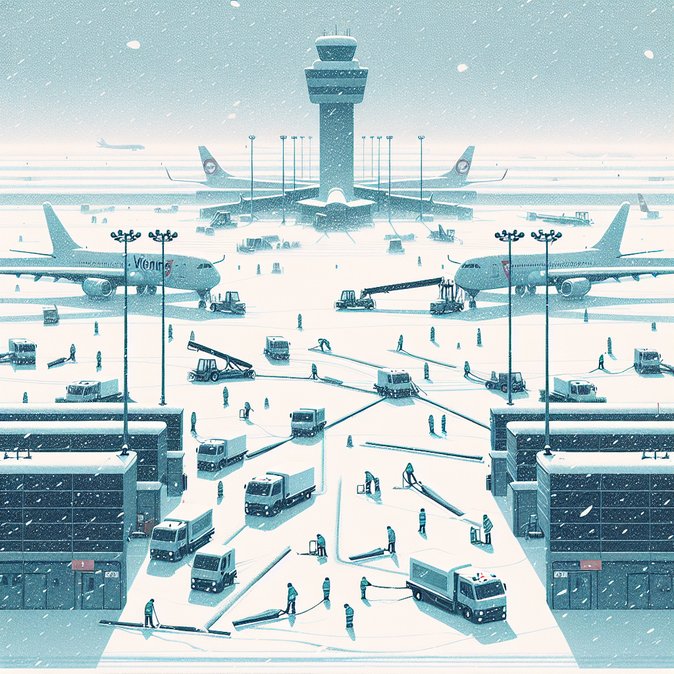
Vienna International Airport (VIE) fully reopened on the morning of 22 February 2026 after an overnight effort to clear more than 30 centimetres of wind-packed snow that had paralysed Austria’s main aviation gateway the day before. The record storm, which swept across eastern Austria between 20 and 22 February, forced VIE to suspend all flight movements for almost 14 hours, cancelling more than 380 departures and arrivals and stranding an estimated 42 000 passengers. Airport operator Flughafen Wien AG said the closure was “the longest weather-related halt in two decades”. Some 220 pieces of snow-clearing equipment and 600 ground-handling staff worked through the night to reopen the two runways. While the first Austrian Airlines A320 lifted off for Frankfurt at 07:16, airport bosses warned that knock-on delays would persist for at least 48 hours as airlines reposition aircraft and crews.
![Vienna International Airport Resumes Operations After Historic Snowstorm Shutdown]()
Should the ensuing delays force you to reroute through non-Schengen airports, extend a stopover, or obtain an unexpected transit permit, VisaHQ can streamline the paperwork. Its Austria portal (https://www.visahq.com/austria/) lets travellers and corporate mobility teams secure visas, electronic travel authorisations, and up-to-date entry guidance in minutes—adding a welcome buffer when winter weather scrambles even the best-laid itineraries.
The disruption had a cascading impact on regional mobility networks. Rail operator ÖBB added capacity on its Vienna–Salzburg Westbahn service and waived re-booking fees, while long-distance coaches arriving from Munich and Prague were granted temporary permits to drop passengers air-side at VIE’s Terminal 3 car-park. Logistics firms reported that more than 120 tonnes of time-critical medical and semiconductor cargo were diverted to Munich and Budapest airports, requiring cross-border trucking under tight temperature-control standards. For multinational companies, the episode underscored the vulnerability of relying on a single hub: Vienna handles roughly 65 percent of Austria’s passenger traffic and is the primary Schengen transit point for Central and Eastern Europe. Corporate travel managers are now reviewing contingency plans that include authorising rail or road routings, stocking emergency supplies at Vienna offices for stranded staff, and re-checking insurance coverage for weather-related force-majeure. Analysts also expect renewed debate over a long-mooted third runway, shelved in 2024 amid environmental opposition, as business groups argue that greater runway resilience is essential to Austria’s competitiveness. Practical advice for travellers: anyone due to fly via Vienna this week should reconfirm bookings online, allow extra transfer time and keep receipts for additional expenses—EU-261 compensation rules apply when weather disrupts flights originating in the EU, but airlines often reimburse meals and accommodation as a goodwill gesture. Travellers whose itineraries involve tight Schengen-area connections should note that missed onward segments can trigger over-stay risks under the 90/180-day rule; experts recommend documenting any delay-related border stamps or airline letters to avoid future compliance issues.

Should the ensuing delays force you to reroute through non-Schengen airports, extend a stopover, or obtain an unexpected transit permit, VisaHQ can streamline the paperwork. Its Austria portal (https://www.visahq.com/austria/) lets travellers and corporate mobility teams secure visas, electronic travel authorisations, and up-to-date entry guidance in minutes—adding a welcome buffer when winter weather scrambles even the best-laid itineraries.
The disruption had a cascading impact on regional mobility networks. Rail operator ÖBB added capacity on its Vienna–Salzburg Westbahn service and waived re-booking fees, while long-distance coaches arriving from Munich and Prague were granted temporary permits to drop passengers air-side at VIE’s Terminal 3 car-park. Logistics firms reported that more than 120 tonnes of time-critical medical and semiconductor cargo were diverted to Munich and Budapest airports, requiring cross-border trucking under tight temperature-control standards. For multinational companies, the episode underscored the vulnerability of relying on a single hub: Vienna handles roughly 65 percent of Austria’s passenger traffic and is the primary Schengen transit point for Central and Eastern Europe. Corporate travel managers are now reviewing contingency plans that include authorising rail or road routings, stocking emergency supplies at Vienna offices for stranded staff, and re-checking insurance coverage for weather-related force-majeure. Analysts also expect renewed debate over a long-mooted third runway, shelved in 2024 amid environmental opposition, as business groups argue that greater runway resilience is essential to Austria’s competitiveness. Practical advice for travellers: anyone due to fly via Vienna this week should reconfirm bookings online, allow extra transfer time and keep receipts for additional expenses—EU-261 compensation rules apply when weather disrupts flights originating in the EU, but airlines often reimburse meals and accommodation as a goodwill gesture. Travellers whose itineraries involve tight Schengen-area connections should note that missed onward segments can trigger over-stay risks under the 90/180-day rule; experts recommend documenting any delay-related border stamps or airline letters to avoid future compliance issues.