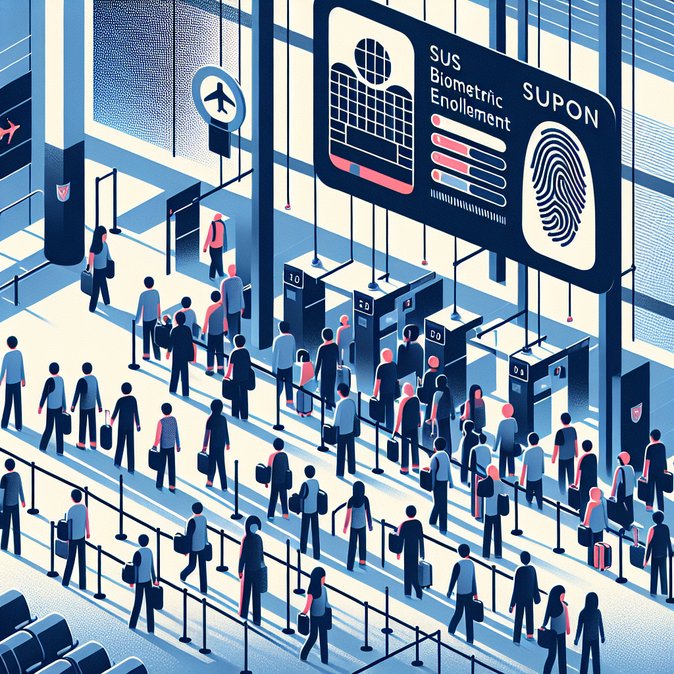
With barely eight weeks to go before the Entry/Exit System (EES) becomes mandatory at all air and sea borders, Brussels has blinked. In a decision published on 20 February 2026, the European Commission authorised Schengen members to suspend the taking of fingerprints and facial images for up to six hours per day when queues become unmanageable. The specialist site Schengen90 reports that the temporary derogation was granted after intense lobbying by France and Spain, whose airports anticipate record traffic ahead of Euro 2026 and the Alpine Winter Games.
![EU Lets Schengen States – Including France – Pause EES Biometric Capture During Summer Peaks]()
Travellers looking to minimise surprises during this transition can also lean on VisaHQ for up-to-date guidance on Schengen entry rules. The platform aggregates the latest EES advisories for France and other member states, offers real-time visa and passport validity checks, and can arrange courier pick-up of documents when a consular visit is still required—see https://www.visahq.com/france/ for details.
Under the deal, border police may invoke the “traffic saturation” clause only if waiting times exceed 60 minutes and if basic passport checks continue. Member states must notify the Commission ex-post and publish daily statistics on skipped biometric enrollments. Airlines and airport operators welcomed the flexibility, saying it gives them “breathing space” to fine-tune e-gates and recruit extra staff before the full EES roll-out on 10 April. For France, the option is a critical hedge. Paris-Charles-de-Gaulle already processes 200,000 passengers on peak summer days and simulations by operator Groupe ADP show that full EES capture could add two hours to non-EU arrival times. By being able to turn off biometrics for, say, the 06:00-09:00 Atlantic arrivals bank and the 18:00-21:00 Gulf bank, the airport hopes to keep total processing under 45 minutes. Business-travel managers should note that the derogation is discretionary and may differ by airport and even by terminal. Travellers should therefore: 1) arrive earlier than usual; 2) pre-register via the French border-police smartphone app once it becomes available; and 3) carry proof of onward itineraries, as manual inspection of supporting documents will continue even when biometric recording is paused. Longer term, the Commission insists the concession will end on 30 September 2026. By then, France expects to have 270 additional EES kiosks in service and to reopen its PARAFE e-gate system to third-country residents holding French residence permits.

Travellers looking to minimise surprises during this transition can also lean on VisaHQ for up-to-date guidance on Schengen entry rules. The platform aggregates the latest EES advisories for France and other member states, offers real-time visa and passport validity checks, and can arrange courier pick-up of documents when a consular visit is still required—see https://www.visahq.com/france/ for details.
Under the deal, border police may invoke the “traffic saturation” clause only if waiting times exceed 60 minutes and if basic passport checks continue. Member states must notify the Commission ex-post and publish daily statistics on skipped biometric enrollments. Airlines and airport operators welcomed the flexibility, saying it gives them “breathing space” to fine-tune e-gates and recruit extra staff before the full EES roll-out on 10 April. For France, the option is a critical hedge. Paris-Charles-de-Gaulle already processes 200,000 passengers on peak summer days and simulations by operator Groupe ADP show that full EES capture could add two hours to non-EU arrival times. By being able to turn off biometrics for, say, the 06:00-09:00 Atlantic arrivals bank and the 18:00-21:00 Gulf bank, the airport hopes to keep total processing under 45 minutes. Business-travel managers should note that the derogation is discretionary and may differ by airport and even by terminal. Travellers should therefore: 1) arrive earlier than usual; 2) pre-register via the French border-police smartphone app once it becomes available; and 3) carry proof of onward itineraries, as manual inspection of supporting documents will continue even when biometric recording is paused. Longer term, the Commission insists the concession will end on 30 September 2026. By then, France expects to have 270 additional EES kiosks in service and to reopen its PARAFE e-gate system to third-country residents holding French residence permits.