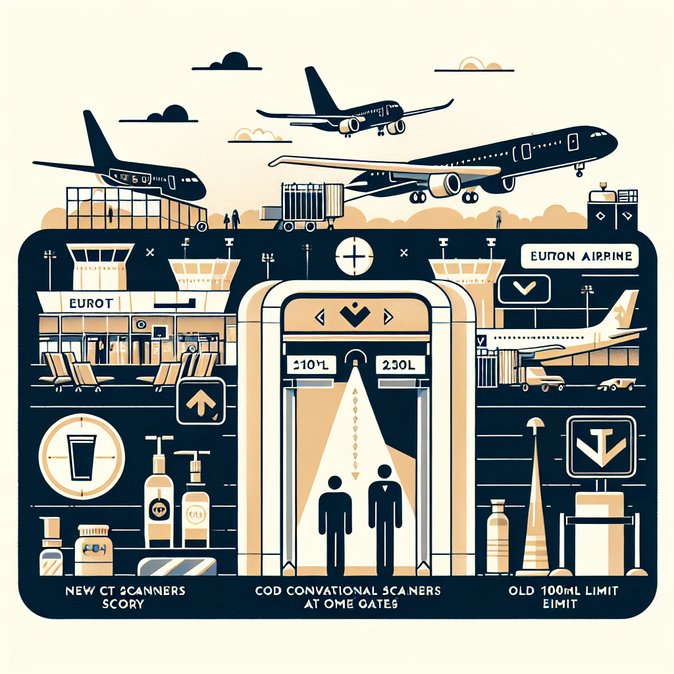
Many European hubs have begun replacing the long-reviled 100 millilitre liquid limit with a far more generous two-litre allowance as next-generation CT scanners roll out across security lanes. London Heathrow became the latest to scrap the restriction this week, and airports in Germany, Italy and the Nordic region are moving at pace. The change, outlined in an overview published on 30 January 2026, is part of an EU-wide push to modernise cabin-baggage screening and harmonise rules ahead of the Entry/Exit System go-live in April.
For Belgian business travellers the headline sounding across Europe comes with a crucial footnote: Brussels Airport has **not yet** switched over. Brussels Airlines’ official guidance still instructs passengers to pack liquids above 100 ml in checked bags and to present containers of up to 100 ml (max 1 litre total) in a transparent plastic pouch at security. Travellers connecting through multiple airports therefore face a patchwork—able to carry full-size toiletries on one leg but not the other.
Airport management in Zaventem says it is assessing tenders for CT equipment and expects phased installation during the second half of 2026. Until all lanes are upgraded, the federal aviation police insist the 100 ml cap remains “fully enforceable.”
![EU airports start lifting 100 ml liquid ban – but Brussels travellers must still follow old rule for now]()
Amid this evolving landscape, VisaHQ’s Belgium portal (https://www.visahq.com/belgium/) offers a convenient way for travellers and corporate travel teams to stay on top of changing airport regulations. In addition to handling visa and passport formalities, the service aggregates real-time security and documentation updates—such as liquid allowances—so passengers can verify requirements for each leg of their journey before they pack.
Charleroi (CRL) and regional Belgian airports are in an even earlier planning stage, meaning the status quo could last many months.
Corporate mobility teams should alert staff that headline media coverage does **not** equal immediate rule changes everywhere. Employees departing Belgium—or returning via Brussels—must keep within the 100 ml limit to avoid confiscations and potential boarding delays. Travel managers may consider stocking compliant toiletry kits at Belgian offices and reminding frequent flyers to check each airport’s policy 48 hours before departure.
Longer term, the removal of the liquid cap promises shorter queues at security and fewer baggage-handling snarls, improving on-time performance for tight European connections. But the transition period will require precise communication so that multinational staff do not assume the generous allowance applies system-wide.
For Belgian business travellers the headline sounding across Europe comes with a crucial footnote: Brussels Airport has **not yet** switched over. Brussels Airlines’ official guidance still instructs passengers to pack liquids above 100 ml in checked bags and to present containers of up to 100 ml (max 1 litre total) in a transparent plastic pouch at security. Travellers connecting through multiple airports therefore face a patchwork—able to carry full-size toiletries on one leg but not the other.
Airport management in Zaventem says it is assessing tenders for CT equipment and expects phased installation during the second half of 2026. Until all lanes are upgraded, the federal aviation police insist the 100 ml cap remains “fully enforceable.”

Amid this evolving landscape, VisaHQ’s Belgium portal (https://www.visahq.com/belgium/) offers a convenient way for travellers and corporate travel teams to stay on top of changing airport regulations. In addition to handling visa and passport formalities, the service aggregates real-time security and documentation updates—such as liquid allowances—so passengers can verify requirements for each leg of their journey before they pack.
Charleroi (CRL) and regional Belgian airports are in an even earlier planning stage, meaning the status quo could last many months.
Corporate mobility teams should alert staff that headline media coverage does **not** equal immediate rule changes everywhere. Employees departing Belgium—or returning via Brussels—must keep within the 100 ml limit to avoid confiscations and potential boarding delays. Travel managers may consider stocking compliant toiletry kits at Belgian offices and reminding frequent flyers to check each airport’s policy 48 hours before departure.
Longer term, the removal of the liquid cap promises shorter queues at security and fewer baggage-handling snarls, improving on-time performance for tight European connections. But the transition period will require precise communication so that multinational staff do not assume the generous allowance applies system-wide.