The Transport Ministry has broken down how the previously announced CZK 72.2 billion (≈ €3 billion) rail budget will be spent, highlighting projects that will touch almost every region. Twenty billion crowns will go toward routine maintenance, but the headline items are new-build and modernisation works on strategic corridors.
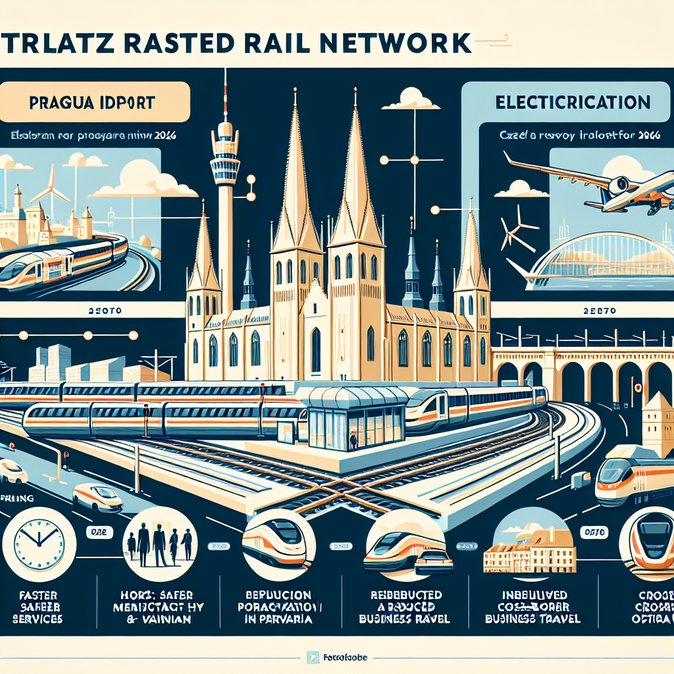
Construction of the long-awaited Prague–Airport–Kladno segment will start in spring 2026, running largely on a new alignment designed for 145 km/h. West Bohemia gains a boost through the electrification of the Pilsen–Nýřany–Chotěšov line, slated to improve passenger times to Bavaria and open an alternative freight route that bypasses congested road crossings. In Moravia, a full rebuild of the Ostrava hub will increase platform capacity by 30 percent, while the flood-damaged Opava–Kravaře line will finally be restored.
International rail consultants, contractors, and mobile employees heading to the Czech Republic to work on or assess these projects can streamline their travel logistics with VisaHQ. The platform provides step-by-step online visa processing, document checks, and real-time application tracking, ensuring teams spend less time on paperwork and more on delivering infrastructure improvements. Full details are available at https://www.visahq.com/czech-republic/
![CZK 72 Billion Rail Plan Details Revealed – Commuters and Cross-Border Travellers to Benefit]()
Commuters on the busy Kolín–Kutná Hora stretch will see double-tracking and signalling upgrades that allow more trains per hour and reduce delays cascading onto the Prague–Brno corridor. Safety receives attention too: 750 million crowns are reserved for modern, sensor-equipped level-crossing barriers, responding to a spike in accidents involving trucks and regional trains.
The investment plan must still clear the Chamber of Deputies when the state budget is voted on next month, but cross-party support for strategic infrastructure suggests easy passage. Contractors are preparing bids, with the ministry promising to weight tenders toward life-cycle cost rather than lowest upfront price – a shift welcomed by international engineering firms seeking longer-term service contracts.
For global-mobility managers, the practical upside is quicker, more predictable rail commutes for seconded staff and a realistic airport-rail alternative to company-car travel. Firms that subsidise employee season tickets are pencilling in cost savings once high-frequency electric services become the norm; meanwhile, real-estate analysts expect residential demand to rise along upgraded corridors.
Construction of the long-awaited Prague–Airport–Kladno segment will start in spring 2026, running largely on a new alignment designed for 145 km/h. West Bohemia gains a boost through the electrification of the Pilsen–Nýřany–Chotěšov line, slated to improve passenger times to Bavaria and open an alternative freight route that bypasses congested road crossings. In Moravia, a full rebuild of the Ostrava hub will increase platform capacity by 30 percent, while the flood-damaged Opava–Kravaře line will finally be restored.
International rail consultants, contractors, and mobile employees heading to the Czech Republic to work on or assess these projects can streamline their travel logistics with VisaHQ. The platform provides step-by-step online visa processing, document checks, and real-time application tracking, ensuring teams spend less time on paperwork and more on delivering infrastructure improvements. Full details are available at https://www.visahq.com/czech-republic/

Commuters on the busy Kolín–Kutná Hora stretch will see double-tracking and signalling upgrades that allow more trains per hour and reduce delays cascading onto the Prague–Brno corridor. Safety receives attention too: 750 million crowns are reserved for modern, sensor-equipped level-crossing barriers, responding to a spike in accidents involving trucks and regional trains.
The investment plan must still clear the Chamber of Deputies when the state budget is voted on next month, but cross-party support for strategic infrastructure suggests easy passage. Contractors are preparing bids, with the ministry promising to weight tenders toward life-cycle cost rather than lowest upfront price – a shift welcomed by international engineering firms seeking longer-term service contracts.
For global-mobility managers, the practical upside is quicker, more predictable rail commutes for seconded staff and a realistic airport-rail alternative to company-car travel. Firms that subsidise employee season tickets are pencilling in cost savings once high-frequency electric services become the norm; meanwhile, real-estate analysts expect residential demand to rise along upgraded corridors.